A Journey that Marked the Response to the Tragedy
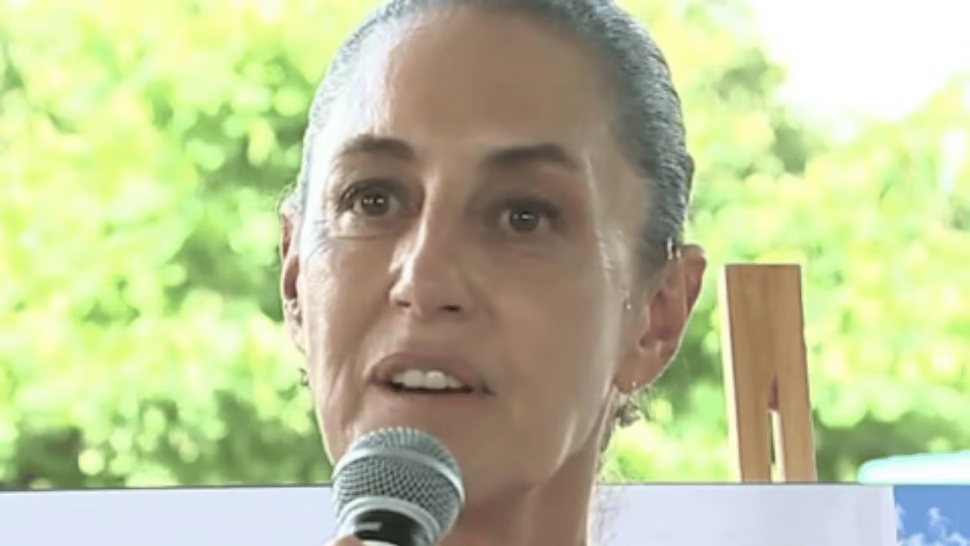
On a day where the nation held its breath, the President of Mexico, Claudia Sheinbaum Pardo, transformed her agenda into a mission of urgency and solidarity. His presence was not a mere protocol; It was a picture of leadership in the midst of chaos, a beacon of hope for those who saw their lives fractured by a moment of misfortune. With a firm step and determination in her eyes, the president walked the corridors of the Tehuantepec Hospital Clinic of the ISSSTE, the IMSS Bienestar Salina Cruz General Hospital and the General Hospital of Zone No. 2 of Salina Cruz of the IMSS, in the state of Oaxaca. Their objective was one and clear: to verify with their own eyes that each of the people injured by the unfortunate incident on the Interoceanic Train received the medical attention they deserved, that no face of pain would be forgotten.
In each room, in front of each bed, the head of the Executive not only observed; He listened, consoled and acted. With a voice filled with a solemnity that only great crises impose, he announced an immediate support of 30 thousand pesos for each family, an economic balm intended to cover urgent transportation expenses and the first needs in this dark hour. But that sum was only the first chapter of a much deeper commitment. Behind her, moving with the precision of a well-oiled rescue mechanism, the entire apparatus of the State was deployed. The Executive Commission for Attention to Victims (CEAV), together with servants of the Nation and officials of the federal and state governments, were already working on a comprehensive follow-up plan for each victim, weaving a support network that sought to cover everything from the material to the emotional.
A Commitment That Transcends the Immediate
Sheinbaum Pardo’s words resonated in the hospital air like an unbreakable promise: “It is immediate support (which is being given to the injured), in addition, I repeat, to the transportation costs and all the support that the family members require. And it will be supported with everything that is required, according to what is determined by the Prosecutor’s Office and by the Victims Commission of the Ministry of the Interior, all support will be given to all families.” This statement was not a simple statement; It was a pact with the victims, a commitment that the government’s support would be as long as the recovery and justice process demanded, involving the Prosecutor’s Office and the Victims Commission of the Secretariat of the Interior.
In this crusade for attention, the President was not alone. She was accompanied by a delegation that reflected the union of national efforts: the Secretary of the Navy, Admiral Raymundo Pedro Morales Ángeles; the undersecretary of Human Rights, Population and Migration of the Ministry of the Interior, Félix Arturo Medina Padilla; the general director of the IMSS Bienestar, Alejandro Svarch Pérez; and the general director of the IMSS, Zoé Robledo Aburto. Together, they formed the response command in the face of one of the most delicate emergencies in the recent history of rail transport.
Meanwhile, the official figures, cold in their precision but fiery in their meaning, painted a heartbreaking picture. According to the latest report from the Secretary of the Interior, 34 people remain hospitalized, fighting for their recovery under specialized medical care. In an act of painful resignation, the lifeless bodies of the 13 people who, in the tragedy, lost the battle have already been recovered. For families immersed in confusion and anguish, the same agency has set up a help hotline: the number 55 22 30 21 06 is available to provide information, guidance and initial institutional comfort in the midst of the storm.
This episode, marked by loss and pain, has also been a litmus test for the Mexican State’s capacity to react. The presidential visit to the hospital centers of Oaxaca symbolizes a fundamental axis in crisis management: proximity, direct verification and the promise of support that seeks to be comprehensive. The tragedy of the Interoceanic Train leaves an indelible mark, but also a precedent for the mobilization of resources and inter-institutional coordination to care for the victims of large-scale accidents. The road to full recovery will be long, but the first steps, as evidenced, are being taken with an active government presence and a declared commitment to leave no one behind.
Solidarity is strengthened by sharing. If this information about the emergency response seems relevant to you, share it on your social networks to keep more people informed. Explore more on our site for other news of national impact.