From landing strip to playing field: Texcoco’s ecological twist plot
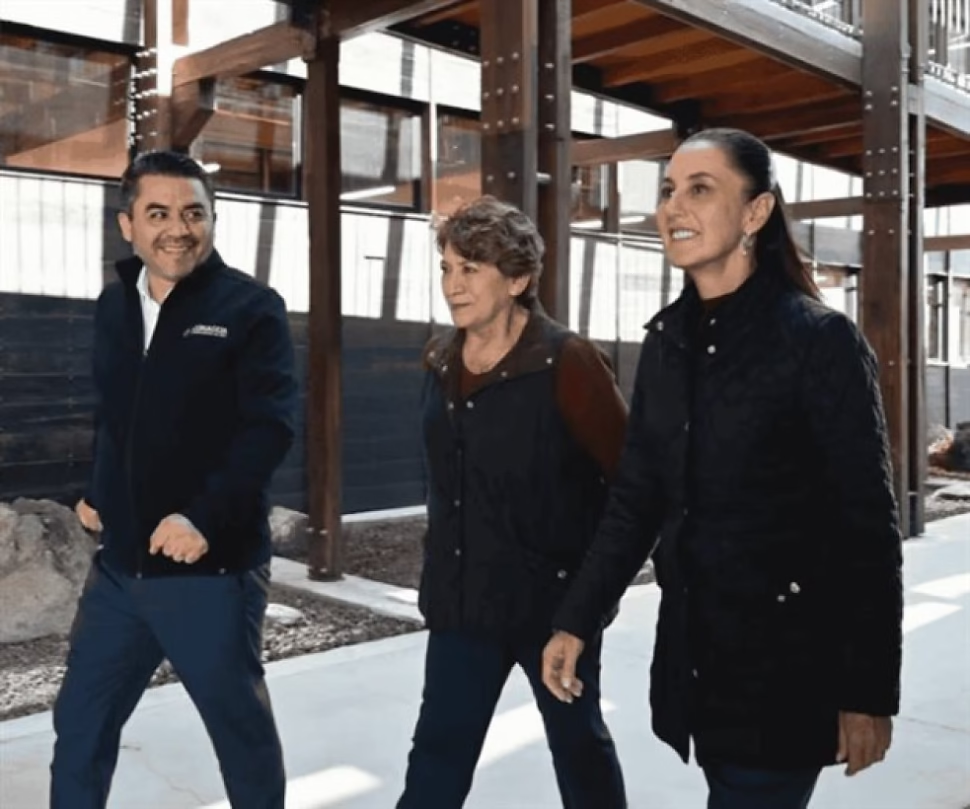
Make yourself comfortable, because I’m going to tell you the story of how a government mega-project that seemed like something out of a bad logistical dream was transformed, with a plot twist worthy of a streaming series, into the largest urban park in Latin America. Our protagonist, President Claudia Sheinbaum, put on her tennis shoes and, in a video that looks like an Instagram reel but with more historical significance, toured what is now the Lago de Texcoco Ecological Park. His message was clear, direct and with a touch of “I told you so”: these 14 thousand hectares are now a natural sanctuary, not the ghost of an unviable airport that, in his own words, “was going to sink.” Literally. Because building on an ancient lake usually has those little geotechnical complications that master plans sometimes ignore.
For context, because not all of us live glued to the news: in the era of Enrique Peña Nieto, this land was destined to be the brand new New International Airport of CDMX (NAICM). The project generated controversy, protests and a popular consultation that, in an ending more unexpected than that of a season of *The Crown*, ended with President Andrés Manuel López Obrador canceling the work. What for some was a whim, for others was saving a critical ecological zone. And today, the result is in sight, or at least, in the president’s feed.
Baseball, soccer and lots of green: the new recreation hub
And what is there in this park that was once a symbol of national division? According to the presidential tour, everything but planes. Sheinbaum, accompanied by Governor Delfina Gómez, showed that instead of landing strips, there are now fields to learn baseball, soccer and even American football. There is also a gym and, most importantly, large expanses of water and vegetation that serve as a gigantic lung for the chaotic metropolitan area. “Long live the transformation!” he exclaimed with an enthusiasm rarely seen outside of a concert. The official narrative is clear: the well-being of citizens and environmental recovery were privileged over a pharaonic and technically questionable infrastructure project.
The discourse goes beyond the recreational. It is a constant rhetorical and political coup: “very beautiful park” vs. “airport that is going to sink”; “environmental space for all” vs. “unviable work.” It’s the perfect *redemption arc* for a piece of land that carried the weight of bad decisions. Now, the park stands as the physical emblem of the so-called Fourth Transformation, a place where families from the east of the State of Mexico and CDMX can, in theory, escape from the concrete without having to travel for hours. It’s as if they’ve turned the scene of a potential disaster into the set of an inspirational film about sustainability.
The moral of this story, wrapped in the millennial sarcasm that characterizes us, is that sometimes canceling plans (especially multimillion-dollar and poorly planned ones) can have a happy ending. Or at least, one with more green areas and fewer cracks due to subsidence. It remains to be seen whether the maintenance and accessibility of this megapark will live up to the idyllic narrative, but for now, the change in land use is, without a doubt, one of the most dramatic the city has seen in decades. From controversy to the shovel, and from the shovel to the park.
Can you imagine exercising where planes almost landed? Share this incredible urban transformation on your networks and explore more stories about how public spaces are being redefined in our environment section.