


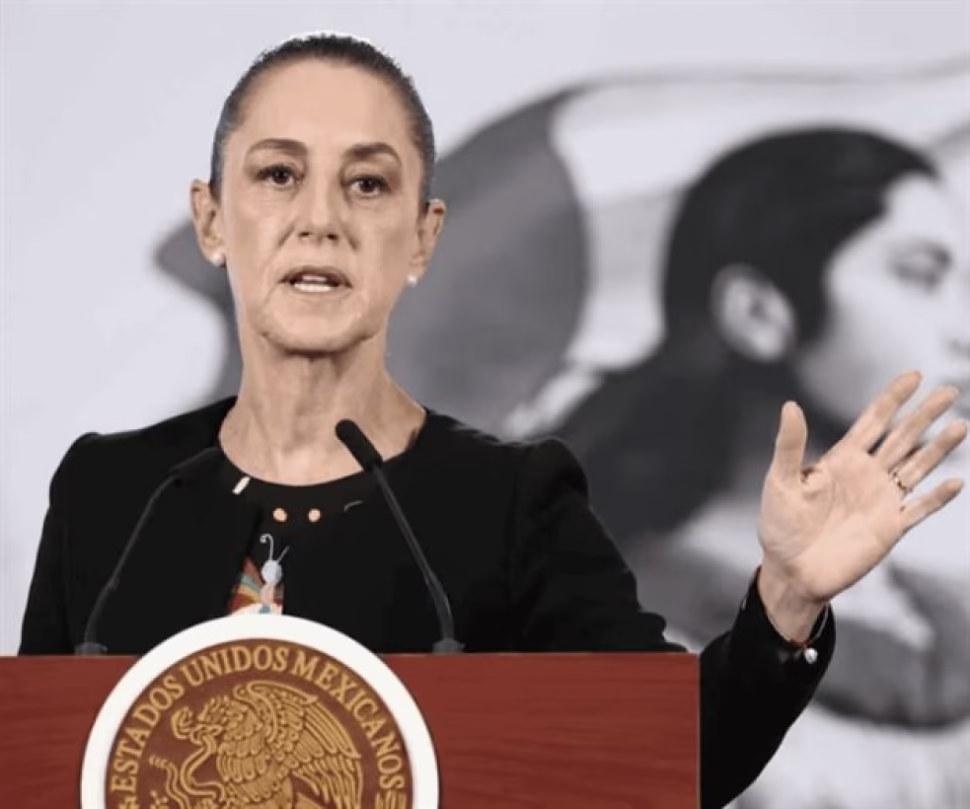
Sheinbaum emphasizes the physical limits to comply with the water treaty
The president of Mexico, Claudia Sheinbaum Pardo, responded in a firm and technical manner to the recent statements of the president of the United States, Donald Trump, who threatened to impose a 5% tariff on Mexican imports if the country does not comply with the delivery of water established in the International Boundary and Water Treaty of 1944. The president stressed that water provision is subject to objective and unalterable factors, stating that “the water that can be delivered is what can be delivered, no more can be delivered.”
This position clearly delimits the political will of the Mexican federal administration from the limits imposed by the hydrological reality and the existing infrastructure. Sheinbaum stressed his government’s ongoing commitment to the bilateral agreement, but drew a crucial distinction between diplomatic good faith and operational capacity, which depends on environmental variables.
Diplomatic will in the face of commercial conditions
When specifically addressing the threat of the trade tariff, the head of the national Executive stated that there is the will of both nations to resolve the matter without the need to resort to economic pressure measures. “There is the will of both countries, which is good, without the need to reach an issue of tariffs,” he declared. This statement seeks to separate compliance with a technical agreement on water resources from trade negotiations, marking a position of principle in the bilateral relationship.
The central message is that compliance with the treaty is not a matter of discretionary will, but is conditioned by technical elements. Sheinbaum meticulously explained that the amount of water to be transferred is determined, first, by the rainfall recorded in the corresponding cycle (2025, in this case) and, second, by the maximum transfer capacity of the hydraulic infrastructure available. These are factors that cannot be modified by decree or political pressure, which bases the Mexican position on concrete data and on the legal framework of the treaty itself.
Analysis of the technical foundations of the agreement
The Water Treaty of 1944 is a complex legal instrument that distributes the waters of shared rivers, mainly the Colorado and the Bravo (or Grande). It establishes quotas and delivery mechanisms that, although mandatory, take into account hydrometeorological variations in their spirit and application. President Sheinbaum’s argument aligns with a technical interpretation of the agreement: the obligation is fulfilled within the limits that nature and engineering allow. Insisting on a delivery beyond these limits would not only be physically impossible, but could contravene the principle of rational and equitable use that governs international water resources law.
This situation highlights the intricate connection between transboundary basin management, diplomacy and economics. The Mexican response, articulated in an expert and analytical tone, seeks to elevate the discussion from the realm of immediate trade threats to a debate based on hydrological science, water resources engineering, and strict compliance with international legal frameworks. The episode underscores the importance of protecting binational agreements from political volatility, ensuring that their implementation is based on technical and reciprocity criteria.
Share this analysis on the complex international relations regarding water resources and explore more content on foreign policy and environmental management on our social networks.


