Sheinbaum promises process for hearings and warns about fraud with AI

The president addresses 'media blows', promises guarantees for audiences and warns about AI fraud on networks like TikTok.

Sheinbaum’s morning: between ‘media hits’ and deepfakes on TikTok

Well, here we are again. Tuesday the 13th, a day that historically gives a bad feeling, and Claudia Sheinbaum arrives at the National Palace for her morning conference. The menu of the day: a portion of criticism of the media, a main course of regulatory promises and a dessert warning about the dangers of artificial intelligence. A combo that has everything but boredom.

The president began by saying the phrase of the moment: she accused some media outlets of carrying out “media coups”. Sounds strong, doesn’t it? As if the news were an army planning an uprising. But he quickly clarified – almost as if asking that the tweet not be taken out of context – that in his government there are no “past practices” against media companies. In other words, no old habits. Everything new, everything fresh.

RelatedHow to delete your Meta AI data on WhatsApp

The center of his speech was what sounds great but is sometimes difficult to see in practice: the right to information. Sheinbaum assured that “a process is coming” to guarantee it, thanks to a change in the law that is already constitutional. The idea, according to her, is that in a few months any citizen can stand up – I imagine with a cell phone in hand – and claim: ‘Hey, you are not informing me properly.’ It sounds empowering, almost like giving superpowers to the public against bad headlines.

“The right to hearings must be guaranteed… And a process is coming where in a few months they must have all the guarantees so that any citizen can say: ‘you are not informing me adequately’.”

But this is where the script takes a sci-fi movie type turn. Because if the president warned about anything, it was the frauds carried out with artificial intelligence. Yes, those deepfake videos that look real but are faker than a Monopoly ticket. He said it’s “a very good debate” how to ensure people know when content was generated by AI.

And she gave scary examples: on platforms like TikTok fake videos circulate of supposed members of the Armed Forces calling to attack drug trafficking… or even of herself asking to invest in Pemex. In other words, your timeline could be full of ghost authorities giving orders that never existed. The level of digital dystopia is reaching worrying levels.

“They look real. The topic of artificial intelligence is a very good debate, how to ensure that people know that it was generated by artificial intelligence,” Sheinbaum commented, acknowledging how difficult this topic becomes.

The regulatory dilemma: who bells the digital cat?

The president was clear about something: this has to be better regulated to protect people. “It has to be better regulated to ensure that people know that it is false information,” he said. But he also admitted the obvious: “regularization has its complications.” Translation: Setting rules for the internet is like trying to tame a tornado with a butterfly net.

And what about those directly affected? Sheinbaum briefly mentioned voice actors – those voices behind your favorite movies – who have seen how their work can be cloned or supplanted by AI. Regarding that, he said that progress has already been made on the issue, although without giving many details. There remains that feeling of we will tell you more soon.In the end, the message is a mix between promise and warning. On the one hand, the government promises a process to empower audiences over traditional media. On the other hand, it warns us about a digital landscape where you can no longer trust what you see or hear because it could be the product of a malicious algorithm.

It is the perfect reflection of our times: we strive to have more access to real information while we navigate a deepening ocean of manufactured misinformation. A true generational challenge.


Did you find this analysis of the presidential speech interesting? Share this note to generate more conversation about how we inform ourselves and are protected (or not) in the digital age.
Earthquake in La Guaira: 2,295 dead and thousands missing

Families seek to identify their loved ones in the rubble before mass graves.

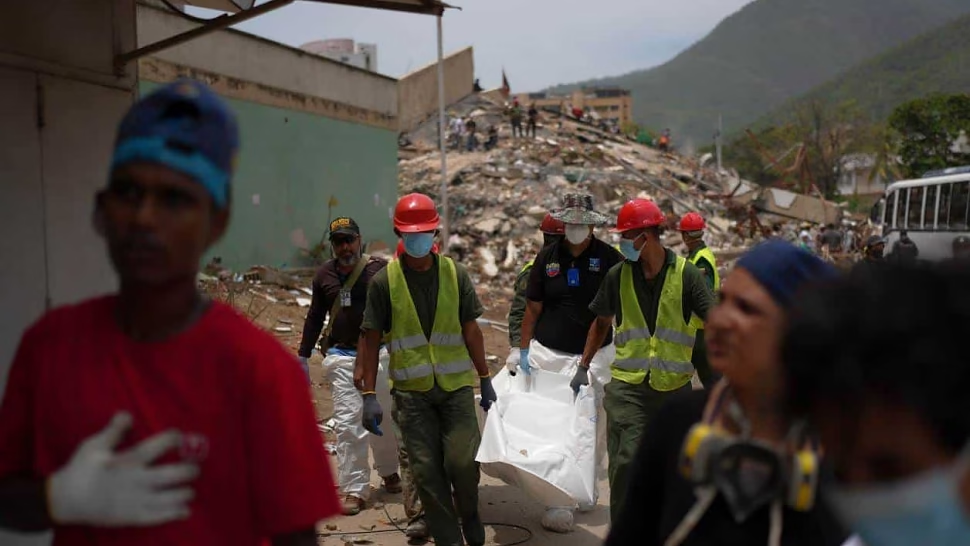
The tragedy of the June 24 earthquake in the Venezuelan state of La Guaira leaves at least 2,295 dead. Thousands of people remain missing. Hundreds of families tour hospitals and makeshift morgues to identify bodies before they are sent to mass graves.

Number of victims and rescue efforts

The forensic teams, led by technician Joel Mirabal, work tirelessly. According to specialists, between 60 and 70 percent of the victims are recognized by family or neighbors. The advanced state of decomposition complicates tasks. Refrigerated containers have been installed due to the increase in bodies. The authorities do not rule out opening mass graves.

Around the port of La Guaira and the temporary morgues, dozens of families remain formed for hours. They use tattoos, scars or clothing to confirm identities. The uncertainty about the fate of the missing aggravates the pain.

The drama of families

Rosa López recounted the difficult process of finding the body of her son-in-law, José Antonio Toledo, who died when the building where he worked as a security guard collapsed. After visiting several sites, the family managed to identify his remains. Without resources for a funeral service, the mayor’s office gave them a free space to bury him.

Rescuers estimate that recovery efforts will last at least three months due to the number of collapsed buildings. Thousands of volunteers have joined the search, hoping that families can say goodbye to their loved ones.

Continue reading

Sheinbaum announces investment of 4 billion pesos for the Purépecha people

The president detailed new commitments in health, education and security during her visit to Michoacán.

Justice Plan for the Purépecha people

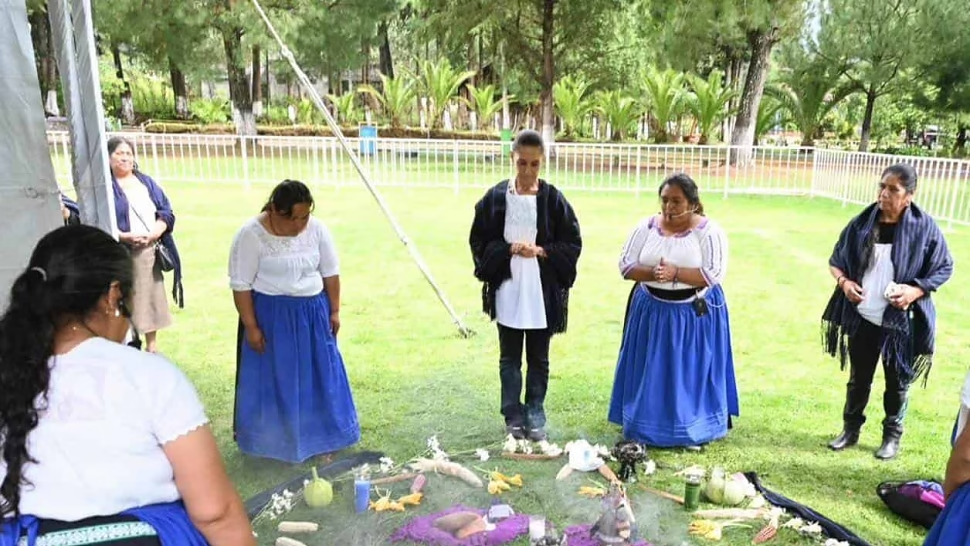
From Cherán, Michoacán, President Claudia Sheinbaum highlighted the progress of the Justice Plan for the Purépecha people. One year and two months after its implementation, more than 4 billion pesos (mp) have been allocated for health, education, roads and security.

“How are the Justice Plans made? With you. They are not made in an office of the federal government, of the State Government, they are made in assemblies,” said Sheinbaum.

The president recalled that, with the Second Floor of the Fourth Transformation, the Constitution was modified to recognize indigenous and Afro-Mexican peoples as subjects of public law. In addition, the Contribution Fund for the Social Infrastructure of Indigenous and Afro-Mexican Peoples (FAISPIAM) went from 12 thousand million pesos in 2025 to 13 thousand 500 million pesos by 2026, with the objective that this resource is established in the Constitution so that it increases each year.

The director of INPI, Adelfo Regino Montes, detailed the distribution of the investment: 27 artisanal paths (74.34 km, 485.01 million pesos), School Houses and Canteens for 527 children, 21 Community Houses of Indigenous Languages, and 161 communities benefited from FAISPIAM (212.74 million pesos in 2025 and 234.47 mdp in 2026).

Sheinbaum announced new commitments: improve the Cherán Hospital with a hemodialysis area, fix the Sports Unit, open degrees in Medicine and Nursing, strengthen community businesses, build a C2 in the community and hold a meeting on security in Mexico City.

The Undersecretary of Sciences and Humanities, Violeta Vázquez-Rojas, reported other advances: construction of an ISSSTE hospital, studies for an IMSS Bienestar hospital, hiring of 646 doctors and more than a thousand nurses, a National Guard barracks for 150 elements, remodeling of 17 highway sections, delivery of 27 thousand efficient stoves, and translation of the Women’s Booklet into Purépecha.

The governor of Michoacán, Alfredo Ramírez Bedolla, supported the initiative and highlighted the defense of the uses and customs of the native peoples.

Continue reading

Colombians arrested for training in the manufacture of explosives in Michoacán

Colombian detainees linked to the manufacture of explosives in Michoacán.

The Security Cabinet has arrested Colombian citizens linked to the training and manufacturing of improvised explosive devices in Michoacán. This was reported by the Secretary of Security and Citizen Protection, Omar García Harfuch, during the morning conference on Friday, July 3 in Morelia.

These arrests are part of investigations that identified the entry of several people involved into the country, mainly through the Mexico City International Airport and other air entry points. The National Intelligence Center monitored these movements.

The entry of foreign people by land was also detected, who allegedly collaborate in the training of members of criminal groups to install these devices. García Harfuch pointed out that there is an ongoing investigation to locate the leaders of these networks in Michoacán, including alleged high-level members of the Jalisco Nueva Generación Cartel.

The head of the SSPC confirmed the participation of citizens from different countries, mainly from Colombia. We are working in coordination with Colombian authorities to strengthen the investigations. In the coming days, the exact number of people arrested related to the manufacture and use of these explosives will be specified.

Continue reading