Sheinbaum presents Plan Michoacán after murder of mayor

The federal response comes after a crime that shocked the state, promising to restore order in a land marked by conflict.

A Plan that, surprise, arrives just after the tragedy

In a turn of events that absolutely no one saw coming, the federal government has decided that maybe, just maybe, it should do something about the violence in Michoacán. The trigger? Nothing more and nothing less than the brutal murder of the mayor of Uruapan, Carlos Manzo. Because, clearly, it takes a high-profile public official being killed to get things moving. Thus, with the pomp and circumstance that only a Sunday at the National Palace can offer, President Claudia Sheinbaum Pardo has stood in front of the microphones to present the brand new Michoacán Plan for Peace and Justice. One wonders if the hopeful name was given before or after cleaning up the blood from the crime scene.

To give it a touch of verisimilitude – or perhaps just to have someone to point out if everything goes wrong – the event had the always comforting presence of the entity’s governor, Alfredo Ramírez Bedolla, along with what appears to be the president’s legal cabinet and half of its expanded cabinet. Because if anything solves insecurity problems, it is a good photograph with many people in suits in a luxurious room. The plan, they tell us, was born in a “context of growing violence.” Wow, what an elegant way to describe the daily hell that Michoacans live through, a hell that reached its zenith with the cowardly homicide of a councilor. The strategy, in theory, seeks to address “concerns” about security and justice. Concerns, yes, as if people were uneasy about a tax increase and not because their mayors are being shot in broad daylight.

RelatedSeven officials arrested for the murder of Mayor Manzo

The consequences: fear, distrust and a nice new brochure

Meanwhile, in the real world, far from well-intentioned speeches, the crime against Carlos Manzo not only took the life of a person, but also inoculated a massive dose of fear and rest in the population of Uruapan and beyond. The citizens, those beings to whom the plan is supposedly directed, today look on with a mixture of hope and deeply rooted skepticism. The implementation of this new government initiative is seen, officially, as a “necessary response.” Of course, as necessary as it would have been six months or a year ago, when the violence was already out of control. But who are we to judge the timing of security policy? Maybe the calendars at the National Palace are slower.

One can’t help but speculate with a cynical smile: how many times have we seen this same script? Act I: An atrocious violent event that shocks the country. Act II: The officials on duty urgently meet and announce a “comprehensive plan” with a name that sounds like a superhero movie. Act III: …Well, Act III is usually the most disappointing, characterized by slow implementation, dubious results, and gradual oblivion until the next scandalous crime. It is the cycle of life, Mexico version. Authorities, with unwavering faith in the power of the new acronym, hope that this joint effort — a phrase that sounds as good as it is hollow — will help restore tranquility. Because, as we all know, tranquility is that thing that magically appears after a press conference, not something that is built with intelligence, resources and years of constant work.

So there you have it. A state in flames, a murdered mayor, and a new plan with a nice name. Is this the time the formula works, or are we simply witnessing the quintessential political ritual: acting decisively *after* the disaster has already occurred? Time, that implacable judge, will tell. Meanwhile, ordinary citizens, the true experts in surviving this security crisis, will continue with their daily lives, crossing their fingers that the next stray bullet—or targeted bullet—does not bear their name.

Do you think this plan will make a real difference or is it just another announcement? Share this note on your social networks and get your audience to think about the eternal security challenges in our country. Explore more content related to political and social news on our site.

Marina de México y EU acuerdan nuevas estrategias de seguridad marítima

México y EU refuerzan seguridad marítima con nuevos acuerdos operativos y tecnológicos.

Reunión de alto nivel entre mandos navales

El almirante Raymundo Pedro Morales Ángeles, titular de la Secretaría de Marina (Semar), se reunió con mandos de la Armada y la Guardia Costera de Estados Unidos del 3 al 5 de junio. El objetivo fue diseñar estrategias de seguridad marítima, fortalecer labores de búsqueda y rescate, y reafirmar el compromiso binacional contra la delincuencia organizada transnacional.

Los acuerdos se formalizaron con los almirantes James W. Kilby y Kevin E. Lunday, subjefe de operaciones navales y comandante de la Guardia Costera, respectivamente. En las mesas de trabajo se revisaron mecanismos de coordinación bajo principios de confianza mutua y respeto a la soberanía. El espacio marítimo se consolida como uno de los ejes más dinámicos de la agenda bilateral.

RelatedThe Navy faces investigations for internal corruption

Cooperación tecnológica y ambiental

Las autoridades estadounidenses reconocieron la capacidad operativa de la Armada de México, destacando el modelo de trinomio naval —buques, helicópteros y patrullas interceptoras— y la incorporación de sistemas no tripulados para vigilancia y seguimiento de objetivos.

El secretario Morales Ángeles subrayó la urgencia de fortalecer la Iniciativa de Seguridad y Protección Marítima para América del Norte (NAMSI). Este mecanismo trilateral, vigente desde 2008, permite intercambio de información y operaciones coincidentes para frenar actividades ilícitas, manteniendo el control soberano de cada país. En el ámbito ambiental, México ratificó su compromiso contra la pesca ilegal, con énfasis en el Golfo de California y el Golfo de México.

Ambas partes acordaron reactivar los ejercicios binacionales SAREX para mejorar la capacitación en emergencias. La Semar implementará el sistema SAROPS 4.5, desarrollado con la Guardia Costera estadounidense, que optimiza recursos y reduce tiempos de localización de personas o embarcaciones. El plan integral incluye protección portuaria, ciberseguridad e interoperabilidad académica.

Continue reading

Profepa rescata seis animales silvestres en Baja California Sur

Aves, reptiles y un venado fueron atendidos en diferentes municipios del estado.

Rescate de fauna silvestre

Tras reportes ciudadanos, la Procuraduría Federal de Protección al Ambiente (Profepa) atendió a seis animales silvestres en Baja California Sur. Los ejemplares fueron hallados lesionados, desorientados o fuera de su hábitat natural.

La autoridad ambiental, encabezada por Mariana Boy Tamborrell, informó que las acciones ocurrieron entre el 7 de mayo y el 2 de junio. Las especies rescatadas incluyen polluelos de águila pescadora, un búho cornudo y un venado bura.

RelatedProfepa rescata 345 animales silvestres en tianguis de Guadalajara

En la comunidad de Puerto Adolfo López Mateos, en Comondú, tres polluelos de águila pescadora fueron atendidos. Dos tenían aparente incapacidad de volar y otro cayó de un nido. Todos recibieron atención médica.

Una serpiente de cascabel de diamante rojo fue hallada en una construcción en Los Cabos. Sin lesiones, fue liberada en un sitio alejado de asentamientos humanos.

Un búho cornudo, atacado por perros domésticos en Los Cabos, presentaba dificultad para volar. Recibió atención veterinaria especializada y después fue liberado en un lugar adecuado para su supervivencia.

Una hembra adulta de venado bura fue atropellada en una carretera cerca del Rancho La Fortuna, en Los Cabos. Sufrió laceraciones, golpes severos y una fractura expuesta en una extremidad. Falleció durante el traslado para recibir atención especializada.

En todos los casos, Profepa realizó valoración, resguardo temporal y liberación o canalización a atención especializada según las condiciones de cada animal.

Continue reading

Aseguran 150 kilos de metanfetamina en Baja California

150 kilos de metanfetamina asegurados en operativo federal en Baja California.

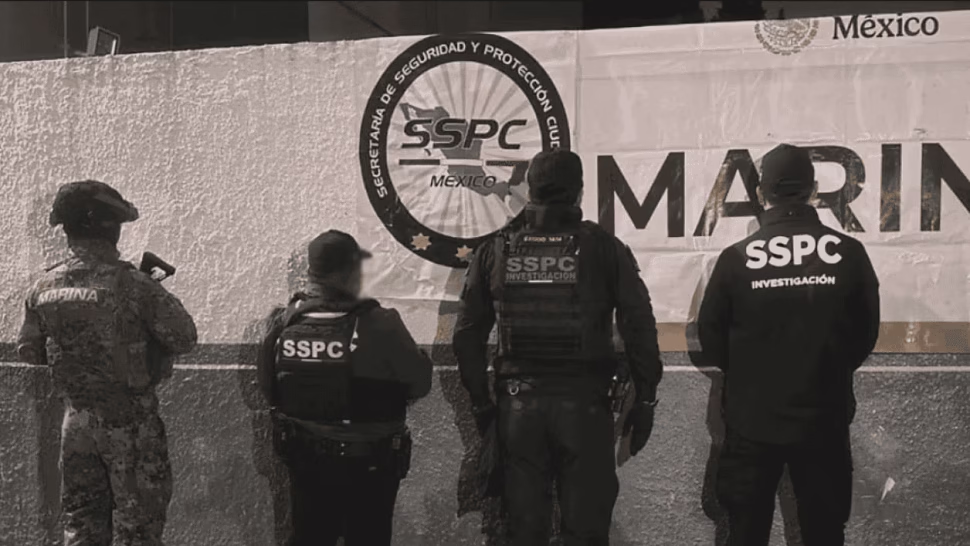
Personal de la Secretaría de Seguridad y Protección Ciudadana, la Marina Armada y la Fiscalía General de la República aseguraron 150 kilogramos de metanfetamina en Baja California. El operativo formó parte de acciones para debilitar estructuras del crimen organizado en la entidad.

Detenciones clave para el operativo

El Gabinete de Seguridad informó que el aseguramiento se derivó de la detención de dos personas, a quienes se les incautaron 68 kilos de cristal. Con esa información, los agentes federales realizaron investigaciones que llevaron al decomiso de los 150 kilos adicionales.

RelatedAuthorities seize 203 kilos of methamphetamine in a highway operation

Impacto económico y social

La droga asegurada equivale a 3 millones 750 mil dosis que no llegarán a las calles. Además, representa una afectación económica de cerca de 38 millones de pesos para las organizaciones delictivas. La sustancia fue puesta a disposición del Ministerio Público para integrar la carpeta de investigación del caso.

Continue reading