Sheinbaum asks to turn the page after the death of CIA agents in Mexico

Sheinbaum rules out conflict with the US over the death of CIA agents in Chihuahua.

The diplomatic theater has a new act

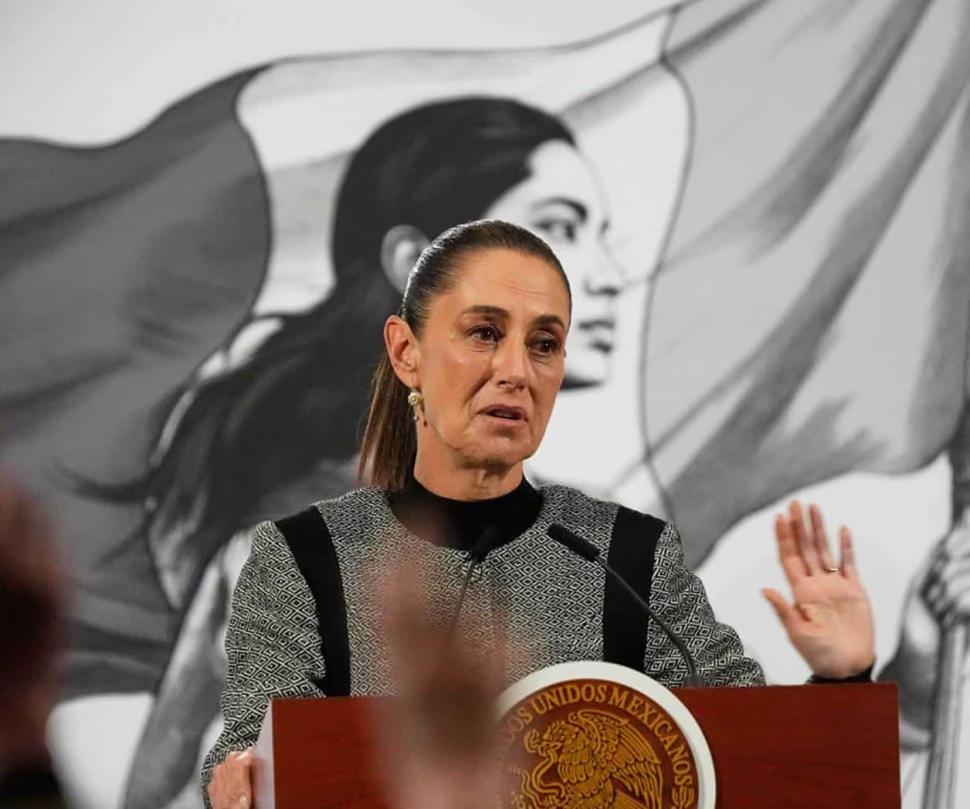
President Claudia Sheinbaum made it clear this Monday that there will be no lawsuit with the United States over the accident that killed two CIA agents in Chihuahua. But be careful: it is not a simple “nothing happens.” It’s a calculated move.

“We hope that it is an exceptional case… that a situation like this will not be repeated again,” said the president in her morning conference.

Here’s the drama: those agents did not have permission to operate in Mexican territory. One entered as a tourist, the other with a diplomatic passport. The federal Security Secretariat was blunt: they did not know that gringo spies were moving through their land.

RelatedCIA agents die in Mexico and uncover a crisis

The mystery of the operation

The two Americans died along with two officials from the local prosecutor’s office during a dismantling of a synthetic drugs laboratory. The CIA hasn’t said a word. Sheinbaum demands answers: he wants the Attorney General’s Office and the Senate to clarify how the hell this operation was put together.

The opposition governor María Eugenia Campos and state prosecutor César Jáuregui were already summoned to the Senate for this Tuesday. The clock is ticking.

Sovereignty in the center of the ring

And here’s the kicker: U.S. Ambassador Ronald Johnson blurted out last week that “the private sector needs certainty, security and a corruption-free environment.” Sheinbaum responded with class but without mincing words: the United States “is not a country that has to tell us how to behave.”

It’s not new. Since 2012, when an embassy van was shot up and two CIA agents were wounded, the relationship has been a tug-of-war. López Obrador put the brakes on it with a law that forces foreign agents to report their movements. That law is still in effect.

My father always said: “Politics is not about getting excited, it’s about understanding who wins.” Here whoever maintains narrative control wins. Sheinbaum knows it: he gives in publicly to win strategically.
El Mayo Zambada receives life sentence in the United States

The historic leader of the Sinaloa Cartel was sentenced to life in prison in New York.

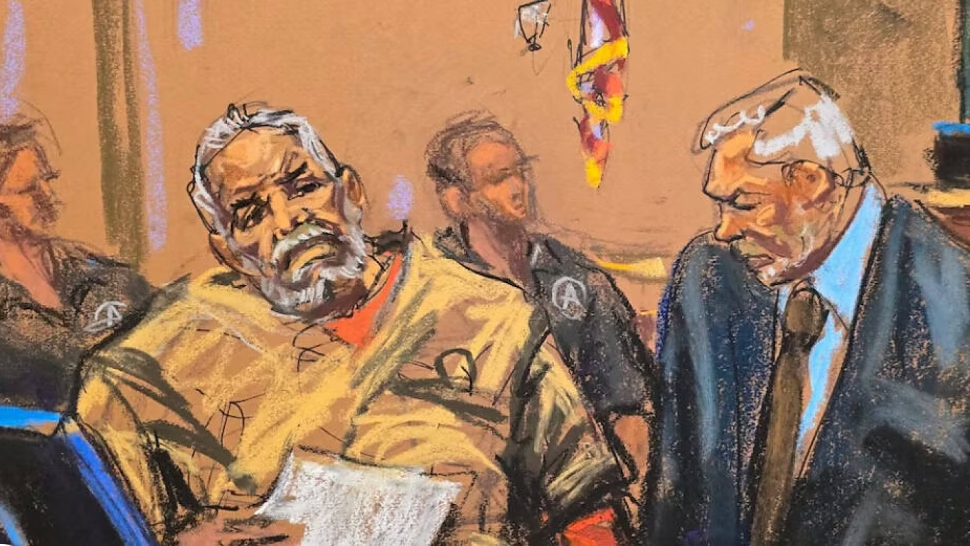
Ismael “El Mayo” Zambada, 76 years old and considered for decades one of the main leaders of the Sinaloa Cartel, was sentenced this Monday to life in prison by a federal court in Brooklyn, New York. Judge Brian Cogan determined that the drug trafficker will spend the rest of his life in prison after pleading guilty to various crimes related to drug trafficking, money laundering and organized crime.

The crimes against Zambada

During the hearing, the judge noted that the seriousness of the crimes attributed to Zambada—including the trafficking of large quantities of cocaine, heroin and fentanyl, as well as numerous homicides linked to the criminal organization—fully justifies the imposition of the maximum sentence provided for by US law. In addition, he ordered the confiscation of 15 billion dollars as reparation for the damages caused.

Before hearing the sentence, Zambada addressed a message in which he apologized to the victims of his actions, assumed responsibility for his crimes, and urged young people not to follow the path of organized crime. The former leader of the Sinaloa Cartel accepted the charges in 2025 as part of an agreement with the US Prosecutor’s Office, through which he avoided facing the death penalty.

Reactions and next steps

With this resolution, “El Mayo” remains in the same legal status as Joaquín “El Chapo” Guzmán, who is also serving a life sentence in the United States. However, US authorities warned that the sentence does not represent the end of their offensive against drug trafficking, but rather the beginning of new actions against members of the cartels and officials allegedly linked to these organizations.

The conviction could also intensify the differences between the governments of Mexico and the United States, due to the controversies that surrounded the capture of Zambada in July 2024. President Claudia Sheinbaum has questioned the operation carried out in Mexican territory and has requested to clarify the participation of US agencies in the transfer of the historic capo to that country.

Continue reading

Kenia López Rabadán defends Ruffo Appel as a political prisoner

PAN deputy calls the former governor detained by prosecutor Huachicol a political prisoner.

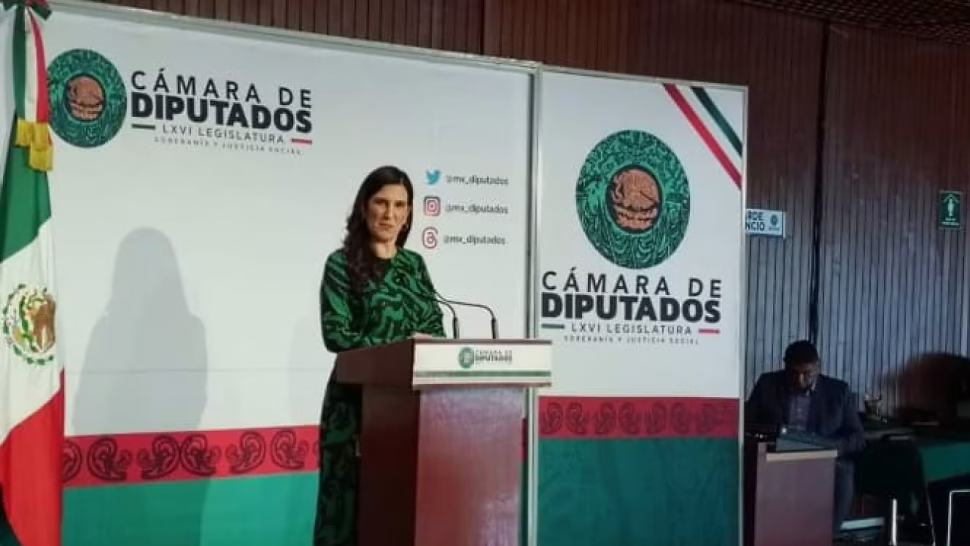
The president of the Board of Directors of the Chamber of Deputies, Kenia López Rabadán, described the former governor of Baja California, Ernesto Ruffo Appel, as a political prisoner. The former president was arrested on July 16 for his alleged participation in the crime of fiscal huachicol.

Questions to the judicial process

López Rabadán questioned the judicial process against Ruffo Appel. He noted that it represents a historic moment for Mexican democracy, being the first opposition candidate to win a governorship in the country, in Baja California during 1989.

The PAN legislator criticized that the former governor faces prison for an investigation into fuel smuggling. He pointed out that there are no detained officials, despite the fact that the authorities participate in the authorization, surveillance and operation of the import and distribution processes of hydrocarbons.

Continue reading

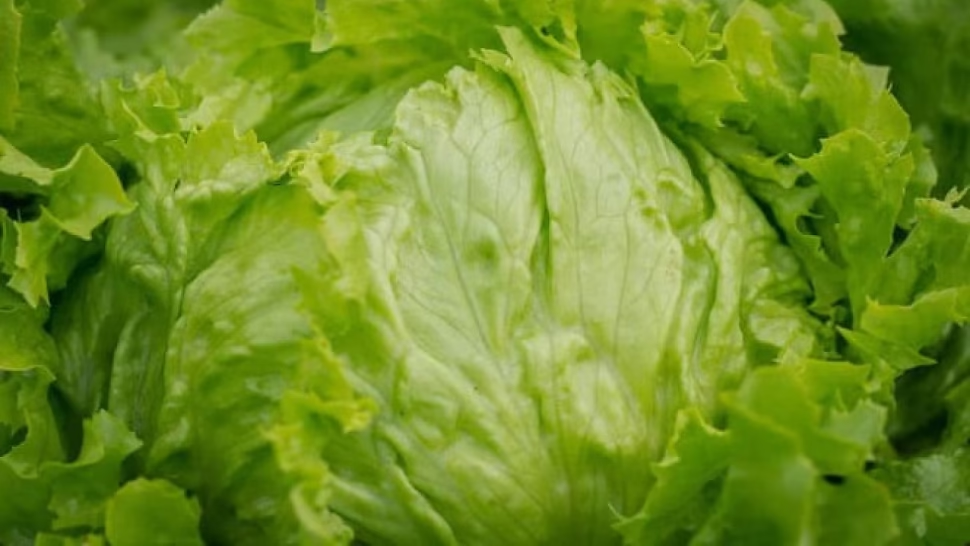
FDA retracts: false positive for cyclospora in Mexican lettuce

FDA corrects error regarding positive parasite in lettuce from Guanajuato.

The United States Food and Drug Administration (FDA) backed down. A sample of Mexican lettuce, tested during an import screening at the southern border, had tested positive for cyclospora. The agency is now calling it a “false positive” and notifying Taylor Farms of the correction.

The error does not modify the ongoing investigation. The FDA maintains an open investigation into the outbreak of cyclosporiasis that affects several states. Preventive measures remain in force.

Voluntary withdrawal and clarification

On Saturday, Taylor Farms voluntarily recalled all iceberg lettuce produced in Guanajuato, Mexico. The measure, which included 35 products distributed in 27 entities, responded to possible links with the reported cases. Following clarification from the FDA, the company said it completed the precautionary recall. It insisted that the authority had not identified an actual positive test in its products. The erroneous sample corresponded to a different shipment, collected in routine inspections, not to the product already recalled.

Outbreak figures

The Centers for Disease Control and Prevention (CDC) reported more than 1,600 confirmed cases of cyclosporiasis in Indiana, Kentucky, Michigan, Ohio and West Virginia. Researchers found that several patients had consumed food at Taco Bell restaurants that used Taylor Farms lettuce.

The FDA and CDC continue to coordinate actions with federal and state authorities. The objective: identify the origin of the outbreak and prevent new infections. The situation keeps consumers and health authorities on alert.

Continue reading