Analysis of the incident on the Tampico-Mante highway
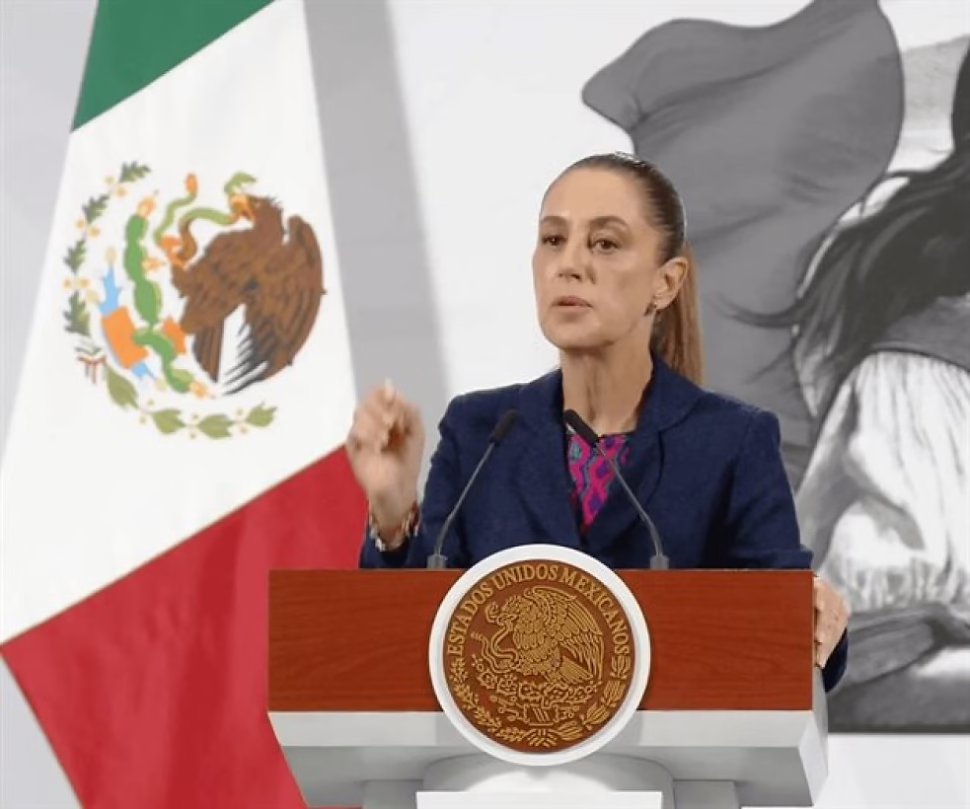
The President of Mexico, Claudia Sheinbaum Pardo, has referred to the tragic event that occurred on the Tampico-Mante federal highway, classifying it as a regrettable case that requires a thorough investigation. The episode, which culminated in the death of six civilians and two injuries, involved a convoy of elements of the Mexican Army and has generated an intense debate about the protocols for the use of force. The incident was recorded in the official log around 8:00 p.m. on Monday, at kilometer 71 of said road, specifically in the vicinity of the town known as Estación Manuel, belonging to the municipality of González, in the state of Tamaulipas. This region has historically been a complex setting for national security, which adds layers of context to an already sensitive event.
According to the official information report issued by the Secretariat of National Defense (SEDENA), the sequence of events began when the occupants of a Pick Up truck intercepted one of the three military units that were part of the convoy. The institutional version maintains that the civilians’ intention was to attack the military unit, an action that the professional soldiers interpreted as an imminent and direct threat against their physical integrity. Given this perception of risk, the elements of the military force responded to the alleged aggression, triggering the fatal outcome. The official narrative focuses, therefore, on self-defense as the primary justification for the use of firearms.
Legal framework and review of military action
During her speech at the morning conference, the president stressed that SEDENA acted quickly and assumed its responsibility by taking action on the matter immediately. Sheinbaum Pardo explained the review procedure that, by law, must be followed in these cases. “There are the corresponding complaints, obviously first the exhaustive review of the case as normally happens, by the authorities themselves, the Military Police of the National Defense, but also obviously the civil trial,” he stated. This double track, military and civil, is essential to guarantee the transparency of the process and accountability, ensuring that no action that has deviated from the established legal framework goes unpunished.
The Chief of the federal Executive reiterated that Mexican legislation establishes very specific parameters under which federal forces, including the Army, must act in a rational and proportional manner. The use of firearms is not a discretionary power; It is subject to a strict protocol that evaluates the need, opportunity and intensity of the response. “We have a robust legal system where the authority, if it has an arrest warrant or is witnessing a crime in flagrante delicto, acts to arrest the person responsible or those responsible. However, the use of the firearm has to be rational. There is a law that establishes under what precise conditions it can be used,” he stressed with legal precision. This regulatory framework seeks to balance the imperative need to combat crime with the State’s unavoidable obligation to protect the lives of all people.
The analysis of this incident cannot be separated from the broader context of internal security and the use of force policy in Mexico. The implementation of the armed forces in public security tasks has been a recurring strategy, but also controversial, due to the inherent risks and the complexity of the scenarios they face. Each event of this nature requires a deep evaluation of operational protocols, personnel training and supervision mechanisms. The President’s promise to review “what happened first in order to have all the data on what happened” points directly to the meticulous reconstruction of the facts, an essential step to determine if the response was in accordance with the law or if, on the contrary, there was a deviation in the procedure.
The immediate conclusion that emerges from President Sheinbaum‘s statements is her administration’s stated commitment to legal truth and justice. The approach to the families of the victims, mentioned explicitly, suggests a recognition of the pain caused and an intention, at least discursive, not to evade the responsibility of the State. The ongoing investigation will be the litmus test to determine the strength of this commitment. Not only will the application of justice in a particular case depend on its findings, but also the possible recalibration of the protocols that govern the interaction between State forces and citizens, a critical aspect for the health of democracy and the rule of law in Mexico.
This event in Tamaulipas functions as a case study on the operational and ethical challenges faced by security forces in territories with a high incidence of crime. The tension between the mission to preserve order and the duty to protect fundamental rights, such as life and personal security, lies at the heart of the debate. The resolution of this case will set a significant precedent for the actions of institutions in the future, impacting citizen trust and the legitimacy of the security strategies implemented by the federal government. The exhaustive investigation and subsequent accountability are, therefore, not only a legal requirement, but a political and social necessity of the first order.
Share this analysis on your social networks to encourage informed conversation about security and justice, and explore more content related to the action protocols of federal forces on our site.