When nature decides to make an unexpected crossover
Imagine this: we were all in 2025, believing that the worst that could happen was a hurricane with a grandmother’s name, “Priscila”, and suddenly, the weather unleashed on us a canonical event worthy of a final season of an apocalyptic series. Given the biblical rainfall that left a balance of 64 people dead and another 65 unaccounted for in five states, our president, Claudia Sheinbaum, came out to explain with the calm of someone trying to justify a spoiler: there was simply no scientific way to anticipate the intensity of this atmospheric phenomenon. Basically, it was the meteorological equivalent of getting an unexpected bill, but on a national scale and with a lot more water.
During her now classic morning conference at the National Palace this October 13, the president admitted that the meteorological services and the Secretary of the Navy (Semar) had their focus on Hurricane “Priscila”, which was flirting with increasing its category in the Pacific. But, in a plot twist that not even M. Night Shyamalan would have dared to write, several climate systems decided to make a surprise collaboration and created an atypical scenario of extreme rain. In other words, it was the Fyre Festival of natural disasters: they promised something manageable and ended up being absolute chaos.
The unexpected cameo of multiple atmospheric phenomena
Sheinbaum, with the patience of someone explaining for the umpteenth time how TikTok works to a boomer, explained: “Normally, Civil Protection is alerted when a hurricane, a cyclone, a phenomenon of this type comes. Days in advance you can see if its category is increasing or not. We were focused, among other things, on Hurricane ‘Priscila'”. But, surprise surprise, life (or in this case, the atmosphere) had other plans. Heavy rains had been predicted in the affected area, but no one expected the mega combo of events that was created. There was no scientific or meteorological condition that could indicate that the rain was going to be of this magnitude, he stated. Translation: the weather ghosted us with the worst possible move.
To give a touch of technical credibility to the explanation, the president passed the microphone to the Secretary of the Navy, Admiral Raymundo Pedro Morales Ángeles, who basically told us about the climate fanfiction that developed. On October 8, the synoptic chart (the meteorologists’ WhatsApp group, but seriously) showed a star cast: Tropical Storm “Priscila” south of Los Cabos, Storm Octave, a low pressure that would later become Hurricane “Raymond” in the Gulf of Tehuantepec, and another low pressure off Veracruz. As if that were not enough, a cold front coming from Texas decided to join the party and generated a trough line that crossed right through the rainy zone. It was basically the Avengers: Endgame of natural disasters, but without the fancy suits and with a lot more mud.
Secretary Morales Ángeles added another crucial piece of information: the rainy season was in its final phase, with rivers and groundwater tables up to the top and hills weaker than our willpower at an all-you-can-eat buffet. These conditions, he explained, increased the magnitude of the floods and landslides. I mean, it was the perfect storm, literally. “This is predictable in the general meteorological context, but identifying exactly how much rain will fall is not so simple,” he admitted. Basically, it’s like knowing it’s going to rain, but not whether it will be a shower or the flood.
Lessons learned and the promise of a more technological future
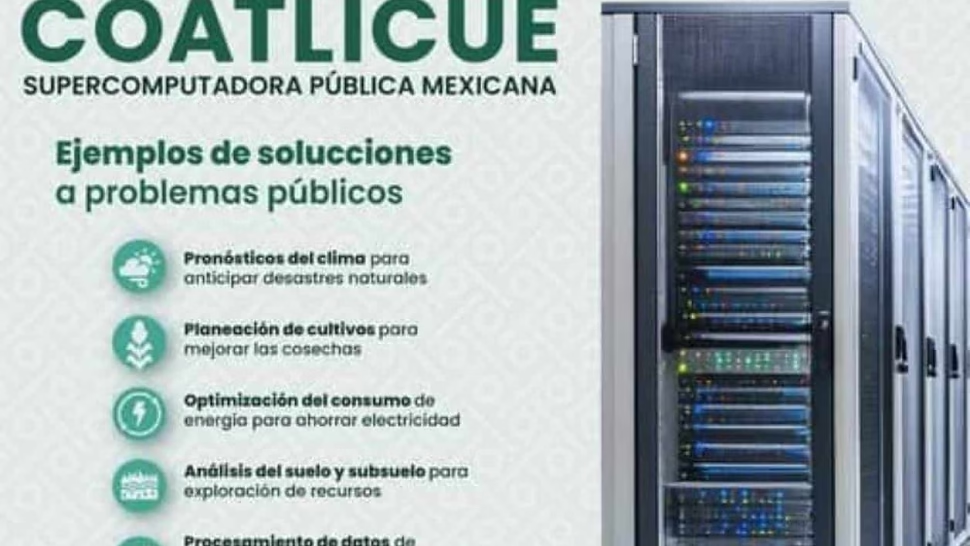
Sheinbaum, in “we learned from this” mode, stressed that, although atmospheric phenomena could not be precisely anticipated, his government is working to strengthen scientific tools for prevention and early warning. Because, let’s be honest, in the age of ChatGPT and commercial space travel, the fact that we can’t predict heavy rain without it catching us like a pop quiz is a bit… vintage.
“It is very important that, faced with this situation, we as a government have all the necessary scientific tools to guarantee prior warning where possible,” declared the president. And he announced the creation of two research groups: one in the Pacific — which will include the placement of buoys, because apparently that is what the sea was missing — and another in the Gulf of Mexico. It sounds good, although one would hope that in the middle of the fourth transformation we would already have a warning system that does not depend on buoys that look like something out of a 90s movie.
In summary, this tragedy made it clear to us that, no matter how many technological advances we have, nature still has a few tricks up its sleeve. The key, according to Sheinbaum, is to improve monitoring systems and not let our guard down, even when we believe the worst is over. Because, as we millennials know well after experiencing several economic crises and a pandemic, the unexpected is the only thing that can really be expected.
Were you surprised by the explanation of this climate phenomenon? Share this note on your social networks so that more people know the details and do not miss our next updates on current affairs and disaster prevention.