Sheinbaum distinguishes protesters and affirms that the dialogue with the field continues

The president clarifies the profile of the protesters and details her government's actions to meet the demands of the countryside, while warning about the impact of the protests.

Analysis of the presidential statements on the mobilizations

With the announcement of the resumption of blockades on federal and state communication routes by conglomerates of farmers and transporters, President Claudia Sheinbaum Pardo made a crucial distinction. The president stated that not all members of these protests can be strictly classified as farm producers, while reiterating her administration’s commitment to keeping communication channels open through the Secretariat of the Interior (Segob).

During her morning conference, the head of the federal executive specified that these are actions promoted by specific organizations and not a generalized movement in the agricultural sector. “Just like peasants, peasants, well no. They are some organizations,” he asserted. In parallel to this clarification, he reported that that same day a meeting would be held at the Segob facilities, within the framework of the negotiation tables established to process their requests.

RelatedGovernment calls for a dialogue table with farmers and transporters

Context of government support and complexity of demands

Sheinbaum Pardo emphasized that his government has carried out intense work to support the primary sector, particularly in a complex economic scenario characterized by the fall in international prices of basic grains. The strategy, he detailed, has been operated through agencies such as the Secretary of Agriculture and Rural Development (Sader) and the Food for Well-being program, enabling windows to grant complementary support in various federal entities. These resources have been directed mainly to growers of corn, wheat and other grains.

“We support the countryside as much as we can, with what we can, everything necessary that is in our hands,” he declared. The President recognized the existence of approaches that are difficult to comply with, not only due to fiscal and budgetary restrictions, but also due to legal and regulatory frameworks. However, he stressed that most of the demands have already been met, estimating that currently there are “very few people” who persist in pressure actions. From this perspective, he considered that there is no justification to affect the general population through the interruption of transportation and logistics corridors. “There is no reason why they could take any means of communication,” he stated emphatically.

Origin of the conflict and potential socioeconomic impact

The president’s statement came after the National Front for the Rescue of the Mexican Countryside (FNRCM), the Peasant Agricultural Movement (MAC) and the National Association of Transporters (ANTAC) issued an ultimatum. These groups warned about carrying out stoppages on key road arteries starting on December 17, if satisfactory agreements are not reached with the Government of Mexico. The disagreements expressed by the groups cover both subsidies for agriculture and demands from the freight transport union, generating alerts about possible effects on interurban mobility and commercial activity in the middle of the year-end season.

This scenario presents an analysis of the governance of social protest and the management of sectoral conflicts. The government’s position seeks, on the one hand, to demarcate the movement from a broad representation of the peasantry and, on the other, to project an image of willingness to dialogue and concrete support actions. The success of this strategy will depend on the perception of legitimacy generated by the dialogue tables and the ability to channel pending demands through institutional mechanisms, thus avoiding the escalation of forceful measures and their consequent economic and social costs. The distinction between legitimate participants and actors with other interests is a recurring element in conflict management, seeking to modulate public opinion and social support for protests.

Does this analysis on the management of social conflicts seem relevant to you? Share it on your social networks and explore more content on agricultural policy and the national economy in our news section.
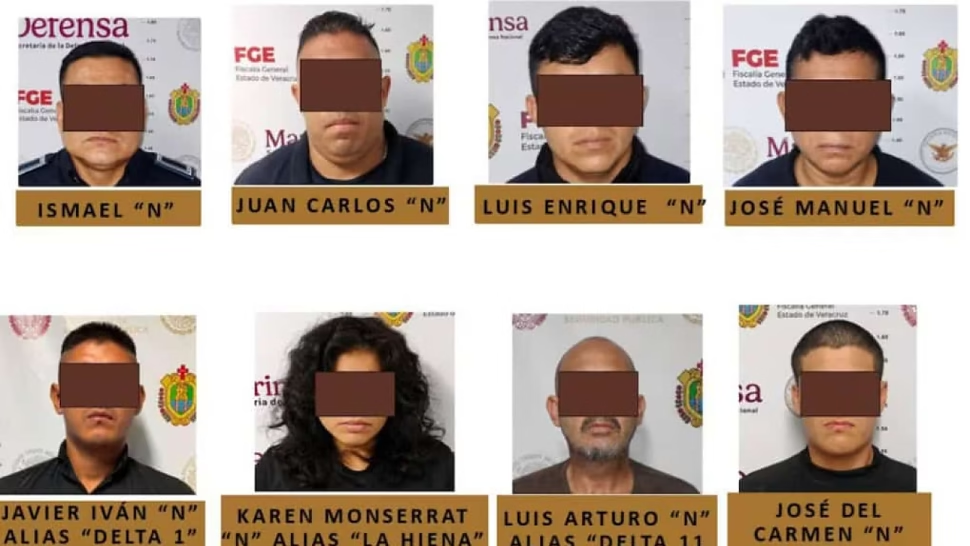

They find remains of journalist Roxana Guzmán; They arrest eight, four were police officers

Eight arrested, four of them police officers, for the disappearance and death of the communicator in Nanchital.

The Veracruz Prosecutor’s Office confirmed the discovery of the remains of Roxana Guzmán, founding journalist of Pulso Informativo del Sureste. She had been deprived of her liberty at her home in Nanchital a month ago.

Kidnapping and arrests

Eight people were arrested, including four municipal police officers from Ixhuatlán del Sureste. According to the Prosecutor’s Office, the agents provided logistical support, resources and food to the criminal group. The names of those captured: Javier Iván “N” (alias Delta 1), José del Carmen “N” (Delta 7), Kenia “N” (La Hiena) and Luis Arturo “N” (El Pelón).

The events occurred on a ranch in the municipality of Moloacán. Roxana’s mother declared that the attackers were dressed as police officers and claimed that they were taking her daughter to a police station. Until now, the Prosecutor’s Office has not specified the motive.

Alarming context

With this loss, Veracruz adds 34 journalists deprived of their lives. The entity continues to be the most dangerous for practicing journalism in Mexico. The eight detainees are now at the disposal of the judicial authorities. The investigation continues to determine responsibilities.

Continue reading

CNDH requests changes to indigenous law to protect culture

CNDH calls to include prior consultation and stop commercial use without permission.

CNDH proposal

The National Human Rights Commission (CNDH) urged to strengthen the proposal for the General Law on the Rights of Indigenous and Afro-Mexican Peoples. The organization considers that it must guarantee real protection of cultural heritage. It also requires the direct participation of communities in the consultation process promoted by the federal government.

The pronouncement is given at the beginning of the Prior, Free and Informed Consultation Process. For the CNDH, this initiative is an opportunity to consolidate the legal framework that protects the material and intangible heritage of indigenous peoples. In addition, it seeks to avoid its misappropriation or exploitation.

The CNDH recalled that in its General Recommendation 35/2019 it already documented cases of unauthorized commercial use of indigenous designs, textiles and cultural expressions. This evidenced the need to strengthen legal mechanisms. For this reason, he highlighted the importance of recognizing collective authorship and the cultural rights of communities.

Necessary measures

The organization also called for strengthening the National System for the Protection of the Cultural Heritage of Indigenous and Afro-Mexican Peoples and Communities. He requested to provide it with more resources and ensure the operation of its national registry. He insisted that the law must provide for prior, free and informed consent for any commercial use of cultural elements.

Continue reading

Tramadol only with a prescription since July

Cofepris reclassifies the opioid analgesic to prevent dependence.

Starting July 14, tramadol will only be sold with a medical prescription that includes the professional license of the treating doctor. The Federal Commission for the Protection against Sanitary Risks (Cofepris) approved this reclassification with a preventive approach.

“This measure was implemented with a preventive approach against the inappropriate consumption of this opioid medication, due to its potential for dependence,” the agency indicated.

What changes with the new regulation?

Pharmacies must seal prescriptions, note the date and quantity filled. Also record each operation immediately in the corresponding control books. The goal is to curb unsupervised use and prevent dependency.

Alternatives to Tramadol

Cofepris pointed out that for mild to moderate pain there are other options: ibuprofen, naproxen, diclofenac and paracetamol. For neuropathic pain, antidepressants such as duloxetine and amitriptyline, or anticonvulsants such as gabapentin and pregabalin, may be used.

The measure seeks to balance access to pain relief with the prevention of health risks. Tramadol is an opioid with potential for abuse, and its controlled sale is intended to reduce misuse.

Continue reading