Sheinbaum announces dialogue with farmers after blockades

The official response to the demands of the countryside generates tension and threats of escalating the mobilizations, while a new meeting is announced.

The field can’t take it anymore: patience has run out and the tractors take to the streets

Imagine the scene: while you and I are having coffee wondering if the Instagram algorithm hates us, the corn farmers of this country decided enough was enough and flipped the script. After leaving the dialogue table with the federal government because, according to them, “a fair price” for a ton of corn was not reached, President Claudia Sheinbaum Pardo came out with the classic “there is a proposal.” Sounds like that “let’s talk” message your ex sends, right?

In her now traditional morning conference from National Palace, our federal president, with a calm that we would like to have on a Monday morning, mentioned that the secretary of Agriculture and Rural Development, Julio Berdegué, will attend on Thursday to talk about the issue and others “related to the countryside.” Basically, the classic follow-up meeting that everyone in the office knows can end in nothing or everything, there is no middle ground.

RelatedMexico launches a national plan to rescue native corn

“Yes, there is a proposal that was made to them, the working table is open. The dialogue table will continue, there is a proposal and the windows are open,” declared the President. Meanwhile, the farmers, with the determination of someone who sees their favorite series being canceled by the streaming platform, threaten to raise their mobilizations. The message is clear: either there is a solution, or the road chaos will be worse than rush hour traffic.

The negotiation that went south and the offer that no one asked for

The trigger for this national drama was that the producers left the negotiation table at the Secretary of the Interior (Segob) this Monday. The reason? The desired price of 7,200 pesos per ton of corn was not reached. The farmers, with patience more exhausted than your cell phone battery at a concert, warned that “the fight will intensify.” In other words, they went from airplane mode to maximum protest mode.

After meeting with Berdegué and trying, without success, to enter Segob, the farmers demanded the reinstatement of a “real, open and decisive” negotiation table. Basically, they asked for a conversation that doesn’t seem like just another episode of an endless soap opera where no one understands each other.

And so that there were no doubts left, the Peasant Agricultural Movement released a statement that, in summary, says: “The government’s proposal was an offense.” They described the offer of $6,050 pesos not as a negotiation, but as “a mockery that condemns our families to hunger.” A level of drama worthy of a Twitter thread, but with very real consequences.

“The struggle is transformed. The demand is undeniable. Yesterday, October 27, the Mexican countryside demonstrated its strength, its unity and its dignity. We left peacefully, but with the iron determination of those who feed this nation,” they declared. And they finished off with the battle cry that we were all waiting for: “Enough of the simulations! Patience is over!” It sounds like when you get tired of being delayed in customer service, but multiplied by a thousand.

Lawsuits are not Tiktoks: they are conditions for survival

The field workers were clearer than a YouTube tutorial. They sent a direct message to the Government of Mexico and the President: “The time for false promises is over. The peace of this country depends on the dignity of its farmers.” Basically, it’s the ultimatum you give your roommate to finally wash the dishes.

And, be careful, because their requests are not negotiable. They made it clearer than the Spotify algorithm on a day of nostalgia: they are “the absolute minimum for the dignity and survival of the Mexican countryside.” The magic numbers? $7 thousand 200 per ton of corn and $6 thousand per ton of sorghum. It’s not a birthday wish list, it’s your red line. And they warned, with the seriousness of someone who is not up to joking: “Either there are fair prices now, or the fight will intensify.” The message is on the table, along with the ball in the executive’s court.

What’s next? Well, this Thursday we will have the round of dialogue with Secretary Berdegué. We all hope that it is not another meeting where there is a lot of talk and little is resolved, because the tractors are already in position and the patience of the field, literally, has already been harvested.

Are you left wanting more context about the situation in the Mexican countryside? Share this article on your social networks and explore more analysis about the national economy and the social movements that are defining the course of the country. Your feed will appreciate the substance and meme content.

Sheinbaum reinforces security and housing in Cuautla

The president presented a package of social and security actions in Cuautla, Morelos.

President Claudia Sheinbaum visited Cuautla, Morelos, to announce a set of social and security measures. Among them, the construction of 10 new schools of the “Margarita Maza” National High School, house-to-house visits, more jobs through Young People Building the Future and a greater presence of the National Guard.

“We are going to build together, because this is a job for everyone, for families to care for their children, for the state government and for the federal government,” the president highlighted.

The visit occurred after the arrest of the mayor of Cuautla. Sheinbaum instructed strengthening the federal presence with attention to the causes, as part of the National Security Strategy. Next week they will begin house-to-house tours and outreach to merchants. He promised to return in three months to monitor progress.

Housing for Wellbeing

At the event, 128 Infonavit homes and 207 Insus deeds were also delivered. Sheinbaum recalled the four components of the program: build 1.8 million new houses for people with incomes of one to two minimum wages; deliver the same number of credits for improvement; grant a million deeds; and restructure unpayable loans for 5 million families.

Octavio Romero Oropeza, director of Infonavit, reported that of the goal of 1.2 million homes, there are already 440 approved complexes that total 514 thousand houses (43% progress). In Morelos, the goal is 13 thousand new homes with an investment of 8,150 million pesos.

Edna Elena Vega Rangel, head of Sedatu, explained that 128 homes and 207 deeds were delivered. Governor Margarita González Saravia thanked the expansion of the state goal to 24 thousand houses in the six-year term, in addition to other works such as modernization of the countryside, a Convention Center in Cuernavaca and the “Circuito Tierra y Libertad” highway program.

The beneficiary Kendra Ramírez Orozco expressed her gratitude for access to housing. Sheinbaum reiterated his commitment to return in three months to follow up.

Continue reading

They demand justice for a journalist in Oaxaca; colleague receives threats

Threats against journalist in Oaxaca after the murder of Alejandro Leyva; protest in the Guelaguetza.

Threats against correspondent

After the murder of Francisco Alejandro Leyva Aguilar, Proceso‘s correspondent in Oaxaca, Pedro Matías Arrazola, was intimidated through social networks. They warned him that he would be next.

Organizations such as Reporters Without Borders and the UN demanded that the threats be investigated and security guarantees granted. The Oaxaca Prosecutor’s Office deployed two agents to protect him, and the state police carry out patrols near his home.

“I didn’t find out until they told me about Reporters Without Borders and then the UN, but I didn’t pay much attention to it (…). Better to keep a low profile,” declared Matías.

The journalist explained that he avoided spreading the threats so as not to divert attention from Leyva’s case. However, colleagues advised him not to minimize the risk, in a context of growing attacks against the press.

Two years ago, individuals threw Molotov cocktails with nails at his home, without causing any injuries. That attack forced him to leave the country for six months. Sixteen years earlier he was kidnapped and tortured.

“I am not afraid. I am a believer. I have a mission in this life and it will be until God decides,” he stated.

Matías filed a complaint for threats with the State Prosecutor’s Office. Its incorporation into the federal protection mechanism began.

“If we remain silent, they will have achieved their purpose. In recognition of Alejandro Leyva, I will continue along the same critical line,” he said.

Protest in Guelaguetza

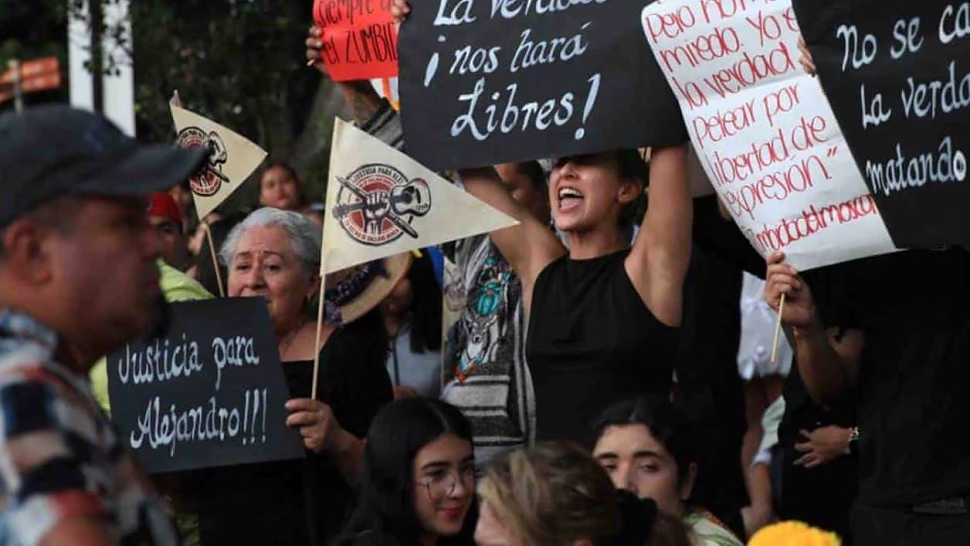
Relatives and friends of Alejandro Leyva protested during the Guelaguetza delegation parade. With tarps, banners on the roof of a house and dressed in black, they demanded justice.

“We are Alejandro’s family and we ask for justice for my uncle. We know the situation in the country. It is not just Oaxaca, it is the entire country. Please join our cause,” expressed the protesters.

Continue reading

Sheinbaum announces border reopening for Mexican cattle

Gradual reopening of the US border to Mexican cattle at the end of August.

New stage for national livestock farming

President Claudia Sheinbaum confirmed that the United States border will gradually reopen at the end of August for the export of Mexican livestock. The measure represents economic relief for the country and for thousands of families dedicated to livestock farming.

Both nations suffered losses during the shutdown, caused by the presence of the screwworm. Sheinbaum acknowledged that the coordinated work between governments and producers for more than a year made it possible to contain the pest.

“You know that we have been working on the issue, both with all the livestock organizations and with the governors, to contain the screwworm,” said the president from Cuautla, Morelos.

As part of the strategy, a plant to produce sterile flies is already operating in Chiapas. In addition, Cofepris is analyzing a new strain that would make the process more efficient.

Sheinbaum explained that the effort is carried out in conjunction with the governments of Mexico, the United States and Panama. This articulation created the conditions for the US authority to authorize the opening of the border.

Continue reading