Sheinbaum highlights peaceful nature of 8M marches

The president describes the 8M marches as mostly peaceful, highlighting a small group with violent acts.

The official story about 8M: peace, multitude and a ‘small group’

Claudia Sheinbaum painted a picture. That of the International Women’s Day marches as a predominantly quiet event. Its official narrative prioritizes peaceful magnitude over incidents.

The president highlighted that in most of the entities the demonstrations were peaceful. “I would say in all of them,” he said, although he later qualified the capital.

“In most of the entities of the Republic they were peaceful demonstrations, I would say in all of them. Here in Mexico City it was a march of around 100 thousand women, peaceful.”

The core of the message is clear: normality and control. The figure of 100 thousand attendees in CDMX serves as an anchor for that version.

RelatedMexico ranks second in homicides of LGBT+ people in Latin America

The ‘small group’ and the men on stage

Then came the asterisk. The recognition that there were violent acts. Sheinbaum attributed them to a minority and, curiously, highlighted the male presence.

“And a part of a very small group that commits violent acts… By the way, many men in the violent acts, not even a good part of them were women.”

There is the discursive turn. By emphasizing that many were men, she conceptually detaches violence from the mainstream feminist movement. It is a tactical move: condemn the facts while protecting the general image of 8M.

His government reiterated its rejection of these forms. But the rhetorical weight fell on the minority of the issue compared to the rest of the country.

The question that remains, as always, is what defines small when talking about riots. And why certain details—like that note about men—become relevant in the official explanation.
Sterile fly plant inaugurated in Chiapas; key binational cooperation

New binational plant will produce 100 million sterile insects per week to protect livestock.

Strategic plant against livestock pest

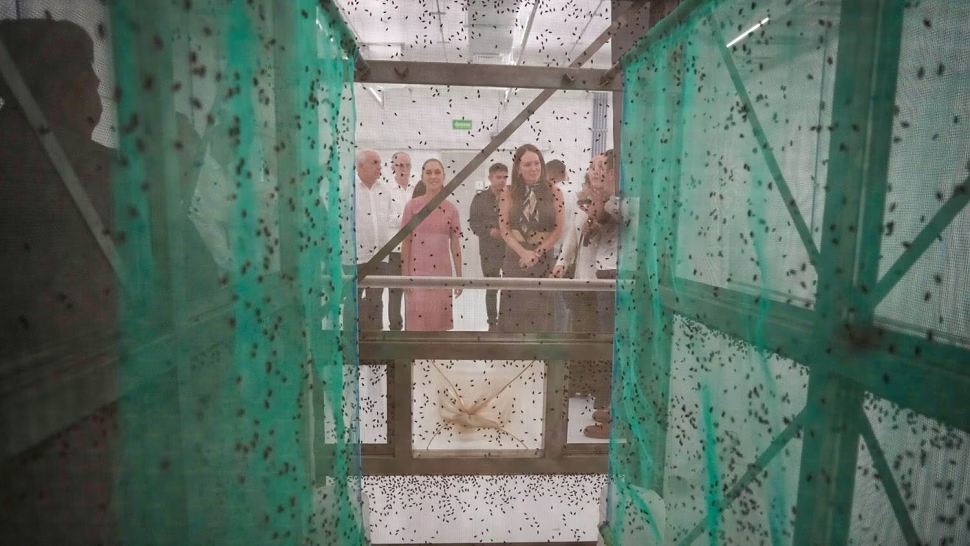
President Claudia Sheinbaum inaugurated the Production Plant for Sterile Livestock Screwworm Flies (GBG) in Metapa de Domínguez, Chiapas. The project is binational between Mexico and the United States.

The facility will produce 100 million sterile insects each week. The objective: control the pest and strengthen animal health in both countries.

Sheinbaum highlighted that international cooperation generates results in the face of phytosanitary challenges that do not recognize borders. He thanked President Donald Trump and the US authorities for their financial and technical contribution.

Investment and results

The US ambassador to Mexico, Ronald D. Johnson, announced an additional investment of 83.8 million dollars. The resources will be used to intensify the fight against the pest, increase the production of sterile flies and strengthen preventive strategies.

The US Secretary of Agriculture, Brooke L. Rollins, described the achievement as an example of the success of coordinated work.

For her part, the Secretary of Agriculture and Rural Development, Columba Jazmín López Gutiérrez, explained that the plant was built in 12 months. As part of the containment actions, 5.3 million heads of cattle have been inspected, more than 84 thousand commercial shipments have been verified and 7 billion sterile flies have been released with the support of specialists.

The bilateral relationship, Sheinbaum stressed, must continue on mutual respect, constant dialogue and sovereignty.

Continue reading

Former Pemex director investigated for alleged assault on his wife

The Morelos Prosecutor's Office is investigating Víctor Rodríguez Padilla for alleged assault on his wife.

Investigation in progress

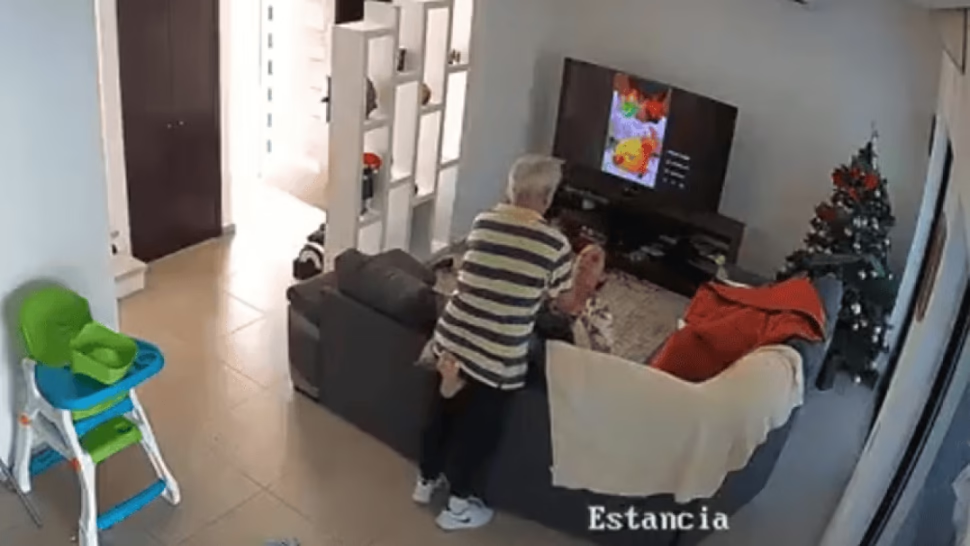
The Attorney General’s Office of the State of Morelos initiated an investigation file against Víctor Rodríguez Padilla, former director of Petróleos Mexicanos, after the dissemination of a video in which he is seen allegedly attacking his wife, María Felicia Jiménez. The recording, which circulates on social networks, shows Rodríguez Padilla repeatedly hitting the victim inside a home in the municipality of Emiliano Zapata, adjacent to Cuernavaca. According to the metadata of the video, the attack occurred on March 15.

The state agency reported that since Friday it has been exchanging information with the Women’s Secretariat of the Government of Mexico to guarantee the protection of the victim.

“The Attorney General’s Office of the State of Morelos initiated an investigation folder for the probable criminal acts derived from the dissemination of a public complaint through a video, where an act of violence against a woman is seen,” cited the FGE.

Protection actions

The Morelos Prosecutor’s Office specified that the investigation was opened in full respect for the rights of women, girls, boys and adolescents. The statement indicates that the events probably occurred on March 15 inside a home in Emiliano Zapata, with the alleged participation of a former federal official.

The institution assumed the commitment to exhaust all measures to determine responsibilities and guarantee a life free of violence for the victim. So far, no precautionary measures have been reported against Rodríguez Padilla, and the investigation is still ongoing.

Continue reading

Sheinbaum supervises progress of IMSS-Wellbeing with governors

Sheinbaum leads meeting with 23 governors to evaluate progress in the health system.

Advances in public health

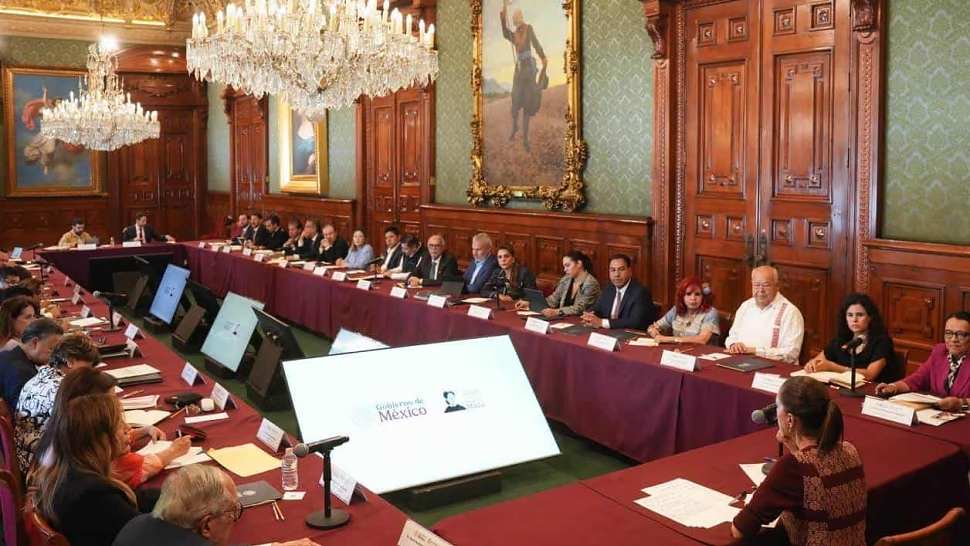
At the National Palace, President Claudia Sheinbaum led a follow-up meeting on the IMSS-Wellbeing model. Governors of the 23 entities integrated into the program participated.

“The objective is to guarantee quality, universal and free medical care for the people of Mexico.”

The federal cabinet was attended by Rosa Icela Rodríguez (Government), David Kershenobich (Health), Luisa María Alcalde (Legal Department), Eduardo Clark (Undersecretariat of Health), and the directors of IMSS-Bienestar (Alejandro Svarch), IMSS (Zoé Robledo) and Issste (Martí Batres).

The state leaders present were: Marina del Pilar Ávila (Baja California), Víctor Castro (Baja California Sur), Layda Sansores (Campeche), Eduardo Ramírez (Chiapas), Clara Brugada (CDMX), Indira Vizcaíno (Colima), Delfina Gómez (State of Mexico), Evelyn Salgado (Guerrero), Julio Menchaca (Hidalgo), Alfredo Ramírez (Michoacán), Margarita González (Morelos), Miguel Navarro (Nayarit), Salomón Jara (Oaxaca), Alejandro Armenta (Puebla), Mara Lezama (Quintana Roo), Ricardo Gallardo (San Luis Potosí), Yeraldine Bonilla (Sinaloa), Alfonso Durazo (Sonora), Javier May (Tabasco), Américo Villarreal (Tamaulipas), Lorena Cuéllar (Tlaxcala), Rocío Nahle (Veracruz), Joaquín Díaz (Yucatán) and David Monreal (Zacatecas).

The meeting is part of the periodic supervision to consolidate free coverage of health services in the country.

Continue reading