
Sheinbaum denies data on cartel drones on the border

The president denies having information about the use of drones by cartels after the closure of airspace in Texas.

Sheinbaum’s response to drone rumors

The curtain rises on another act of tension on the northern border. This time, the script was written by the closure of airspace in El Paso, Texas, after reports of alleged illicit drone activities. And from Mexico City, President Claudia Sheinbaum took the microphone to give her version.

His statement was as clear as a tap on the table: there is no information to confirm that story.

“There is no information on the use of drones on the border,” said the president when questioned.

That is to say, the National Palace claims to have no evidence that criminal groups are using these flying devices. But here comes the plot twist. Sheinbaum did not close the door completely. It left a window open for coordination with Washington.

“If you have any information, the FAA or any area of the United States government, you can ask the government of Mexico,” he said.

His message is a call to leave assumptions aside and focus on facts and constant communication between neighbors. In the theater of binational security, it seems that they prefer to wait for the official script to be passed to them before acting.

RelatedNATO intercepts Russian drones in Polish airspace

What does this mean for families living near the border? For now, more questions than answers. The president asks not to speculate, but informative silence sometimes speaks louder than words. The act continues, and the audience waits for the next movement.
They eliminate 1,711 procedures in the digitalization plan

Simplification program advances 60%; They seek to reduce corruption with technology.

Advance in simplification of procedures

Claudia Sheinbaum reported that the Procedures Simplification Program, run by the Digital Transformation and Telecommunications Agency (ATDT), has registered a progress of 60 percent. So far, 1,711 procedures have been eliminated and 3,497 have been simplified, with the goal of intervening 4,500 by 2026.

“Technology is there to make people’s lives easier and to avoid corruption,” said the president during the morning conference.

José Antonio Peña Merino, head of the ATDT, described this as the largest simplification in the country. Requirements were reduced from six to two on average. The gob.mx portal has been used by 56 million people, with two million weekly visits. The 24/7 window, a virtual assistant with AI, records almost two million interactions.

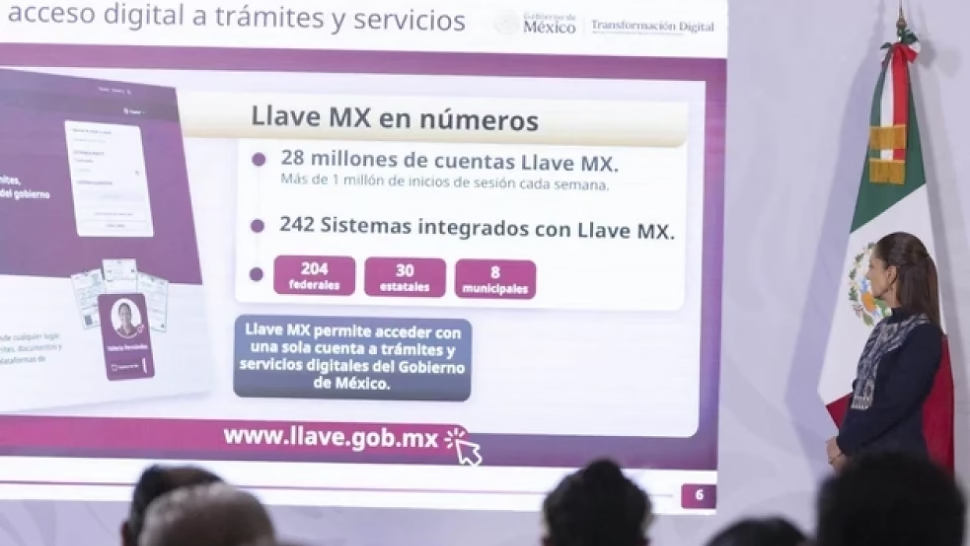
Llave Mx has 28 million accounts and one million uses per week, integrating 242 systems. The National Civil Registry Platform digitized 80 percent of its services; 18.2 million users already carry out transactions online. Resolution times went from 20 to five days.

In the passport, applications were reduced from 21 to five procedures and the requirements from six to three, with a 50 percent drop in resolution time. Almost five million users have used the platform. The consulates also simplified their processes: from 72 to 37 procedures, and from six to two requirements, with five million users.

In investments, the Digital Window for Medium-sized Companies was created, integrated into 18 entities. Federal procedures must be resolved in a maximum of 90 business days; otherwise, they will be considered authorized. For investments in Wellness Centers, amounts greater than 2 billion pesos or strategic sectors, authorization is immediate.

In addition, the Single Window for Foreign Trade and the National Platform for Commercial Establishments were activated, available in 105 municipalities. The latter allows businesses to be opened immediately and online, reducing from seven licenses to six notices and one license.

Continue reading

IPN is positioned among the three best public universities in Mexico

The Polytechnic climbs positions in the QS 2027 global ranking and consolidates itself as a reference in research.

IPN progress in the QS 2027 ranking

The National Polytechnic Institute was ranked among the three best-positioned public universities in Mexico, according to the 2027 edition of the QS World University Rankings, prepared by Quacquarelli Symonds.

The study places the IPN in the range 901–950 worldwide, within a universe of 1,507 classified institutions and more than 8,000 evaluated on a global scale. This reflects its presence on the international academic scene.

The institution highlighted that the result confirms its strategic role in higher education, science and technology, as well as sustained progress in academic quality and internationalization.

Key indicators

Among the main advances, the IPN reported improvements in the International Research Network and in the proportion of international students, with an increase of 33.33%. The ratio of students to faculty also increased by 20.58%.

The institute highlighted that the international scientific collaboration indicator showed a cumulative growth of 698% in three years. It attributed this achievement to the strengthening of its global academic ties and the institutional strategy led by its general director, Arturo Reyes Sandoval.

Continue reading

FGR appoints new prosecutors in Colima and Zacatecas

The Attorney General's Office appointed Susana Macías and Daniel Valdés to reinforce the administration of justice.

New appointments in the FGR

The Attorney General’s Office (FGR) appointed federal prosecutors for Colima and Zacatecas. The objective is to strengthen the administration of justice and improve coordination with local authorities.

Susana Aletxa Macías Medina took over as prosecutor in Colima. She has a degree in Law with a postgraduate degree in Criminology. He began his career in 2006 within law enforcement agencies and later held positions in the defunct Attorney General’s Office.

In Zacatecas, Daniel Valdés Vera was appointed representative. He has training in Law and two decades of experience in the Federal Prosecutor’s Office in Sonora, where he held various positions.

With these appointments, the FGR seeks to strengthen its state representation, improve results against irregularities and impunity, as well as strengthen collaboration with state and municipal security and justice authorities.

Continue reading