Sheinbaum defends school-by-school consultation for teacher evaluation

The president rejects that the CNTE decides for all teachers; proposes secret vote.

Sheinbaum’s stance

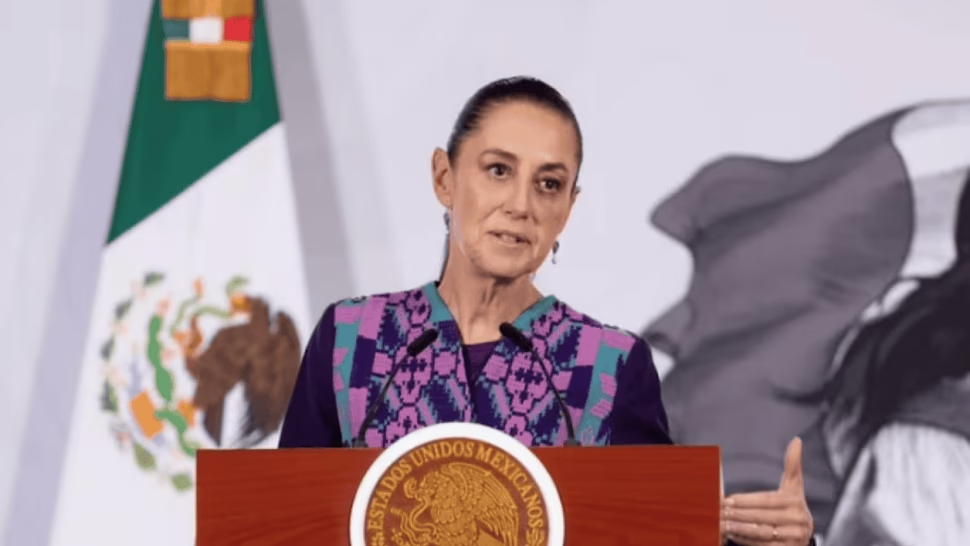
President Claudia Sheinbaum insisted that the country’s teachers must decide their evaluation process through direct consultations in each school, without the CNTE imposing a single position.

“What do the teachers want? That with (section) 22 we decide how teachers throughout the country are going to be evaluated. Well no, who has to give an opinion? The teachers throughout the country, the teachers, then, that is why it is school by school, and they have to participate, not just the CNTE, all the teachers in the country have to participate,” he said.

He added that decisions must be made with the proposals collected in each school and by secret vote.

“For example, there are some sections of the CNTE that propose to return to the mixed commissions, and that there the promotion of teachers be decided, no longer with an exam, no longer without the union, but rather an exclusively labor issue. The discussion of how teachers should be evaluated belongs to the teachers and is a decision of the teachers,” he commented.

Sheinbaum pointed out that the CNTE has union representation only in Oaxaca, Chiapas and Zacatecas, and that there are other teachers in the rest of the country with diverse positions.

RelatedStates with educational lag lead controversial teacher evaluation

He denied that a space was opened in his morning conference for the CNTE to present its requests.

“Here, I gave them a two-day appointment and they did not arrive. There can be a public debate, but the morning is something else, in another space or in the afternoon, but not here, this is the space of the Presidency of the Republic and here a public debate is discussed. Elsewhere, with pleasure,” he expressed.
Sheinbaum: progress in commercial dialogue with the United States

The president trusts in agreements with the US to give certainty to the T-MEC.

Progress in the review of the T-MEC

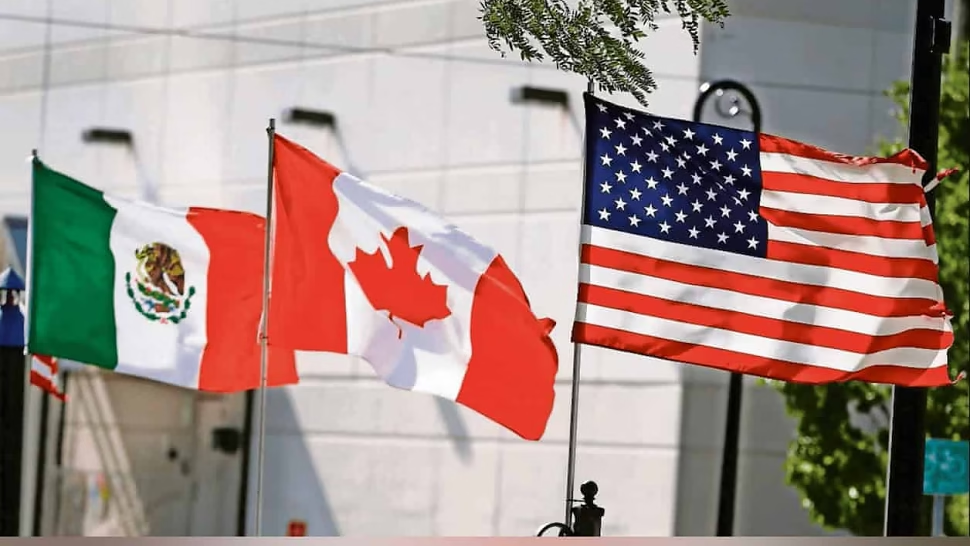
President Claudia Sheinbaum affirmed that trade negotiations with the United States are advancing. He is confident that next week’s talks will generate agreements that give certainty to the bilateral relationship and the T-MEC.

From the National Palace, Sheinbaum confirmed the arrival of a delegation from the Office of the United States Trade Representative (USTR) on July 20.

“Remember that on the 20th, next week, a USTR team is coming here to Mexico to continue the talks and be able to reach some agreements that will give us greater stability in the following years,” he said.

Annual review instead of extension

The president explained that, after Donald Trump’s decision not to extend the USMCA for 16 years, the three countries entered into an annual review scheme for the next decade. There is the possibility of renewing the agreement for another 16 years if there is consensus.

“By President Trump not extending the treaty for 16 years, we entered into an annual review process for the next 10 years and at any time it can be recognized again, if the three countries so wish, for another 16 years,” he indicated.

Sheinbaum stressed that the priority is for this year’s review to be the most important, establishing clear rules to avoid future renegotiations.

“The objective for us is that this year’s review is the most important review and that in any case afterward it will only be a matter of whether or not both countries comply with what we agreed to,” he said.

The president added that the sooner the understandings are finalized, the greater stability trade relations will have. He affirmed that there is significant progress and hopes that the July talks will result in concrete agreements.

Continue reading

New operation in Culiacán prison: cell phones and drugs seized

Authorities seize more than 20 chargers and several electronic devices in a surprise inspection.

Results of the operation

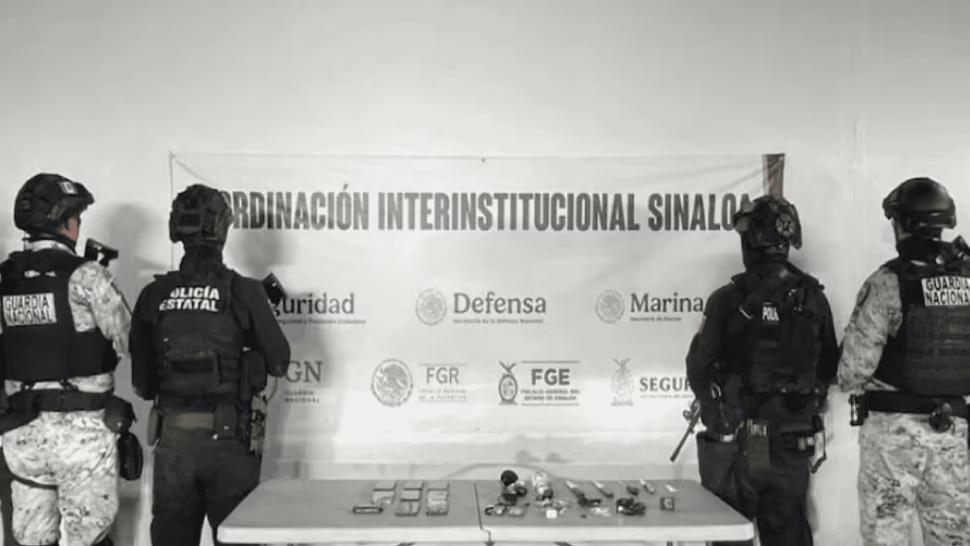
Elements of the National Guard and state police carried out a new surprise inspection in modules of the Culiacán prison. They found 24 mobile chargers, 14 cell phones, 10 USB cables, 9 USB flash drives and doses of alleged illicit substances.

The state Public Security Secretariat detailed that three SIM cards, two modems, four pipes and two grinders for cannabis, a scale, video game controls and consoles, and a radio charger were also seized.

The operation had external protection from the Army Operations Base and the National Guard. The continuous reviews have borne fruit: just last week the seizure of 28 cell phones, 37 chargers, 42 doses of suspected drugs, four SIM cards and a broadband modem was reported.

In that same inspection, with military support, 26 additional cell phones, 34 chargers, USB and auxiliary cables, another modem, a SIM card, two chips, 42 doses of suspected marijuana, two cigarettes of the same substance, a grinder and a music amplifier were discovered.

In the most recent search, a USB memory, two scissors, a vape pen, 18 tips, a smart hearing aid and a video game controller were also found. Everything insured was placed at the disposal of the Public Ministry.

Continue reading

Sheinbaum travels to Quintana Roo for sargassum and Jaguar Park

President Sheinbaum will visit Quintana Roo to address the sargassum crisis and conflict in Jaguar Park.

President Claudia Sheinbaum announced that this weekend she will tour Quintana Roo. The trip includes three central themes: the Jaguar Park in Tulum, the strategy against sargassum and the progress of the Mayan Cargo Train.

Jaguar Park in Tulum

Sheinbaum will meet with federal authorities, hoteliers and merchants to resolve pending problems in the area. Despite the work of the Secretary of the Environment, Alicia Bárcena, Conanp and the Mundo Maya company, there are still unresolved issues. The president stated:

“We are going to see exactly what is happening and there with all the institutions we are going to solve it, talk to the hoteliers, with the merchants to see how we solve it.”

Strategy against sargassum in Cancún

The second point is the increase in sargassum, a phenomenon aggravated by ocean temperatures. The federal government has a comprehensive diagnosis and proposal: collect it at sea and recycle it. Sheinbaum explained:

“We already have a solution, but we are going to observe the problem, see where there is the greatest amount of sargassum and provide a comprehensive solution that has to do with fishing at sea and subsequent recycling.”

On Sunday he will offer a conference from Cancun to detail the strategy.

Progress of the Mayan Cargo Train

As a third point, he will supervise the locomotives of the Mayan Freight Train, which have already arrived. “We are going to visit the locomotives and how the Mayan Freight Train is going,” he said. Friday’s morning conference will be held in Tulum to report on the actions.

Continue reading