Sheinbaum confirms support for Cuba with Sembrando Vida

Mexico maintains its Sowing Life program in Cuba and functions as a collection center for humanitarian aid.

Direct support in Cuba and other countries

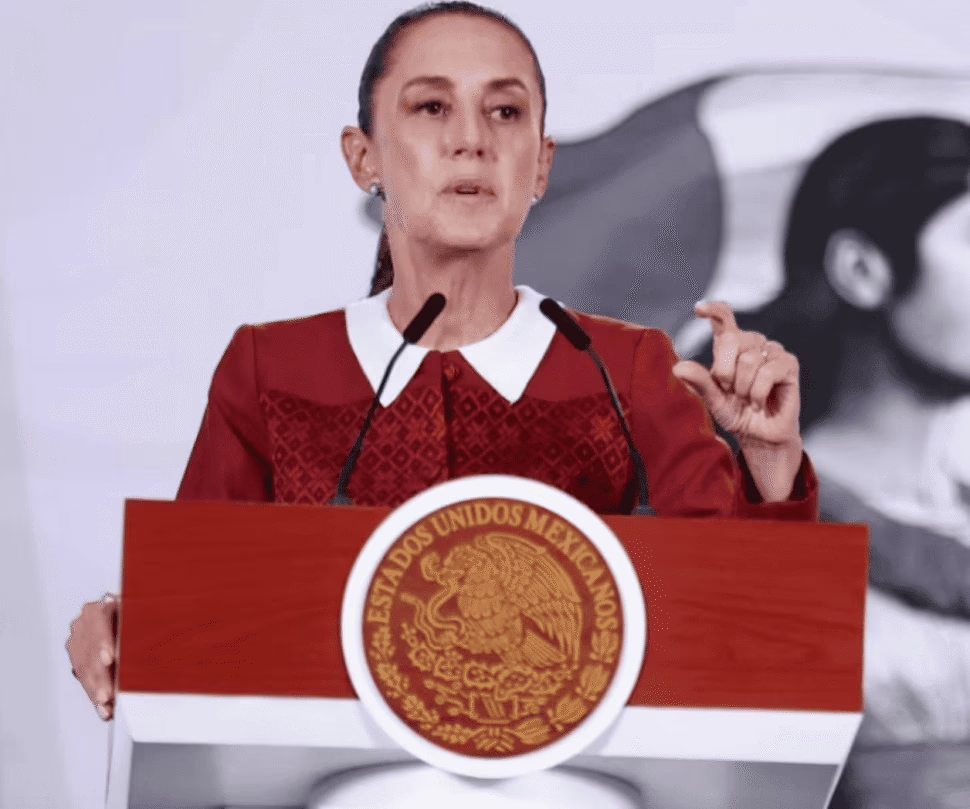
President Claudia Sheinbaum confirmed that the Sembrando Vida program continues to operate in Cuba, Guatemala, Honduras and El Salvador. The resources reach the beneficiaries directly, without intermediaries.

“Yes, Sembrando Vida continues in several countries, among them is Cuba. Sembrando Vida also continues to support Cuban men and women. That support reaches people directly,” he declared during his morning conference.

RelatedCuba thanks Mexico for delivering books and Sheinbaum defends bilateral relationship

International cooperation towards the island

Sheinbaum explained that Mexico has served as a concentration point for supplies sent by other nations. He gave as an example a recent food shipment where Uruguay participated.

“Uruguay sent milk to Mexico and from here the ship was filled and arrived in Cuba,” he explained. In other cases, such as Brazil, Spain and China, countries make their shipments directly, without passing through Mexican territory.

The president stressed that Mexico also participates with its own donations. “We send humanitarian aid and if it is through Mexico, it is done in a transparent manner,” he assured.

The government maintains its commitment to humanitarian cooperation towards Cuba, both through social programs such as Sembrando Vida and with logistical support to facilitate the arrival of aid from other nations.

Housing for Wellbeing: 274 thousand units under construction

274 thousand social housing units have already begun to be built; 604 thousand more are in process throughout the country.

Program progress

Edna Elena Vega Rangel, Secretary of Agrarian, Territorial and Urban Development (Sedatu), reported that under the Housing for Well-being program, 274 thousand social housing units have already begun to be built. In addition, more than 604 thousand have started procedures for their construction throughout the country. This will benefit 2.1 million people.

In the presidential morning conference, the official recalled that the six-year goal is to build 1.8 million homes. “We have made very important progress: 274 thousand homes have already started the building process and it should be noted that 604 thousand have already been contracted. Why is it important to point out this data? Of course, those that have started, we must highlight it in all the entities of the country, and 604 thousand is that we already have the land, the project has already been prepared, the procedures are already in place. So that reflects a very, very important basis,” he noted.

He specified that 33% of the goal is in a position to start work at any time. “What does this mean? 2.1 million people who are benefiting from the program,” he added.

Main advances by entity

Vega Rangel highlighted significant progress in states such as Tabasco, Quintana Roo, Yucatán, Tamaulipas and Veracruz. However, he acknowledged that in some regions progress is low due to the difficulty in obtaining adequate land for social housing. He assured that progress is being made in solving that obstacle.

Continue reading

They restructure 4.8 million Infonavit credits

Infonavit restructured 4.8 million loans; 457 thousand were left at zero.

Massive credit restructuring

Octavio Romero Oropeza, director of Infonavit, reported that more than 4.8 million loans considered unpayable were restructured in the current administration. The objective: correct schemes that made debts grow despite payments.

Of that total, 457 thousand credits remained with a zero balance. Their owners will no longer have to pay. The remaining 4.4 million were restructured with balance reductions, lower rates and fixed monthly payments. The Institute’s collection improved: a group of 650 thousand credits went from 215 million pesos per month to 318 million.

“People pay, as long as they have fair payment conditions,” he said.

Advances in housing

In housing improvement, almost 150 thousand credits were granted in 2026, exceeding the goal of 132 thousand. In the Housing for Wellbeing Program, as of June 14, there are 460 thousand homes contracted, 191 thousand under construction. The six-year goal is 1.2 million houses.

Romero highlighted that 23,281 homes have already been placed in 21 states. 90% of the beneficiaries earn between one and two minimum wages. Three out of every four homes were purchased by people under 40 years of age. More than 25 requirements were eliminated and the credit bureau no longer conditions financing.

Rodrigo Chávez, from Conavi, reports construction and improvement in several entities. The executive member of Fovissste, Jabnely Maldonado, reported 40% progress in restructuring credits for State workers. Since July 1, a new simplified account statement has been in operation. He also announced the third stage of conversion of UMA credits to pesos.

Claudia Sheinbaum assured that the program is progressing: there are already 274 thousand homes under construction, 604 thousand contracted and more than 24 thousand delivered. He highlighted that the restructuring of more than five million loans canceled debts of hundreds of thousands of families.

“We are serving nearly seven million families,” he said.

Regularization of writings

Víctor Rubén Guzmán, from Insus, reported 36,123 deeds delivered and 39,673 accumulated. There are 117,442 lots in process. The State of Mexico leads with 13,286 processes. 557 thousand 980 lots are incorporated. 63.4% of the shares are in the name of mothers, due to “a historical debt to women.”

Continue reading

90% of gas stations sell regular gasoline for less than 24 pesos

Average price of regular gasoline is 23.68 pesos; 90% of stations comply with the agreement.

Advances in fuel prices

The head of the Federal Consumer Prosecutor’s Office (Profeco), César Iván Escalante Ruiz, reported that nine out of ten service stations in the country already sell regular gasoline for less than 24 pesos per liter. The data is part of the monitoring of the agreement to stabilize prices.

The national average price of regular gasoline was 23.68 pesos per liter. As for diesel, the average was 27.15 pesos, five cents less than the previous week. Compliance with this fuel rose from 73.1% to 75% of stations that sell it for under 27 pesos.

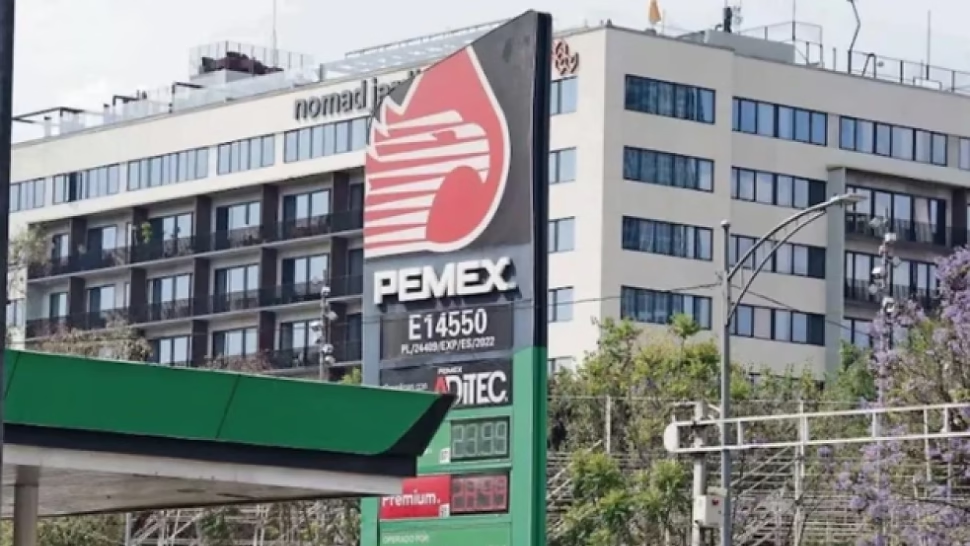
As part of weekly monitoring, Profeco identified a Pemex station in the Venustiano Carranza mayor’s office, Mexico City, as one of those that offers fairer prices for regular gasoline. In contrast, he pointed out an Oxxo Gas station in Gómez Palacio, Durango, for maintaining high margins, with a price of 24.99 pesos per liter.

Stability in the basic basket and actions for the 2026 World Cup

In terms of basic consumption, the official reported that the basket of 24 products maintains a stable trend. The lowest price was recorded in Durango, with 777.90 pesos, while the highest was 949 pesos in León, Guanajuato. Regarding tomatoes, the national average in supply centers is 44.66 pesos per kilogram, decreasing thanks to the National Agreement against Inflation and Famine.

Looking ahead to the 2026 FIFA World Cup, Profeco maintains a special surveillance and advisory operation in the country’s three host stadiums, four international airports, Fan Fest areas and 143 high-traffic points. The objective is to guide and defend the rights of national and foreign consumers. In addition, the special edition of Consumer Magazine includes a quality study on 49 models of LED screens from 13 brands so that consumers make informed purchases.

Finally, the agency reiterated the call to consult its virtual map to locate gas stations with fair prices and compare costs of basic products.

Continue reading