Sheinbaum trusts agreement with the US to avoid 30% tariffs

The Mexican president reveals progress in talks to avoid measures that would affect exports.

Sheinbaum vs. Trump: The tug of war on tariffs that no one asked for

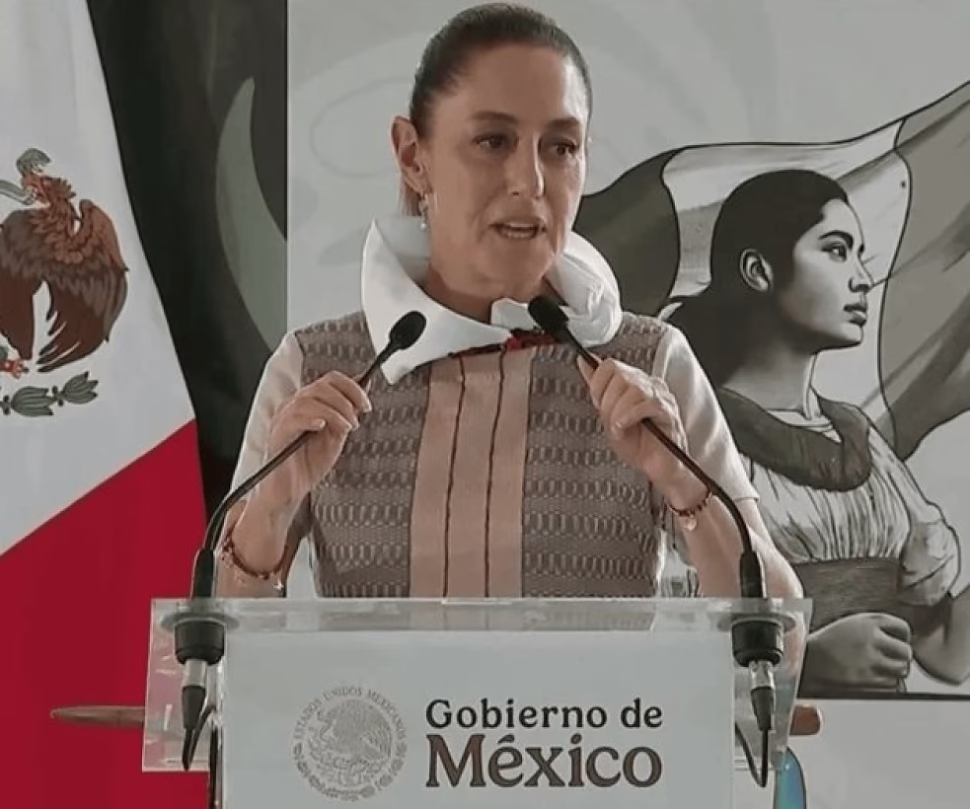
Ah, the tariffs. That little poisoned gift that Donald Trump wants to give to Mexico (and the world) as if it were 2018 again. But president Claudia Sheinbaum, with the calm of someone who knows that guacamole always wins, assures that there will be an agreement before August 1. Optimism or strategy? Maybe a little of both, because according to her, yesterday’s talks in Washington were more productive than a virat meme.

The letter that no one wanted to receive

Imagine waking up to a message from your ex. Well like that, but worse: Trump sent a signed letter announcing 30% tariffs on Mexican exports. “But not just us!” Sheinbaum clarifies, as if that were comforting. “It’s their new tactic: flooding the world with papers as if it were spam.” Of course, the president does not shrink: “We already have a work table with teams from the Economy, Energy and even the Treasury. In other words, the Avengers of the T-MEC.”

RelatedCanada matches US tariff exemptions in the T-MEC

And here is the ironic detail: the same letter that threatens tariffs says that they seek to avoid them. Trump classic: “I destroy you, but with love.” Sheinbaum, in cool mode, responds: “We believe we will reach an agreement… and hopefully without having to sell more avocados on Twitter.”

And now what?

While the markets pretend they don’t care (but they sweat cold), Mexico plays its cards: diplomacy, hard data and, surely, some wink to the Democrats. Because Sheinbaum knows that, in this game, even a tweet can be a master move. Of course, if there is no agreement, get ready for the hashtag #TariffsCivilWar and memes of crying with a taco in your hand.

Millennial moral: In international commerce, as in Tinder, everything depends on how you sell your profile. And Mexico, at least for now, remains in “superlike” mode.

Are you worried about the economic impact? Share this note and continue exploring how these decisions affect us in our foreign trade special. #WhatScaryButWhatExcitement

AICM taxi drivers refuse to apply discounts agreed for the World Cup

Three AICM taxi drivers groups refuse to apply discounts of up to 18% during the World Cup.

Three groups of taxi drivers that operate at the Mexico City International Airport (AICM) refused to apply discounts of up to 18% on their rates during the World Cup. The measure contradicts previous agreements announced by airport authorities and part of the union.

The companies Nueva Imagen, Porto Taxi and Sitio 300 issued a statement to clarify their position. They argued that they have no contractual relationship with the Grupo Aeroportuario Marina (GAM), the entity that promoted the benefits for airport users.

According to permit holders, the announced discounts do not represent a direct reduction in rates. They are, they say, adjustments derived from compensation for improper charges and administrative processes for maintenance work at the AICM.

They demand transparency

The taxi drivers asked the AICM authorities to make public the documents that support these measures. They also called on the GAM to make transparent the minutes and contracts where the application of discounts had been agreed upon. They questioned the legal validity of the obligations attributed to them.

The refusal could affect users who expected more affordable rates during the sporting event. Until now, there is no certainty about the real cost of service at the AICM during the World Cup.

Continue reading

Morena opens the door to a coalition with the PVEM in San Luis Potosí

Morena conditions alliance on PVEM ruling out Ruth González for the governorship.

Morena-PVEM Coalition for 2027?

The state leadership of Morena in San Luis Potosí left open the possibility of an alliance with the Green Ecologist Party (PVEM) for the local elections of 2027. The condition: that the PVEM present a different profile from that of Senator Ruth González.

Rita Ozalia Rodríguez Velázquez, state president of Morena, explained that if the PVEM discards Ruth González—wife of Governor Ricardo Gallardo—the green party could lead the coalition, which would also integrate the Labor Party (PT).

The leader clarified that the relationship with the PVEM at the local level does not face a conflict, although she admitted that there is no direct communication between both state leaders. Decisions about alliances, he said, are made by national leaders.

The possible agreement arises in the midst of the debate about nepotism, after Ruth González’s intention to succeed her husband in the state government was questioned. Morena looks for profiles that avoid that controversy.

Rodríguez Velázquez stressed that there is coordination between the party leadership to define the electoral strategy. For now, the panorama in San Luis Potosí remains open.

Continue reading

Morena accuses INE advisors of being ‘ill-wishers’

The Morena leader accuses INE advisors of being 'ill-wishers' and defends her affiliation system.

Morena questions the impartiality of the INE

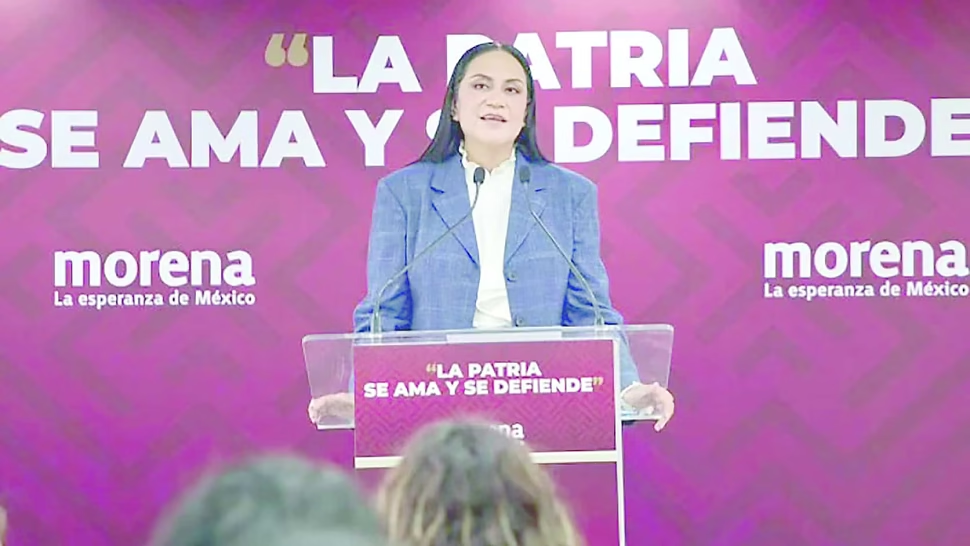
The national leader of Morena, Ariadna Montiel Reyes, pointed out that within the INE there are advisors with critical positions towards her party. He described them as “Morena haters” during a press conference where he addressed recent resolutions on duplicate affiliations.

Montiel affirmed that his party abides by the determinations of the Electoral Court. The authority ordered the elimination of more than 93 thousand affiliate records and leave under review about 19 thousand cases that the INE must verify.

The leader demanded that the institute adhere to the resolutions of the General Council and not to individual opinions. He accused that there are figures close to past electoral administrations who maintain a critical stance towards the movement.

Regarding the affiliation system, Montiel defended that Morena’s application is efficient. He assured that it surpasses that of the INE in functionality, since it allows duplications in the records to be detected.

He also proposed that the INE should have real-time verification mechanisms to cross-check affiliation data. However, he acknowledged that there are different processes between parties and the electoral authority.

Continue reading