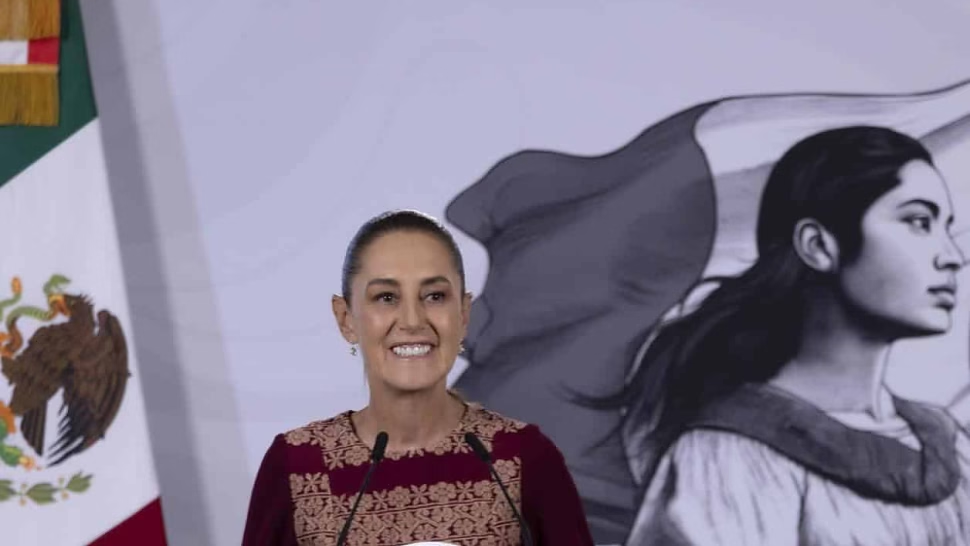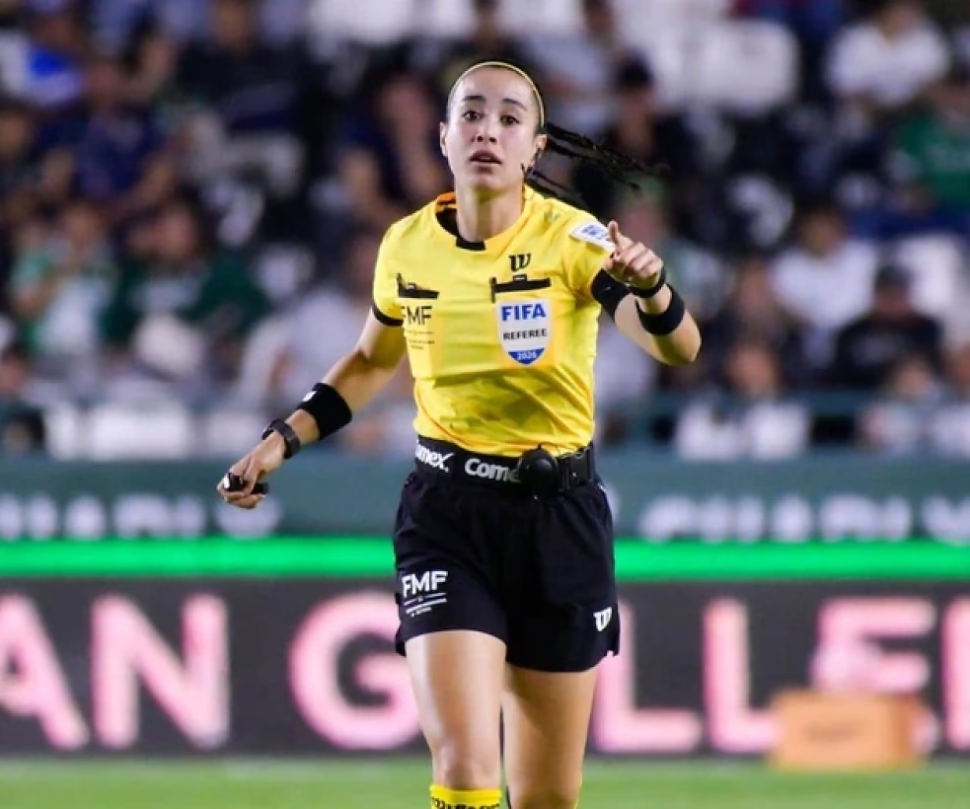
Sheinbaum celebrates appointment of Mexican referee for the 2026 World Cup

The president celebrated the appointment of the Mexican as central judge of the Netherlands-Tunisia.

President Claudia Sheinbaum congratulated referee Katia Itzel García for her historic appointment as central judge in the Netherlands vs Tunisia match at the 2026 World Cup.

The president described the achievement as an example of perseverance and a message of empowerment for Mexican girls, boys and women. He highlighted that the presence of the Aztec whistler in the highest competition in international football represents a benchmark for improvement.

RelatedKatia Itzel García makes history as the first Mexican referee in the Gold Cup

Sheinbaum stressed that this appointment demonstrates that spaces of high competition and professional leadership are open for the development of women in any field they propose.

The appointment of García as central referee is unprecedented for a Mexican in a men’s World Cup. The match between the Netherlands and Tunisia will be played during the group stage of the tournament organized by the United States, Canada and Mexico.
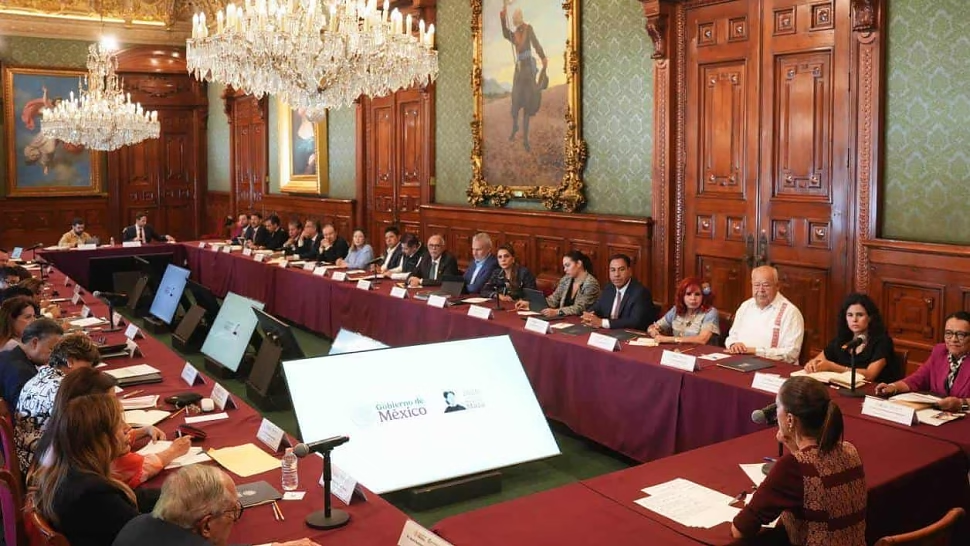

Sheinbaum supervises progress of IMSS-Wellbeing with governors

Sheinbaum leads meeting with 23 governors to evaluate progress in the health system.

Advances in public health

At the National Palace, President Claudia Sheinbaum led a follow-up meeting on the IMSS-Wellbeing model. Governors of the 23 entities integrated into the program participated.

“The objective is to guarantee quality, universal and free medical care for the people of Mexico.”

The federal cabinet was attended by Rosa Icela Rodríguez (Government), David Kershenobich (Health), Luisa María Alcalde (Legal Department), Eduardo Clark (Undersecretariat of Health), and the directors of IMSS-Bienestar (Alejandro Svarch), IMSS (Zoé Robledo) and Issste (Martí Batres).

The state leaders present were: Marina del Pilar Ávila (Baja California), Víctor Castro (Baja California Sur), Layda Sansores (Campeche), Eduardo Ramírez (Chiapas), Clara Brugada (CDMX), Indira Vizcaíno (Colima), Delfina Gómez (State of Mexico), Evelyn Salgado (Guerrero), Julio Menchaca (Hidalgo), Alfredo Ramírez (Michoacán), Margarita González (Morelos), Miguel Navarro (Nayarit), Salomón Jara (Oaxaca), Alejandro Armenta (Puebla), Mara Lezama (Quintana Roo), Ricardo Gallardo (San Luis Potosí), Yeraldine Bonilla (Sinaloa), Alfonso Durazo (Sonora), Javier May (Tabasco), Américo Villarreal (Tamaulipas), Lorena Cuéllar (Tlaxcala), Rocío Nahle (Veracruz), Joaquín Díaz (Yucatán) and David Monreal (Zacatecas).

The meeting is part of the periodic supervision to consolidate free coverage of health services in the country.

Continue reading

Morena dismisses youth commissioner after attack

Morena removed Jaime Castillo from his position after a video that shows him attacking a driver.

The National Executive Committee of Morena announced the dismissal of Jaime Castillo Castillo, who served as Youth Commissioner in Zacatecas. The decision was made after a video linked him to an act of violence against a driver during the celebrations for the victory of the Mexican National Team.

Facts and reaction

The images, spread on social networks, show the now former leader attacking the woman while his vehicle was surrounded by fans in the Historic Center of Zacatecas. The victim has already filed a complaint with the State Prosecutor’s Office.

In a statement, the party stated that in the movement “there is no place for any form of violence,” especially against women. Morena described the separation as an act of congruence and supported the actions of the state committee.

Castillo’s departure seeks to reinforce the institutional position against conduct that violates third parties, in a context where gender violence continues to be a sensitive issue in the public sphere.

Continue reading

Sheinbaum asks King Felipe VI to apologize to indigenous peoples

Sheinbaum apologizes to indigenous peoples; king listens and agrees on cultural exhibitions.

Request for forgiveness and culture

President Claudia Sheinbaum expressed to King Felipe VI the importance of Spain complying with the request for an apology to the indigenous peoples of Mexico. “Fortunately, 28 million Mexican men and women recognize themselves as indigenous; 68 languages ​​are spoken in Mexico,” he noted.

The president stressed that the recognition of pre-Hispanic civilizations and the resistance of these peoples are fundamental for national identity. “We said no to racism, classism and any discrimination,” he said. The monarch listened and proposed including the topic at the indigenous peoples’ table during the Ibero-American summit in November in Madrid.

As a result, they agreed to send three exhibitions to Spain: one on Mayan culture, another on Spanish refugees, and one dedicated to Sor Juana Inés de la Cruz. Sheinbaum highlighted that the meeting was possible thanks to the king’s previous visit to an exhibition on indigenous women in Madrid, where he recognized “abuses committed during the arrival of the Spanish.”

Both leaders also discussed trade, economics and the United Nations Charter. “It was a very cordial meeting; he’s a very down-to-earth person,” Sheinbaum said. After the dialogue, they visited the mural “The Epic of the Mexican People” by Diego Rivera. The king then left for Guadalajara to attend the Spanish team’s match.

Continue reading