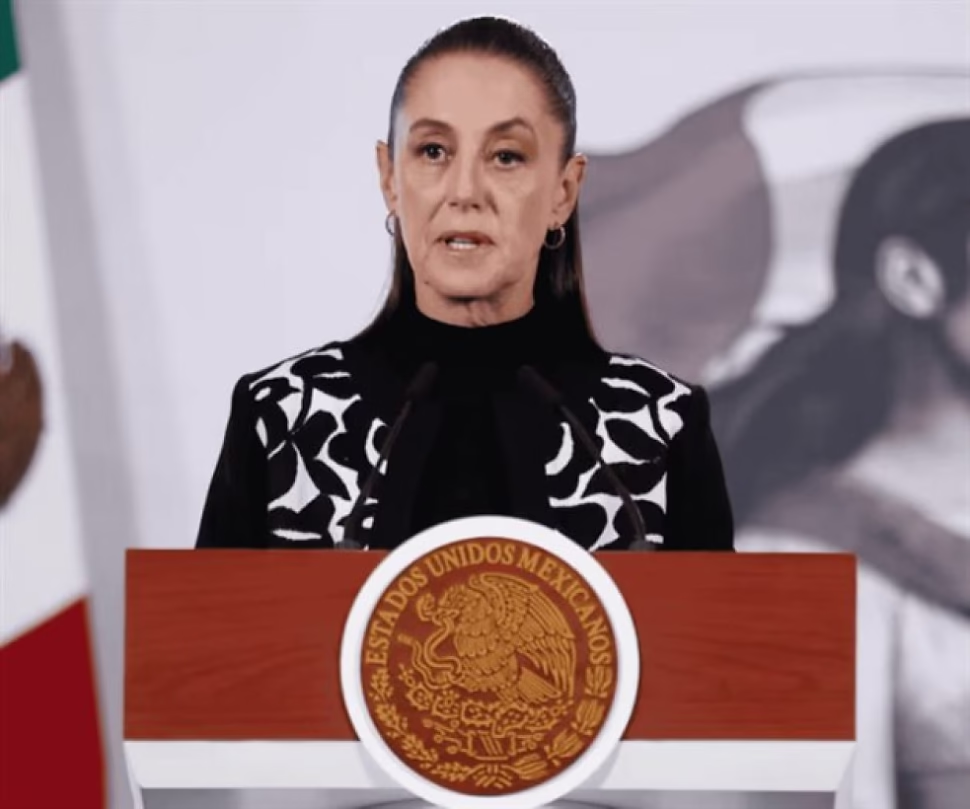
Sheinbaum attributes derailment to speed despite lack of maintenance

The president attributes the fatal accident to speed, while official documents reveal the absence of maintenance records on the road.

The official version and the empty file

Claudia Sheinbaum came out. Given the revelation by EL UNIVERSAL about the lack of maintenance records on Line Z of the Interoceanic Train — which collapsed in December with 14 deaths — the president had her response ready.

In his morning this Wednesday, he directly pointed to the “increase in speed” as the essential cause. “I can overtake you,” he said, “there are no problems on the road.”

RelatedElimination of junk files in WhatsApp to optimize space

But here is the detail that itches and spreads. While she was talking about excessive speeds, the organization in charge of the train itself—Ferrocarril del Istmo de Tehuantepec—confirmed something chilling in writing.

After an “exhaustive and thorough search” in physical and electronic files, they did not find any maintenance reports for that line since its inauguration.

Zero. Nothing. A documentary void where there should be supervision records. How do you declare that a road has no problems when there are not even papers to prove that anyone checked it?

Sheinbaum brandished the usual shield: the ongoing criminal investigation. “The information cannot be given,” he repeated, promising total transparency at the end of the process. Meanwhile, he announced that an international entity will certify the future security of the service.

It’s the classic dance: pointing out a technical factor (speed) while avoiding the monumental administrative hole (lack of basic maintenance). Memory is short, but empty files speak louder than lectures.

The question remains floating, heavier than a wagon: Can a “problem on the road” really be ruled out when there was never a report that guaranteed its status? Speed ​​could have been the final trigger. But dust in the archives suggests the land was already mined.

Morena, PT and PVEM prepare political plan for 2027

The three political forces will define their electoral route. Details will be known in the official announcement.

The plan towards 2027

The national leaders of Morena, PT and PVEM are finalizing the details of a Comprehensive Political Plan for the 2027 elections. The document will establish the work route and the electoral agreements between the three forces.

The president of Morena, Ariadna Montiel, reported that the joint strategy will be announced during the official announcement. However, he avoided confirming whether the alliance will compete together in the 17 entities that will renew governorships.

Added to this is that the PVEM senator, Jasmine Bugarín, pointed out that in San Luis Potosí there is still no defined coalition. Negotiations for candidatures, local agreements and distribution of spaces continue in each state.

The three parties have maintained an alliance in recent processes, but pending issues persist that will define their joint strategy for the next electoral process.

Morena, PT y PVEM alistan plan...

Continue reading

SCJN supports autonomy of municipalities in Tlaxcala

The highest court invalidated budget restrictions imposed by the state.

SCJN ruling in favor of Contla

The Supreme Court of Justice of the Nation (SCJN) invalidated several provisions of the Tlaxcala Expenditure Budget for 2026. The decision arose from a controversy promoted by the municipality of Contla.

Minister Yasmín Esquivel Mossa’s project noted that the restrictions imposed by the state government affected the ability of municipalities to contract, manage resources and operate public services.

Additional limits violate the Constitution

During the discussion, Esquivel highlighted that city councils already have control, oversight and accountability mechanisms for public money. Establishing additional and rigid limits was contrary to the constitutional framework.

The resolution of the Plenary Court reaffirmed the importance of the free municipality as a pillar of Mexican federalism. Local governments must have sufficient powers to meet the needs of their communities.

With this ruling, the Court established that federal entities cannot impose measures that unjustifiably reduce municipal powers. This is key to avoiding impacts on the provision of basic services and the quality of life of the inhabitants.

SCJN respalda autonomía de municipios en...

Continue reading

The United States delivers 313 wanted people to Mexico

313 people delivered to Mexico since January 2025. Sheinbaum demands reciprocity in extraditions.

Bilateral cooperation: 313 people delivered to Mexico

The United States ambassador to Mexico, Ronald Johnson, reported that since January 20, 2025, 313 individuals wanted by national justice have been handed over to the Mexican authorities. The figure corresponds to security collaboration during Donald Trump’s second term.

Johnson cited as an example the capture and transfer of a Mexican citizen accused of sexual crimes against a minor. He avoided giving details about the specific charges or operations, pointing out that this information is the responsibility of the US Department of Justice.

The announcement occurs amid bilateral tensions. Washington has singled out Mexican officials, including the governor of Sinaloa on leave, Rubén Rocha Moya, for alleged ties to organized crime. The Mexican government has rejected these accusations, considering that there is insufficient evidence.

For her part, President Claudia Sheinbaum demanded reciprocity: she assured that Mexico has presented 269 extradition requests since 2018 without any having been attended to. Security cooperation continues to be a fragile point in the bilateral relationship.

Continue reading