Sheinbaum will attend the swearing-in of the new ministers of the SCJN

The president confirms her presence at a key event for the future of the judiciary, marking a milestone in the relationship between powers.

Sheinbaum and the SCJN: A dance of protocol with touches of drama

Ah, Mexican politics. Where the protest shots are more anticipated than the last episode of your favorite series. President Claudia Sheinbaum, in her role as the protagonist of this institutional soap opera, confirmed that she will not miss the premiere of the new members of the Supreme Court of Justice of the Nation (SCJN). And not only that: he will also invite them to his first government report, because what better way to break the ice than with an event full of speeches and calculated looks.

“Yes, I invite you… but don’t be late”

In his now classic morning conference (the morning podcast that no one asked for but we all listened to), Sheinbaum dropped the bomb: he received the invitation of Hugo Aguilar, the next president of the Court, and of course he will attend. “Yes, I’m going to invite all nine,” he said, highlighting that there are five women and four men on the team. A detail that, in the middle of 2025, is still news because, apparently, we are still surprised that women occupy spaces of power.

RelatedNew ministers of the SCJN begin their functions after controversial election

But the best was his confession: “The other day I said that they hadn’t invited me yet… and the letter had arrived.” A classic “I don’t drama, you drama” move, worthy of a misunderstanding on WhatsApp. Of course, the appointment is at 10 at night, a time when any self-respecting millennial is already in pajama mode, but for the political elite it is like “happy hour.”

This Tuesday, the current SCJN will hold its last session before passing the baton to the new members, elected by popular vote in June. A generational change that promises… well, who knows what it promises, but at least there will be photos for the official Instagram.

Why does this matter? Because in the world of politics, public appearances are like likes on social networks: they are worth more than any speech. Sheinbaum attending the inauguration is not only a gesture of courtesy, but a sign that, at least on paper, the Executive and Judicial branches intend to get along. Or that is until someone posts an awkward tweet.

So get ready to see the president and the new ministers smiling in a photo that will surely be analyzed pixel by pixel in search of hidden tensions. Because in Mexico, even a handshake can be material for memes.

Do you want more political analysis with a touch of acid humor? Share this article and follow us so you don’t miss the next chapter of “Power and its Dramas.”
Housing for Wellbeing boosts GDP by 1%, says Sheinbaum

Sheinbaum announces that the housing program contributes 1% to the GDP and will benefit 30 million.

Housing for Wellbeing and its economic impact

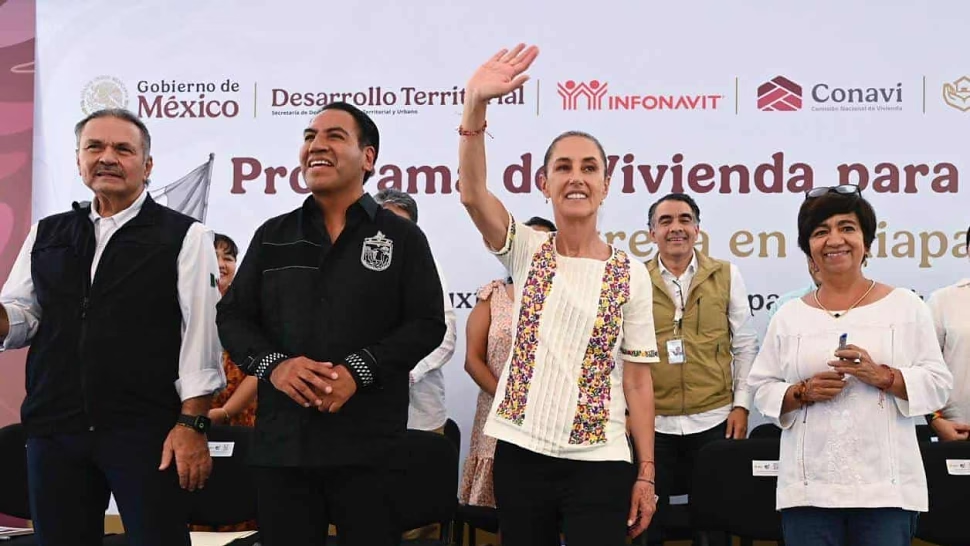
From Tuxtla Gutiérrez, Chiapas, President Claudia Sheinbaum highlighted that the Housing for Wellbeing program contributes about 1 percent to the national Gross Domestic Product (GDP). This, thanks to the jobs it generates in construction and related sectors.

“There is nothing happier that can make the President and her entire team than to see the joy on their faces for receiving a home today,” said Sheinbaum during the delivery of 48 homes in the Infonavit Lacantún development.

In addition, 401 settlement certificates from Fovissste and 503 deeds from Insus were delivered. The president stated that the program will benefit nearly 30 million people during her six-year term.

“Thanks to the Housing for Wellbeing program, it is contributing close to 1 percent of GDP to the country’s economic growth. And if we consider that each home employs at least 4 people, a very important number of jobs are being generated,” he pointed out.

Investment in Chiapas

The Secretary of Agrarian, Territorial and Urban Development, Edna Elena Vega Rangel, explained that in Chiapas 42 billion pesos are allocated to build 70 thousand new homes in the six-year period. Of these, 50 percent are already hired.

The general director of Infonavit, Octavio Romero Oropeza, reported that at the national level there are 420 housing complexes in 31 states, with 475 thousand homes. Of them, 190 thousand are already under construction, and 3,600 have been delivered. In Chiapas, Infonavit contemplates 34 thousand homes with an investment of more than 20 billion pesos.

Governor Eduardo Ramírez Aguilar thanked the President for the homes delivered, while the beneficiary Miguel Ángel Ramírez Trujillo expressed his gratitude for the future it represents for his family.

Continue reading

CRT foresees 85% of registered lines before staggered cuts

The CRT estimates that between 120 and 130 million cell phones will be registered before the progressive cut.

Mobile line registration: 85% will be linked before cuts

The Telecommunications Regulatory Commission (CRT) expects that between 120 and 130 million cell phones will be registered, which represents about 85% of the total active lines in the country.

Currently there are 144.6 million lines. Ricardo Castañeda Álvarez, general director of Regulatory Policy of the CRT, estimated that between 14 and 24 million will not be registered and will be deregistered as the process progresses.

The suspension process will begin on August 15. Lines ending in 0 will be deactivated first and then in stages until the end of the year, with the aim of avoiding technical saturations.

Castañeda explained that the extension was due to the risk that millions of users would not meet the original deadline, which would have generated operational complications similar to massive saturations in emergencies. He ruled out a new extension of the deadline.

He assured that the registry does not violate privacy because the information is managed by the operators. The main objective is to combat crimes such as extortion, fraud and virtual kidnappings.

Continue reading

They accuse the PAN of an irregular scheme in social support

Morena accuses the PAN of an alleged scheme to collect commissions on social programs.

Accusations for alleged diversion in social programs

Morena deputies in Mexico City accused PAN legislators of operating an irregular scheme through the sale and purchase of household products, supposedly disguised as a social support program in Tlalpan and Xochimilco.

According to the complaint, those involved acquired items such as water tanks, cisterns, solar heaters, washing machines, mattresses, laptops and screens through a civil association. They would then have resold them at higher prices to the inhabitants of those districts.

Morena spokesperson Paulo García stated that the mechanism included a triangulation of resources where the civil association paid commissions for each product delivered. In addition, legislators would have made profits between the purchase price and the resale price.

The Morenistas pointed out that the products carried names, photographs and partisan colors, which could constitute personalized promotion of public servants, prohibited by Article 134 of the Constitution outside of electoral campaigns.

The complainants announced that they will file complaints with the Electoral Institute of Mexico City so that the facts can be investigated.

For their part, PAN legislators denied the irregularities. They assured that these are operations between individuals through a foundation that sells products at low cost, without public resources.

The case has opened a debate about transparency and oversight of social programs in the capital’s mayors.

Continue reading