Sheinbaum announces a crucial year for Pemex in production and refining

The president highlights the resurgence of the state company and projects a crucial year for its energy transformation, after a notable improvement in its rating.

An Epic Resurgence: Pemex Under the Eye of the Storm and Hope

In the heart of a nation whose blood is crude oil, a president, Claudia Sheinbaum Pardo, stands as a herald of a renaissance. Not only does he celebrate, he proclaims it from the rooftops: the oil colossus, Petróleos Mexicanos (Pemex), has climbed mountains of financial distrust. All the rating agencies, those judges of economic destiny, have raised their verdict! A ray of light in the darkness of debt, a “it’s going very well” that echoes like a thunder of hope in the ears of an expectant country.

From Cuernavaca, Morelos, where the air carries history, the federal president launched her vision for the year ahead. It’s not just any year. It is 2026, a turning point etched into the calendar of destiny. A period where the work of the parastatal will not be just another task, but rather a fundamental crusade for energy sovereignty. Every pump, every refining, every decision, will carry the weight of Mexico’s future.

RelatedPemex celebrates refining recovery after two decades of decline

The Shadow of Debt and the Art of Salvation

But every epic has its scar. The debt with suppliers, a ghost of the past, was faced with the cunning of a strategist. Sheinbaum recalled, with the solemnity of someone revealing a state secret, the creation of a special financial instrument. A tool forged not only to settle accounts, but to guarantee the previous year’s investment, a bold move that set the stage for this crucial moment. It was a masterstroke, supervised under the watchful eye of the Secretariat of Finance and Public Credit (SHCP), transforming the knot of obligation into the springboard of opportunity.

“This 2026 the work of Pemex is going to be very important,” he declared, and his words were not a simple forecast, but a decree. The giant would awaken on multiple fronts: in the sacred extraction of hydrocarbons, both black gold and gas; and in the alchemy of industrial transformation. Refining, that symbol of self-sufficiency, has already reached the mythical figure of 80% of national consumption supplied by own production. And the gaze extends further, towards the promising and complex realm of the petrochemical industry.

“Pemex is doing very well, working very well,” he insisted, as if to ward off any doubt. The actions, he stated, were carried out with all the necessary framework, a meticulous rescue protocol that now bears unexpected fruits. This process has been so extraordinary that it has transcended borders. The president revealed, with a flash of national pride, that international awards and recognitions have rained down for the SHCP, specifically for the masterful management of Pemex’s overwhelming debt. “It has been done in a very professional manner and with a lot of creativity, and in a very transparent manner,” he stated, painting the picture of an administrative feat that mixes precision with inventiveness, all bathed in the raw light of transparency.

Thus, the narrative is woven between the danger overcome and the monumental promise. The year 2026 is not just a number, it is the stage where Pemex, that titanic character in Mexican history, fights its most decisive battle. It’s not just about barrels and balances; It is about the redemption of a symbol, the reaffirmation of a national pillar and the search for a future where energy bears the indelible seal of Mexico.

Do you think this will be the year of the definitive consolidation of Pemex? Share this news on your social networks and join the debate about the energy future of our country. Explore more analysis and special reports on the industry in our economics section.

Sheinbaum asegura que México y EU mantienen buena relación

Sheinbaum destaca señales de cooperación con EU y descarta ruptura pese a presiones.

Relación bilateral y soberanía

La presidenta Claudia Sheinbaum afirmó que existen muestras de que México y Estados Unidos mantienen una buena relación y avanzan en diversos temas, a pesar de las intenciones de grupos de ultraderecha que buscan la ruptura entre ambos gobiernos.

“La llamada del secretario Rubio ayer, las últimas declaraciones del embajador, la declaración del secretario de Seguridad Nacional de Estados Unidos, la visita del secretario de Marina a Estados Unidos, muestran que la relación continúa.”

Sheinbaum señaló que siempre está abierta la posibilidad de conversar telefónicamente con su homólogo Donald Trump. Enfatizó que no se puede permitir la injerencia ni la violación a la soberanía nacional, pero que también es necesario garantizar el respeto mutuo en los distintos temas bilaterales.

“No podemos permitir la injerencia ni la violación a nuestra soberanía; tenemos que garantizar el respeto mutuo, pero también la relación en los distintos temas que tienen que ver con el gobierno de México y Estados Unidos.”

La mandataria recordó que no existe un acuerdo de tercer país receptor para migrantes de nacionalidades distintas a la mexicana. Sin embargo, por razones humanitarias, el gobierno federal brinda atención y opciones a quienes deciden regresar a su país o quedarse en territorio nacional.

RelatedMéxico no permitirá injerencia, afirma Sheinbaum

El secretario de Relaciones Exteriores, Roberto Velasco Álvarez, detalló que su llamada telefónica con el secretario de Estado Marco Rubio transcurrió en un ambiente cordial y respetuoso. Abordaron la continuidad de la cooperación en seguridad fronteriza, los resultados en aseguramiento de fentanilo, la migración con respeto a derechos humanos y el seguimiento a la revisión del tratado comercial.

Velasco informó que hay aproximadamente 14 mil personas detenidas en centros del Servicio de Control de Inmigración y Aduanas (ICE) y la Oficina de Aduanas y Protección Fronteriza (CBP) de Estados Unidos, en espera de ser repatriadas o de una solución legal. México presentó varios escritos formales ante el Departamento de Estado, aunque aún no se ha informado el estatus de las investigaciones. Además, existen juicios en Estados Unidos sobre este tema en distintas etapas procesales.

Continue reading

American Society niega injerencia tras críticas de Sheinbaum

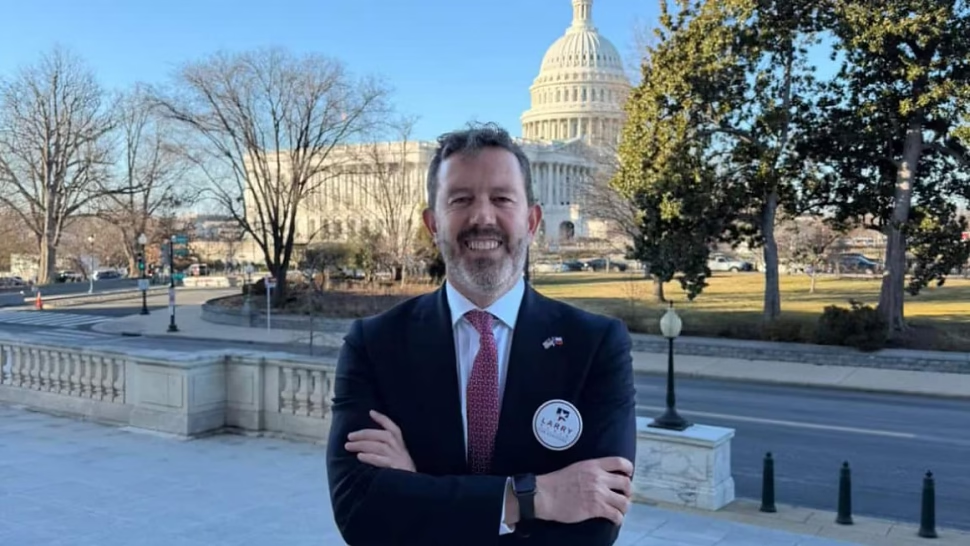
Larry Rubin rechaza acusaciones de injerencia; asegura que la cena buscó fortalecer lazos bilaterales.

Polémica por cena anual

El presidente de la American Society, Larry Rubin, se deslindó de cualquier intención de afectar la relación México-Estados Unidos. Así respondió a las señalamientos de la presidenta Claudia Sheinbaum, quien calificó la cena anual como un espacio donde podrían gestarse actos de injerencia política.

En conferencia de prensa, Rubin rechazó las acusaciones. Aseguró que el evento tuvo como objetivo fortalecer los vínculos bilaterales. Destacó que asistieron representantes de Morena, PAN y Partido Verde, lo que —dijo— demuestra su carácter plural.

RelatedExpert recommends Mexico limit rapprochements with Russia and China

Patrocinio de Grupo Salinas

El empresario también respondió a las críticas sobre la participación de Grupo Salinas como patrocinador. Precisó que el conglomerado únicamente financió una de las actividades culturales del evento. Sostuvo que la cena contó con múltiples patrocinadores y no responde a intereses políticos particulares.

La polémica surgió luego de que Sheinbaum cuestionara la reunión en su conferencia matutina. Consideró que ciertos sectores políticos y empresariales se congregan para influir en la relación bilateral y criticar al gobierno mexicano. Rubin negó categóricamente esas acusaciones.

Contexto bilateral

En medio de un contexto tenso en la relación México-Estados Unidos, marcado por recientes fricciones diplomáticas, la American Society insistió en que su labor desde 1942 ha sido promover el entendimiento y la cooperación entre ambos países.

Continue reading

Maestros de la CNTE bloquean Cuernavaca; exigen abrogación de ley ISSSTE

Miles de docentes exigen eliminar el sistema de cuentas individuales y regresar a pensiones solidarias.

Protestas magisteriales en Morelos

Este martes, contingentes de docentes de la Coordinadora Nacional de Trabajadores de la Educación (CNTE) realizaron bloqueos y toma de casetas en varias entidades. En Morelos, más de cuatro mil maestros marcharon en Cuernavaca para apoyar a sus compañeros en la Ciudad de México y exigir la abrogación de la Ley del ISSSTE de 2007.

Las afectaciones viales paralizaron gran parte del centro de la capital morelense durante horas. Una comisión negociadora se reunió con autoridades estatales en Palacio de Gobierno.

RelatedCNTE teachers block Pensionissste in demand of fair pensions

¿Qué demandan?

“La exigencia central es eliminar el sistema de cuentas individuales y regresar al régimen de pensiones solidarias”, explicó Julita Villalba, vocera del Movimiento Magisterial de Bases (MMB).

Aunque reconoció que existe una propuesta para modificar el esquema de Afores, insistió en que los trabajadores buscan recuperar un modelo que garantice mejores condiciones de retiro.

Los docentes pidieron a la presidenta Claudia Sheinbaum demostrar el carácter humanista de su gobierno y atender una demanda que consideran ignorada.

Próximas acciones

El movimiento anunció que las protestas continuarán. Mañana realizarán una nueva marcha de El Calvario al Zócalo de Cuernavaca. El jueves partirán de Plan de Ayala, a la altura del IMSS, hacia el centro de la ciudad. Además, un contingente viajará a la capital del país para reforzar las movilizaciones nacionales.

Las autoridades estatales no han emitido un pronunciamiento oficial sobre los acuerdos alcanzados en la reunión con la comisión magisterial.

Continue reading