Samuel García inaugurates the first stage of the Interserrana Highway

With the new San Roberto Bridge, trips to the south of the state are shortened by up to 90 minutes, boosting the regional economy.

Samuel García Gives ‘Play’ to the Interserrana Highway and Everyone Zooms in on the Lagoon

It seems that in Nuevo León things are moving faster than a viral TikTok video. Governor Samuel García, in his role as the maximum influencer of infrastructure, officially gave the ‘check’ to the first stage of the much-mentioned Interserrana Highway. Yes, that one that promises to be the most famous shortcut since we discovered keyboard shortcuts. The protagonist of this premiere was the San Roberto Bridge, a structure that, with its 853 meters in length, comes to bridge distances and, incidentally, to give a break to drivers who were already considering buying a pillow for the steering wheel.

The vibe was more like the inauguration of a new trendy spot than a formal event. Samuel, with that energy of someone who has just unlocked an achievement in real life, released the phrase that everyone was waiting for: “Now yes (…), the Interserrana is and is serious.”. Translation for mortals: after so many promises that were lost in limbo like an unanswered WhatsApp message, there is finally something tangible. And it is no small thing. We are talking about a saving of 121 kilometers on the journey to Monterrey. That, in real life time, translates into up to an hour and a half that you can dedicate to more productive things, like watching a series or simply not cursing at the traffic.

RelatedSamuel García announces 4,000 new transport units for November

Fewer Kilometers, More Memes: Connecting the South with the World (or at least with Mty)

But let’s be clear, this is not just so that the inhabitants of Galeana, Arramberri and Zaragoza get to the cinema faster. The real MVP here is freight transportation. Imagine the number of trucks that will no longer have to take the long turn, the one that seems like the preamble to a soap opera. Streamlining logistics means products can move with a fluidity that rivals fashion dances on Reels. Less time on the road equals lower costs and, hopefully, lower prices for consumers. It’s a chain of favors, but with trucks and asphalt.

And of course, the tourism angle could not be missing. It turns out that the south of Nuevo León hides natural gems that deserve more likes than a baby kitten. The Labrador Lagoon and the Zaragoza Waterfalls are there, waiting to be discovered by hordes of millennials and centennials eager for content for their Instagram stories. With this new route, getting to these paradises will be as easy as ordering food through an app. The promise is clear: promote regional commerce and tourism with an infrastructure that, hopefully, lives up to selfies.

The investment is no small feat: 450 million pesos which, we hope, have been invested with the same precision with which we choose a filter. This bridge is just the first chapter in a saga that promises to extend for 26 more kilometers until reaching the mysterious and futuristic Tokyo Bridge (does the name suggest it will have neon lights and Japanese technology? We want to believe so). The ultimate goal is to connect Federal Highway 57 with Highway 85, weaving a road network that unites the region with the northern border. Basically, it’s like connecting the servers better so that the game doesn’t lag.

In short, this inauguration is more than cutting a ribbon. It is a concrete step (pun intended) to improve connectivity in a state that continues to grow. It is a commitment to making life a little less complicated for those who move around the region, whether for work or pleasure. Now we just have to wait for the rest of the work to progress as quickly as trends on the internet change.

Can you imagine visiting the waterfalls of Zaragoza without an epic journey? Share this news with that friend who is always planning the next getaway and discover more projects that are transforming infrastructure on our portal.


Samuel García inaugura la primera etapa de la carretera Interserrana

Massive security reinforcement and alcohol ban at the Azteca

56,000 police officers and alcohol restriction for the game at the Azteca.

Measures for the Mexico-Czech Republic match

The government of Mexico City announced an unprecedented security operation for this Wednesday’s game at the Azteca stadium. 56,000 personnel will be deployed, five times more than the 11,219 employed last week.

The decision responds to the celebrations of the previous Thursday, when some 700,000 people gathered in the capital after Mexico’s victory over South Korea. Although there were no injuries, nearly 40 tons of garbage were collected in the Ángel de la Independencia and the Zócalo.

The Secretary of Security, Pablo Vázquez, detailed that 7,500 police officers will guard the Azteca stadium. Another 3,275 will be in the Zócalo and 4,200 on Reforma Avenue. The objective is to protect players, referees, authorities and fans.

In addition, the Secretary of Government, César Cravioto, reported that starting at 3 p.m. on June 24, a ban on the sale of alcohol will take effect for sixteen hours. Applies to the Historic Center and five neighborhoods of Cuauhtémoc.

Sales will only be allowed in restaurants, hotels and private clubs, accompanied by food. Convenience stores and supermarkets are excluded. The fines for non-compliance amount to up to 293,275 pesos (about $17,251).

The Mexican Alliance of Transporters Organization (AMOTAC) called for mobilizations on highways in the 32 states and blockades in the capital to protest against the violence. The operation also considers these protests.

Continue reading

UNAM, new WHO collaborating center in oral health

The WHO recognizes UNAM as a reference in oral health and aging.

International recognition for UNAM

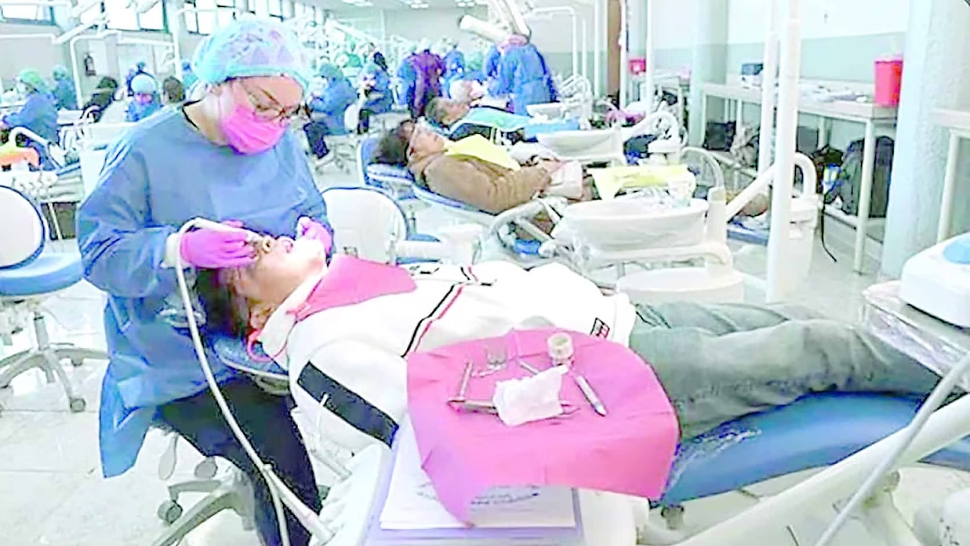
The World Health Organization (WHO) designated the Department of Oral Public Health of the UNAM Faculty of Dentistry as a Collaborating Center in Oral Health and Aging. The distinction is valid for four years.

With this appointment, the highest educational institution consolidates itself as a regional reference in the comprehensive care of older adults.

Implications of the appointment

The recognition will allow university specialists to participate in the development of public policies focused on improving the quality of life of the elderly.

In addition, they will promote strategies to promote among older adults and caregivers the importance of maintaining adequate oral health as an essential part of general well-being.

The designation places UNAM on a level of technical cooperation with the WHO, which opens opportunities to influence global guidelines on aging and oral health.

Continue reading

Digital sexual exploitation affects 1.6 million adolescents in Mexico

1.6 million adolescents in Mexico suffer online sexual exploitation every year.

The report reveals alarming figures

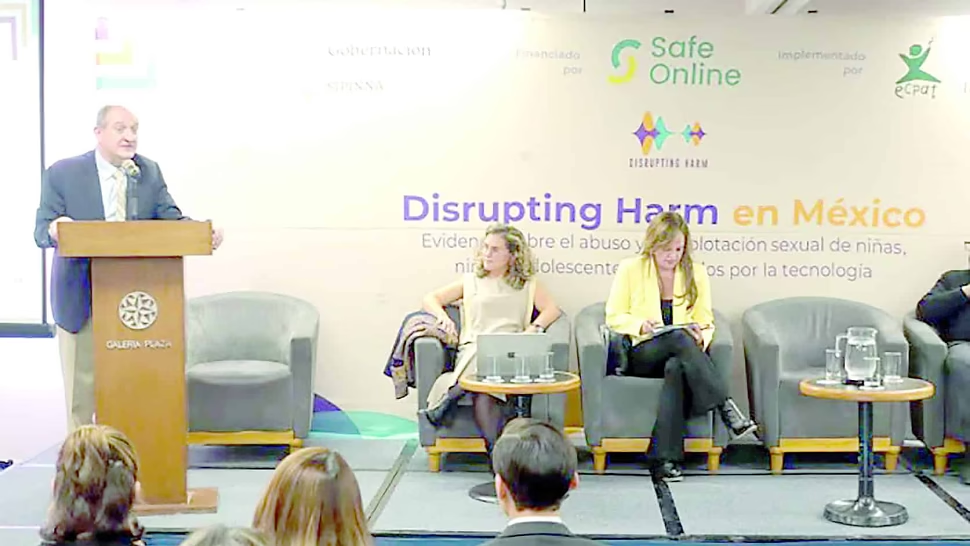
Unicef, ECPAT International and Interpol published the study “Disrupting Harm México”, which indicates that one in eight adolescent Internet users in the country – around 1.6 million – experienced sexual exploitation facilitated by digital technologies for a year.

67% of cases occurred online only, mainly on social networks and platforms. However, violence is not limited to the virtual sphere: in almost two out of every three situations, the victims knew their attackers, who were usually friends, partners or family members.

The report documents serious under-reporting. 32% of victims did not tell anyone what happened out of shame or fear, and less than 1% filed a formal complaint. This reflects normalization and silence around these attacks.

Consequences and call to action

In mental health, the consequences are profound. Those who suffered this type of violence are 15 times more likely to self-harm and 12 times more likely to have thoughts about their own death, compared to those who did not have that experience.

Fernando Carrera, Unicef ​​representative in Mexico, asked to reinforce prevention and responsibility of digital platforms. Lorena Villavicencio Ayala, from SIPINNA, stated that the State must guarantee the safety of girls, boys and adolescents in digital environments.

Continue reading