Samuel García deploys school kits in state educational strategy

An unprecedented deployment at Technical Secondary School 68 marks the beginning of a school year that promises to transform the future of thousands.

A Definitive Episode in the Education of Nuevo León

In the vibrant heart of Monterrey, an event of titanic proportions was about to unfold. Governor Samuel García, a man whose name resonates like thunder in state politics, was preparing for a mission that would transcend the mere protocol act. It was not simply about distributing school supplies; It was the launch of a monumental offensive to fortify the very foundations of basic education in the entity. The chosen setting could not be more symbolic: the Technical Secondary School 68 “Profa. María Guadalupe Cantú de Anda”, a bastion of hope and knowledge.

The atmosphere was charged with a palpable electricity, the kind that only precedes the moments that will remain recorded in history. Every backpack, every pair of sneakers, every meticulously stacked notebook represented a weapon in the battle against ignorance and inequality. This was not a charitable gesture; It was a declaration of war against educational backwardness, a bold bet on the destiny of an entire generation.

RelatedSamuel García announces 4,000 new transport units for November

The Master Strategy Behind the Symbolic Gesture

Flanked by his loyal Secretary of Education, Juan Paura García, the state leader revealed the master plan with the conviction of a general haranguing his troops. Nuevo León, he proclaimed with a firm voice, is no longer competing; leads. It has been crowned, nothing less, as the state with the lowest educational gap in the entire nation, a beacon of academic excellence whose brilliance blinds the rest of the country. The secret to this epic victory? An unparalleled inclusive system, a network of more than 1,300 schools that operate under the revolutionary modality of Full-Time Schools and Extended Day.

But García’s ambition knows no limits. With the passion of a visionary, he described an educational ecosystem so vast and complete that it seems straight out of a utopia. From the cutting-edge CEPAR, a sanctuary for neurodiverse minds, to an early education network that cradles babies from 40 days of age, every link in the chain has been forged with precision. “We have now been in government for 4 years,” he declared, with his eyes set on a horizon of glory, “and we promise that the fifth and sixth will be even better.” A promise that echoed in the air like an unbreakable oath.

The difference, he explained in meticulous detail, is abysmal. While other states settle for the basics, in New Leon schools knowledge is extended for six intensive hours, a sacred time dedicated not only to core subjects, but to a universe of extracurricular activities where English and technology reign supreme. It is a total immersion, a journey with no return towards excellence.

The climax of this educational epic is approaching. The governor made a revelation that made everyone present hold their breath: his administration will move heaven and earth to ensure more scholarships at the Autonomous University of Nuevo León (UANL). It is the key that will open the doors to a world of better opportunities for those young heroes who are about to conquer their secondary education. The future is not a promise; It is a reality that is being built brick by brick.

For his part, the Secretary of Education, Juan Paura García, outlined the roadmap with the precision of a strategist. The triumph will be consolidated on three indestructible pillars: security protocols that will protect the sanctuaries of knowledge, the early diagnosis of socio-emotional problems that threaten the youngest minds, and a connectivity infrastructure that will weave an indestructible digital network. Each point, a master move in this chess for the future.

And then, came the great outcome. The final figure, the number that summarizes an entire epic in a single devastating statistic: 17,329 supports. An army of uniforms, tennis shoes, backpacks and school supplies that went directly into the hands of their recipients, the protagonists of this story. The institutions that witnessed this historical moment, such as the Technical Secondary School 34 and the “Jaime Torres Bodet”, “Pípila” and “Sor Juana Inés de la Cruz” Kindergartens, became eternal guardians of this legacy.

This was more than an event; It was the crucial chapter in a saga that is redefining the future of an entire state. Education in Nuevo León has a new face, and comes loaded with backpacks, supplies and the indelible promise of a radiant tomorrow.

Do you think this is the strategy that will revolutionize education in Mexico? Share this story on your social networks and make the conversation about the future of education heard everywhere. Explore more content about the initiatives that are transforming our country.
US Commander meets with Sedena and Semar in Veracruz

Senior military commanders of Mexico and the United States review joint strategies against organized crime.

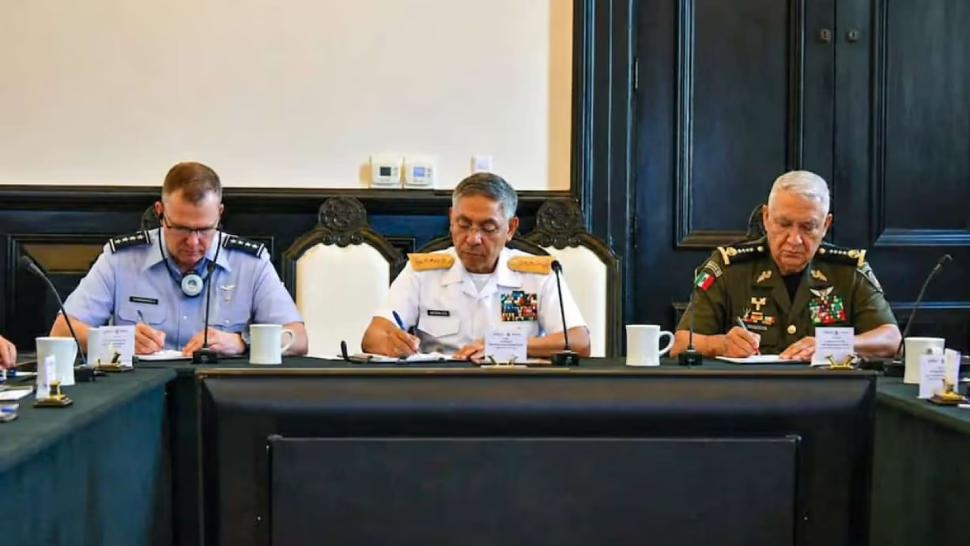
The commander of the United States Northern Command, General Greg Guillot, visited Mexico to meet with senior officials from the Secretariat of National Defense (Sedena) and the Secretariat of the Navy (Semar). The meetings occurred on July 22 in Veracruz.

Bilateral security cooperation

Guillot met with the head of the Sedena, General Ricardo Trevilla, and with the Secretary of the Navy, Admiral Raymundo Pedro Morales. The US embassy described the meetings as progress in the defense relationship between both countries.

Among the topics addressed are specialized training in special operations and against organized crime, the exchange of information, and cooperation to counter unmanned aerial systems. The North American Maritime Security Initiative was also reviewed.

“The security of North America depends on the strength of its alliances and the ability of its members to act with common objectives,” said General Guillot.

Both nations reiterated their commitment to expanding cooperation, respecting sovereignty, territorial integrity and shared responsibility for security.

Continue reading

T-MEC negotiations: tariffs and regional content on the table

Third round of dialogue between Mexico and the US addresses labor mechanisms and strategic rules.

Key points from the third round

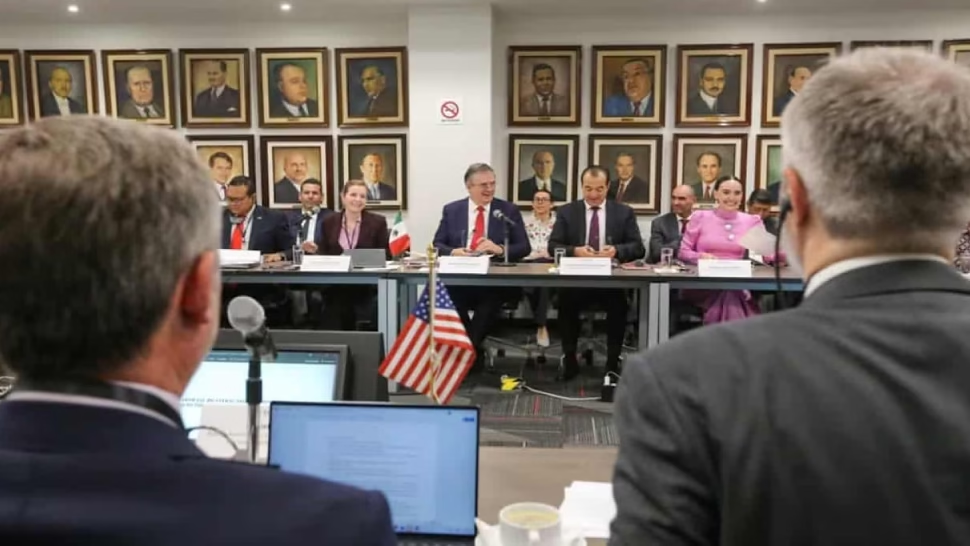
Between July 21 and 23, Mexico and the United States held the third round of negotiations towards the review of the T-MEC. The central issues were tariffs, labor mechanisms, regional content and rules for sectors such as automotive, steel and aluminum.

The president of the Business Coordinating Council (CCE), José Medina Mora, explained that it was proposed to modify the Rapid Response Labor Mechanism to make it reciprocal. Currently, the investigations only apply to companies in Mexican territory.

“It is necessary that the mechanism be applied equitably between both countries,” said Medina Mora.

Another point of discussion was the United States’ intention to increase American content in products made in the region. Mexico defends the concept of regional content and rejects changes that reduce trilateral integration.

The leader added that the seasonality of agricultural products and the impact of tariffs on steel, aluminum and the automotive industry were also reviewed. Some US automakers in Mexico face higher export costs compared to competitors from Japan, Korea and Europe.

For his part, the president of Coparmex, Juan José Sierra, expressed uncertainty regarding the possibility of annual reviews of the treaty, but valued the dialogue between the partners. He indicated that Mexico requires strengthening legal and energy security and the conditions to attract investment.

“It is positive that communication continues, but we need certainty for investors,” said Sierra.

Concamin pointed out that the joint statement between the Secretary of Economy, Marcelo Ebrard, and the US trade representative, Jamieson Greer, confirms that both countries maintain an institutional work path.

Continue reading

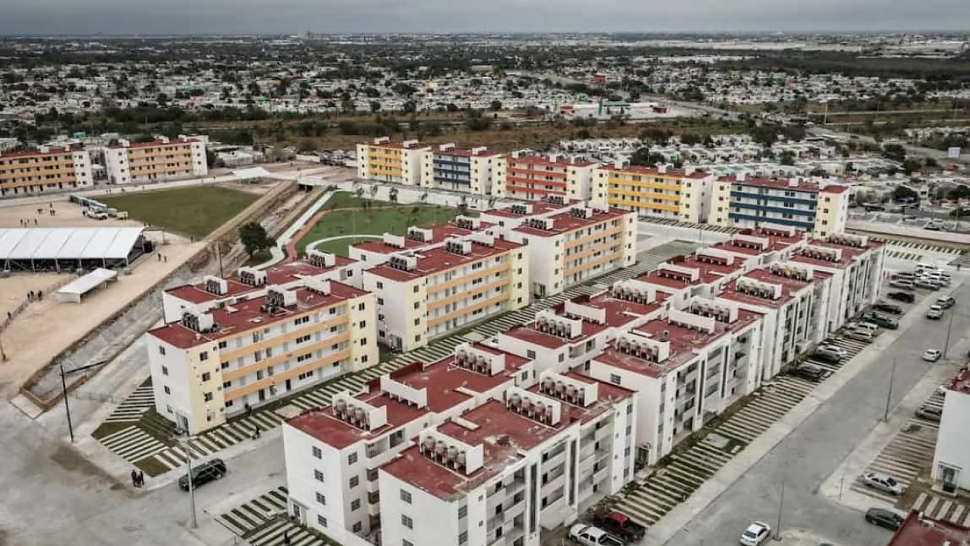
Registration of Housing for Wellbeing 2026 begins

Conavi opens registration in 2026 for subsidized housing in 26 states.

The National Housing Commission (Conavi) launched the 2026 call for the Housing for Well-being Program. The objective: to facilitate access to a decent home for low-income families. Registration will be from July 20 to August 2, in modules installed in 26 entities.

Requirements and financing

The scheme adjusts the monthly payments to the family income, so that the payments are accessible. It is aimed at those who cannot access traditional mortgage loans. Those interested must comply: not have their own home, not have current credit from Infonavit, Fovissste or another institution, and receive less than 17,800 pesos per month. Official identification, CURP, proof of address and income are also required.

Participating municipalities

The modules will only be in locations where Conavi will build projects in 2026. Among them: La Paz (Baja California Sur); Champotón (Campeche); Tapachula and Tuxtla Gutiérrez (Chiapas); Aquiles Serdán (Chihuahua); Piedras Negras and San Pedro (Coahuila); Gómez Palacio (Durango); Axapusco and Cuautitlán Izcalli (State of Mexico); Comonfort, Dolores Hidalgo, Pénjamo, San Diego de la Unión, San Luis de la Paz and Tarimoro (Guanajuato); Acapulco de Juárez, Chilpancingo de los Bravo, Coyuca de Benítez and Técpan de Galeana (Guerrero).

The list also includes municipalities of Hidalgo, Jalisco, Michoacán, Nayarit, Oaxaca, Puebla, Querétaro, Quintana Roo, San Luis Potosí, Sinaloa, Sonora, Tabasco, Tamaulipas, Tlaxcala, Veracruz, Yucatán and Zacatecas. Tepic, Xalisco, Puebla, Tehuacán, Tulum, San Luis Potosí and Valladolid stand out.

The program seeks to serve those who need it most, in a context where access to housing continues to be a challenge for millions of Mexicans.

Continue reading