Rubio and Jaishankar talk to reduce bilateral friction

Rubio and Jaishankar seek to ease commercial and strategic tensions between both nations.

Meeting in New Delhi to unblock differences

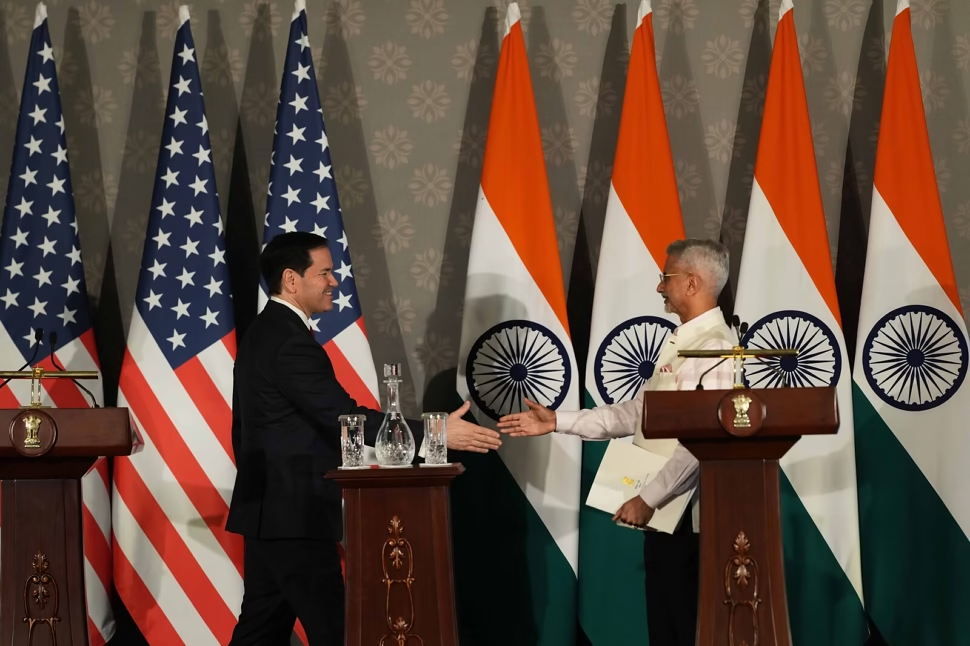
The Secretary of State of the United States, Marco Rubio, and the Foreign Minister of India, Subrahmanyam Jaishankar, met this Sunday in New Delhi. The meeting seeks to stabilize a relationship that is going through its most tense moment in more than two decades.

Frictions have intensified due to the tariff policies promoted by Donald Trump, which raised taxes on Indian products. Added to this is New Delhi’s unease over Washington’s rapprochement with Pakistan and China, as well as American pressure for India to reduce its purchases of Russian oil.

RelatedTrump imposes 50% tariff on India for buying Russian oil

During a joint conference, Rubio stated:

India remains one of the most important strategic partners of the United States.

He added that he hopes to reach a bilateral trade agreement soon. Jaishankar, for his part, stressed that both nations act according to their national interests and defended the need to maintain multiple energy suppliers to guarantee affordable prices.

Commitment to safe maritime routes

Both officials agreed on the importance of keeping international shipping routes open and safe, especially given the tension in the Strait of Hormuz. India insisted it will continue to diversify energy sources as it seeks stability in markets and protection for global supply chains.
Iran conditions nuclear dialogue on cessation of Israeli attacks

The Iranian absence in Switzerland slows down talks on the nuclear program and the Strait of Hormuz.

Pause in conversations

The attempt by the United States and Iran to begin talks on Tehran’s nuclear program and the restoration of oil transit in the Strait of Hormuz was suspended. Iranian officials did not attend the planned meeting in Switzerland.

According to regional sources, Iran conditioned the resumption of dialogue on Israel stopping its attacks against Hezbollah in Lebanon. The situation occurred while both parties were analyzing a provisional agreement that opened two months of negotiations.

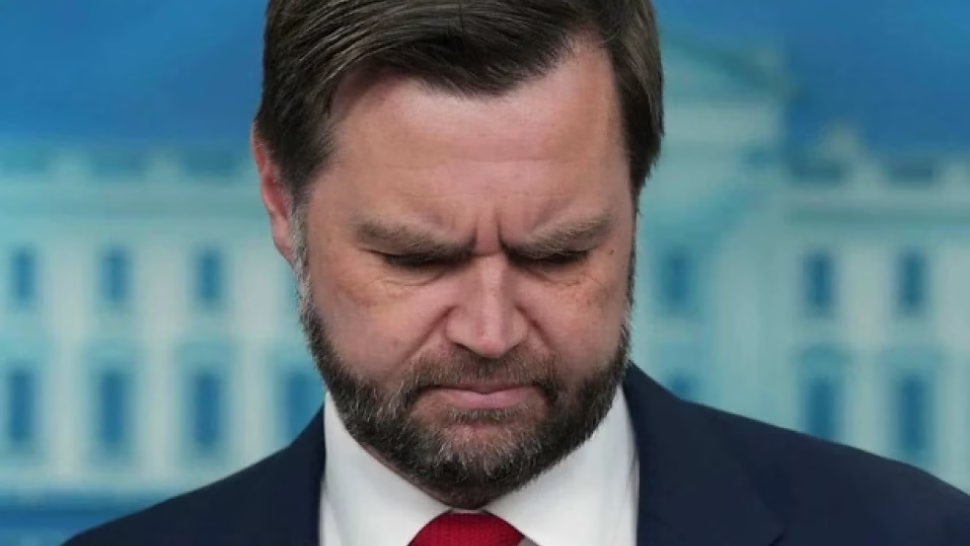
US Vice President JD Vance was scheduled to lead technical talks in Switzerland, but the White House postponed his trip. Washington alleged logistical complications; However, sources indicated that the Iranian position influenced the decision.

Details of the provisional agreement

The pact provides for limits on the Iranian nuclear program and international supervision of enriched material. Differences persist over their scope. While sectors in the United States question the agreement, Iran considers that it is coming to the dialogue from a more solid position.

Tension increased after new clashes in southern Lebanon. Authorities reported deaths from Israeli airstrikes and casualties among Israeli soldiers. Although Israel and Hezbollah are not part of the bilateral agreement, their actions directly affect the negotiations.

The situation reflects how regional tensions affect the future of the Iranian nuclear program and the talks between the powers involved.

Continue reading

Shipwreck in Libya leaves 11 migrants dead and 40 missing

Eleven dead and 40 missing after boat capsizes off the Libyan coast.

Tragedy in the Mediterranean

A boat with dozens of migrants capsized off the eastern coast of Libya. The accident occurred on June 12, but was not reported until this week by the monitoring group Abreen.

The preliminary balance is 11 human remains recovered, 40 missing people and 10 survivors, according to the organization.

Rescue work

Libyan coast guard and Red Crescent teams in Tobruk have recovered bodies that washed ashore in recent days. Searches continue in the area.

Images released show the rescue efforts. The Mediterranean remains a deadly route for those trying to reach Europe.

Continue reading

Millennial festival brings together thousands in China and Taiwan

Thousands celebrate the Dragon Boat Festival with regattas and ancient traditions in China and Taiwan.

Millenary traditions in motion

Mainland China, Hong Kong and Taiwan were the scene of the Dragon Boat Festival. Regattas, dances and cultural activities brought together thousands of people.

With more than two thousand years of history, the celebration dates back to ancient beliefs about health, protection and harmony with nature. It also honors the legend of the poet Qu Yuan.

Families prepared foods such as zongzi and followed customs such as five-color bracelets and home remedies for good health.

In Beijing, boat competitions brought together hundreds of athletes and thousands of spectators, with lion dances, martial arts and craft fairs.

Authorities and experts pointed out that the festival has evolved adapting to modern urban life, but maintains its essence as a tradition that reinforces cultural identity and well-being aspirations in Chinese society.

Continue reading