Ronald Johnson confirms historic reduction in illegal border crossings

The US ambassador reveals shocking figures and strategic alliances on the southern border.

A dramatic turn on the border: the fall that changed everything

In a turn that shook the foundations of immigration policy, Ronald Johnson, the United States ambassador to Mexico, released a statement that resounded like thunder in the midst of the storm. With the solemnity of a general announcing an epic victory, he confirmed what many doubted: illegal crossings plummeted by 95%, a figure that seems taken from an impossible dream. How was this feat accomplished? What hidden forces pulled the strings of this historic decline?

The invisible battle: Trump, Biden and the data wall

From the shadows of diplomacy, Johnson, recently arrived in Mexican lands but with the determination of a veteran, raised his voice in X, the digital public square where words become swords. Not only did he back up the claims of Tommy Pigott, spokesman for the State Department, but he also drew a bloody line between two eras: the mandate of Donald Trump, where the border became a battlefield, and the administration of Joe Biden, under whose sky the numbers plummeted. “We protected the border,” he declared, in a tone that mixed pride and warning. “Each percentage represents lives saved, futures secured.”

RelatedUS Ambassador confirms 95% reduction in illegal crossings

But this wasn’t just about the United States. No, the ambassador weaved a larger network, speaking of regional allies, of a shield that extended beyond visible borders. Had Mexico, that giant always in the spotlight, finally turned the keys to cooperation? Johnson’s words burned with a clear message: “Mexico has shown increasing cooperation.” A simple phrase, but loaded with a weight that could tip the balance of international relations.

The diplomatic curtain: Rubio, secrets and hidden signals

On Friday, May 23, the ambassador, like a chess player revealing his checkmate, aligned himself with Marco Rubio, US Secretary of State, whose words had sown the seed of this revelation. “National security”, “shared efforts”, terms that hid battles fought in closed rooms, far from the eyes of the public. What agreements were signed between the lines? What promises were whispered in the dark?

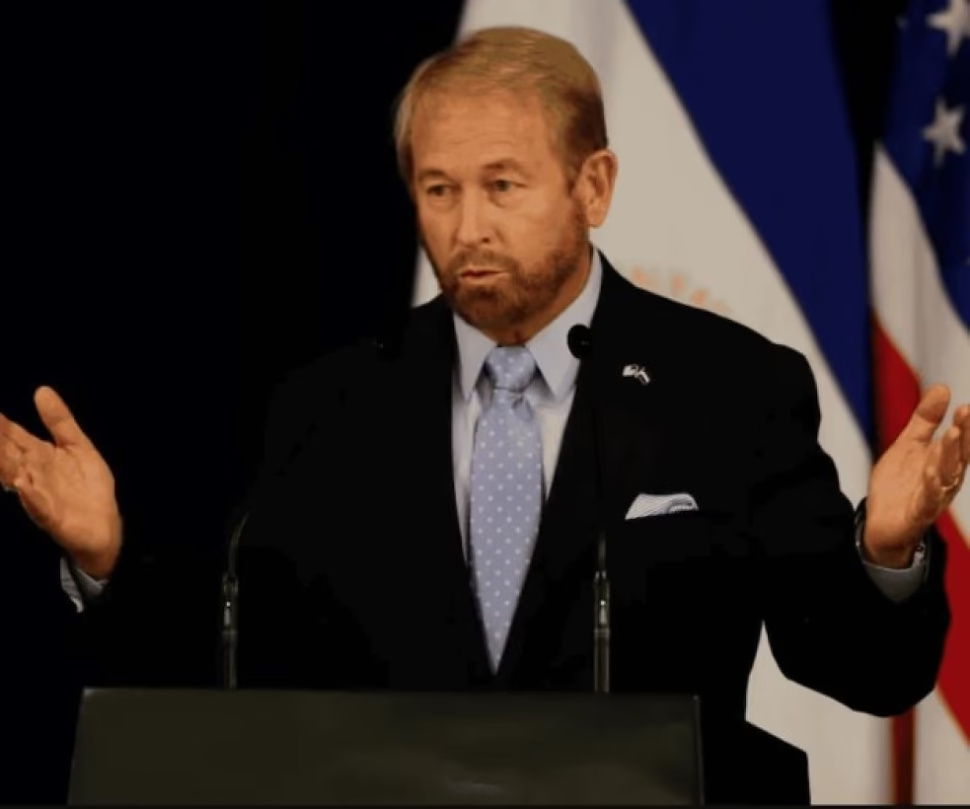
The image attached to the official tweet, a cold and calculated screenshot, showed Johnson as a modern general, his face imperturbable but his eyes shining with the satisfaction of someone who knows he has won a battle, even if the war continues. Photography, more than proof, was a symbol: technology and diplomacy, united in a deadly dance against chaos.

And while the world digests these figures, a question hangs in the air, heavy as a slab: is this the end of an era, or just the calm before a bigger storm?

Share this diplomatic impact and discover more about the alliances that are redefining the border! Explore our exclusive content on global security and international cooperation.
Leo XIV criticizes the ease of financing wars and not hunger

The pontiff warned about the drop in financing for food assistance from 2022.

Call from the pontiff in the face of the food crisis

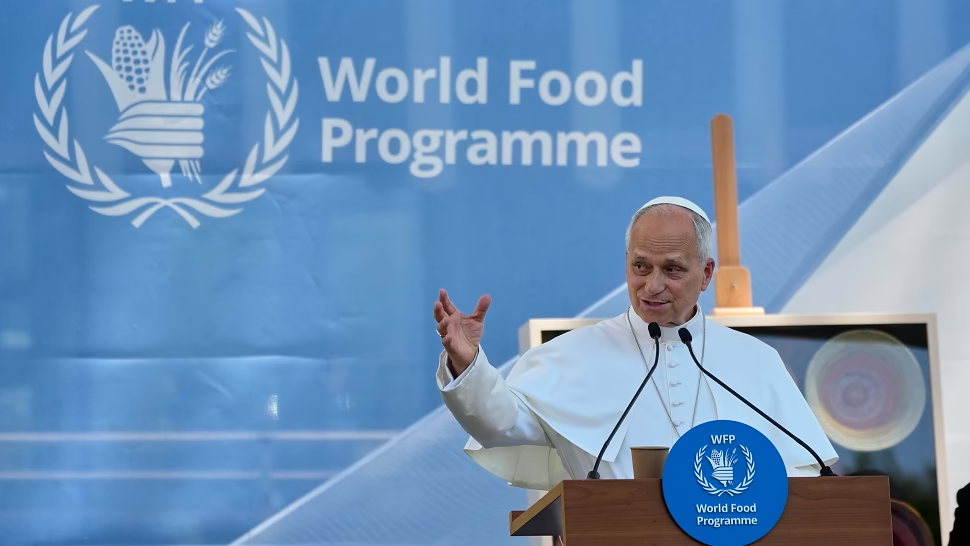
Pope Leo XIV urged governments to allocate more resources to combat hunger. During a meeting in Rome with the UN World Food Program (WFP), he pointed out that it is easier to finance armed conflicts than to guarantee food for millions of people in vulnerable situations.

The pontiff warned that political and administrative obstacles delay humanitarian aid. In contrast, military spending is advancing with fewer obstacles. This paradox reflects a serious inequality in global priorities.

Leo XIV indicated that funding for food assistance has decreased considerably since 2022. Although needs increased due to conflicts, climate crises and economic problems, funds did not grow at the same pace.

He highlighted that recent international contributions, such as the one announced by the United States for the WFP, will benefit millions of people. However, he stressed that there is still a significant gap to cover the necessary resources.

Before the UN body, the pope called on world leaders to place human dignity at the center of their decisions. Strengthening international cooperation is key to confronting hunger and inequality.

Continue reading

Explosion at gas plant in Qatar leaves 13 dead

Explosion at gas terminal in Qatar leaves 13 dead and dozens injured.

Explosion in Ras Laffan: 13 dead and dozens injured

An explosion rocked the gas export terminal in Ras Laffan, one of Qatar’s most important energy facilities. The preliminary balance is 13 people dead and dozens injured.

The incident occurred while workers were trying to resume operations in the area. Work had stopped after previous clashes related to the conflict between Qatar and Iran.

Details of the accident

State-owned Qatar Energy confirmed that the explosion originated at the Barzan gas supply facility. The full extent of the damage caused by the fire is still unknown.

Ras Laffan is home to one of the world’s leading gas liquefaction plants. Disrupting its operations could lead to tensions in global energy markets, given that Qatar is a key exporter of natural gas.

Local authorities are investigating the causes of the explosion. It is not ruled out that technical problems or human failures may have contributed to the incident.

The accident adds to a context of instability in the region. The war with Iran had already affected the Qatari energy infrastructure, and this new fact complicates the recovery of the sector.

Continue reading

Ebola in Congo: 1,003 cases and 254 deaths from rare virus

Ebola outbreak reaches 1,003 confirmed cases in Congo. Difficulties in containing the virus.

Ebola outbreak in eastern Congo

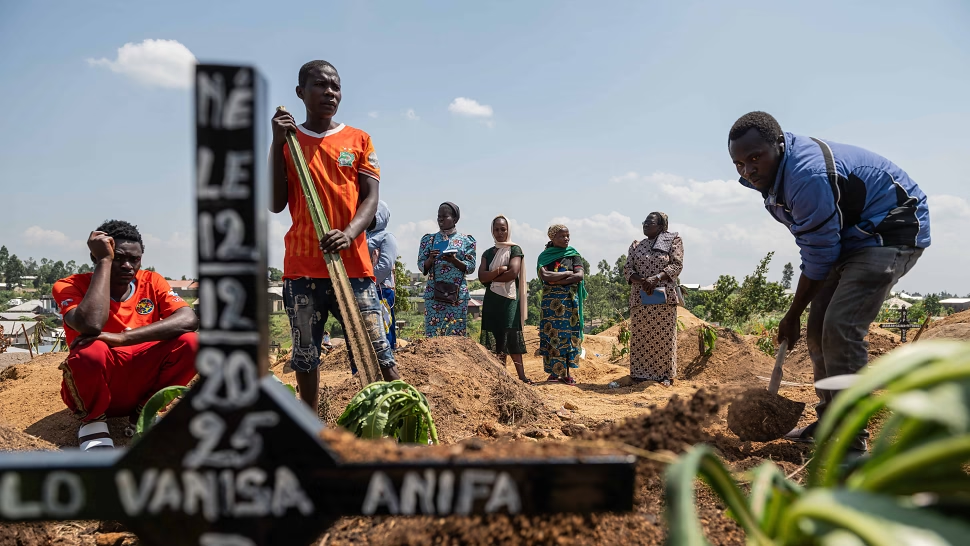
The Ebola outbreak in eastern Democratic Republic of the Congo now has 1,003 confirmed cases. This is reported by the health authorities. Of that total, 254 people have died.

The Congo Ministry of Health indicated that since the outbreak was declared on May 15 in Ituri province, 100 people have recovered. However, 365 patients remain hospitalized or in isolation due to the seriousness of the situation.

A virus without specific treatment

Authorities warn that this outbreak is caused by the Bundibugyo virus, a rare strain. There is no vaccine or specific treatment for this variety. Therefore, they fear that the outbreak will be more extensive than what has been recorded so far. They recognize that the peak of infections has not yet arrived.

Tracing contacts of infected patients remains a challenge. This complicates the containment of the virus and the protection of the population.

Continue reading