Evaluation of the Institutional Response to an Extreme Meteorological Event
Less than twenty-four hours after the torrential rainfall that impacted the Atlamaya neighborhood, in the Álvaro Obregón mayor’s office, a comprehensive recovery operation began. The meteorological phenomenon, characterized by its intensity and short duration, resulted in the direct impact of ten homes and eight vehicle units, according to the official report of the local authorities. The coordinated response between the territorial demarcation and the Government of Mexico City was deployed quickly to assist the residents of this private area.
According to sources from the Secretariat of Comprehensive Risk Management and Civil Protection (Segiagua), a contingent of approximately eighty workers, distributed among personnel from the mayor’s office and the capital’s government, was mobilized to provide logistical and humanitarian support. The intervention strategy focused on two main axes: cleaning public roads and direct assistance to neighbors.
Technical Cleaning and Risk Mitigation Operations
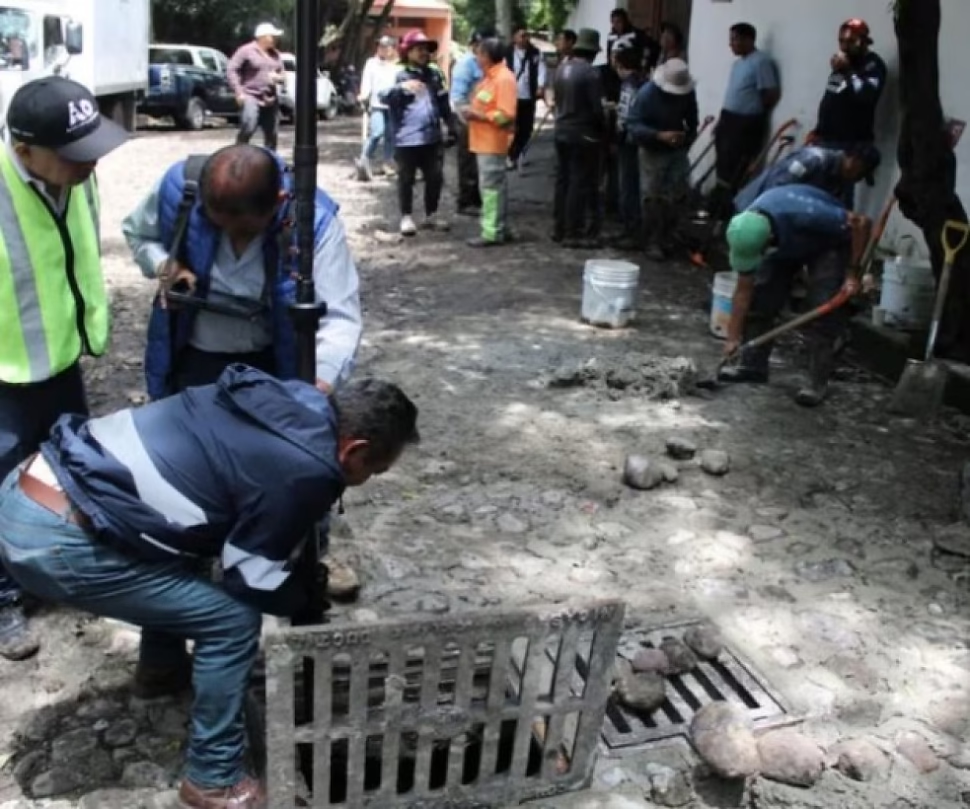
The cleaning operation used two large-capacity solid waste collection vehicles to remove the accumulated sediment. The personnel, equipped with shovels, proceeded to remove the mud deposited on Río San Ángel street, material that arose from the saturation of the soil and surface runoff during the downpour on Sunday afternoon-night. Subsequently, this material was placed in a controlled manner on the trucks.
To guarantee pedestrian and vehicular safety, a deep cleaning phase was implemented using high pressure hydrowashing equipment. This action aimed to eliminate the residues of earth and mud adhered to the paving, a crucial preventive measure to avoid accidents due to slipping on a surface that remained significantly slippery. The applied methodology demonstrates a clear understanding of the secondary risks that persist after a flood event.
Humanitarian Assistance and Damage Assessment
At the same time, teams from the Álvaro Obregón mayor’s office carried out a house-to-house tour to offer direct support to the inhabitants. This support materialized in the distribution of drinking water and the provision of labor to assist in the removal of household goods and belongings that were flooded on the ground floors of the homes. The citizen evaluation of these efforts has been positive. Beatriz Ortega, president of the Atlamaya settler committee, corroborated the effectiveness of the response: “They are working with great efficiency, they have offered us their help from the first moment, they are here at the foot of the canyon and they are not leaving.”
Meanwhile, the specialized personnel of Segiagua continued their clearing work on the roads, a fundamental task to completely restore circulation and prevent new flooding. Mayor Javier López Casarín provided a precise quantification of the meteorological event, pointing out that during Sunday afternoon there was a fall of approximately five million cubic meters of water over the city, of which two million were concentrated in Álvaro Obregón. This extraordinary volume of water exceeded the absorption capacity of the land and the conduction capacity of the sanitary drainage of Río San Ángel, whose collapse was the determining factor that exacerbated the damage reported to the ten homes and eight cars.
This incident highlights the vulnerability of urban infrastructure to high-intensity climate phenomena and the criticality of storm drainage systems. The institutional response, although agile, also invites deep reflection on the need for continued investments in resilient infrastructure and updated risk management plans that consider extreme weather scenarios, increasingly frequent due to climate change. Collaboration between citizens and government is revealed, once again, as an essential pillar for community recovery.
Did you find this analysis on emergency management useful?Share this article on your social networks to inform more people about the importance of preparedness for natural disasters and explore more related content on our portal.