They rescue 700 victims of trafficking in a ranch in Guanajuato

An unprecedented operation uncovers inhumane conditions on an agricultural ranch, revealing a network of exploitation.

The operation that shook Mexico

In a twist worthy of the darkest nightmares, the authorities broke into an agricultural ranch in Dolores Hidalgo, Guanajuato, where time seemed to have stopped in the cruelest of injustices. There, among the dust and suffering, 700 souls cried out in silence, trapped in a web of exploitation and hopelessness. Children, babies, women and men, all victims of a system that had forgotten them.

A hell behind the camp gates

The scenario was Dantesque: overcrowding, inhumane conditions, dishes and food scattered on the floor like crumbs of trampled dignity. The victims, coming from Guerrero, Chiapas, Oaxaca and Veracruz, carried with them not only the weight of forced labor, but also the invisible scars of human trafficking. The Attorney General’s Office of the State of Guanajuato (FGEG) did not hesitate to describe the place as an epicenter of horror, where labor exploitation and violation of human rights were commonplace.

RelatedThey rescue 22 minor victims of labor exploitation in Cancun

But fate had another unexpected twist in store: among the rubble of misery, the authorities discovered narcotics in the possession of one of those responsible, thus opening a new line of investigation that promised to unravel an even more sinister network.

The battle for justice

This operation was not the work of chance, but the result of a meticulous strategy that brought together the best of the security forces: from the National Guard to the Municipal Police, including Civil Protection, the Red Cross and the Human Rights Ombudsman. Each of these anonymous heroes contributed their grain of sand to restore hope to those who had lost it.

The victims received immediate medical and psychological attention, a ray of light in the midst of so much darkness. “This is just the beginning,” declared the FGEG, underscoring its unwavering commitment to justice and the protection of the most vulnerable.

As the investigation continues, one question hangs in the air: how many places like this are still hidden in plain sight? The answer, as in the best tragedies, remains to be written.

Does this story move you? Share it and help us make the fight against human trafficking visible. Explore more content like this and join the conversation.

Weapons and explosives seized in Culiacán; there is a detainee

Arrested in Culiacán with weapons, explosives and stolen vehicle.

Operational in the Los Angeles sector

CULIACAN, Sin. — Elements of the National Guard detained a civilian during a patrol in the Los Angeles sector, northwest of the capital of Sinaloa. The discovery occurred near a private housing unit.

Upon noticing the presence of the authorities, the individual made an evasive maneuver. He was chased and caught up for a search.

Weapons, chargers and explosives

In the truck he was driving—a 2022 model Mazda CX-5, white, reported stolen—two automatic rifles, a pistol, nine supplied magazines and a container with improvised explosive devices, still unquantified, were found.

The detainee was placed at the disposal of the Attorney General’s Office, which will open an investigation file. The vehicle was also seized with a report of theft.

According to previous information, an anonymous call to the emergency lines alerted about armed people in a residence in the area, near the road that leads to the Imala receivership.

Continue reading

Sheinbaum announces 42 CT scanners and telemedicine to strengthen health

The president detailed investments in medical equipment, telemedicine and improvement of clinics.

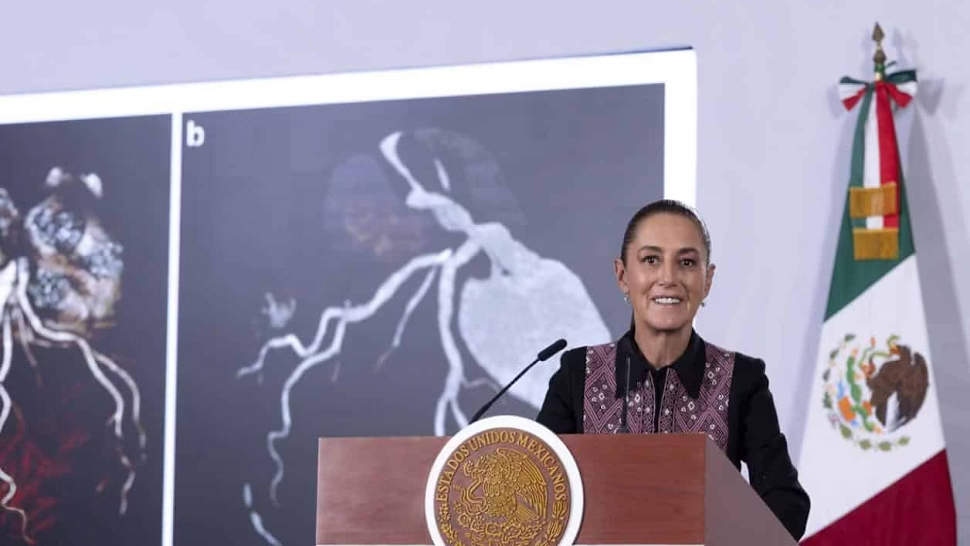
President Claudia Sheinbaum reported on advances in the public health system, with investments in equipment, telemedicine and improvement of clinics. He affirmed that the State must guarantee access to health from prevention to care for complex diseases.

“We are compensating for the profound damage that neoliberalism caused in the health system,” he said at the morning conference.

Equipment and telemedicine

The IMSS installed 42 state-of-the-art CT scanners in 40 hospitals in 19 states. Of these, 41 are from 256 cuts. They allow early detection of tumors and bleeding, perform up to 50 studies per day and reduce waiting times. They were acquired for 29 million pesos each, below the 40 million in the past.

The ISSSTE expanded telemedicine from 239 to 859 units. It offers consultations in 15 specialties, such as cardiology and dermatology, from 118 second and third level units to 741 first level.

The Clinic is Ours

The La Clínica es Nuestra program delivered 4,608 million pesos in 2025 to 8,483 medical units, with the participation of 67,864 people. 42 thousand improvement actions were carried out in infrastructure and equipment. The 2026 call will begin in July, including for the first time 153 units from Yucatán with 80 million pesos.

Sheinbaum added that progress is being made in the House to House Health program, with more than 20 million consultations with older adults and people with disabilities. Starting in August-September, you will be able to collect medications at Farmacias del Bienestar, health centers and a network of pharmacies. Next year the Universal Health Service will begin with a single credential.

Continue reading

Massive security reinforcement and alcohol ban at the Azteca

56,000 police officers and alcohol restriction for the game at the Azteca.

Measures for the Mexico-Czech Republic match

The government of Mexico City announced an unprecedented security operation for this Wednesday’s game at the Azteca stadium. 56,000 personnel will be deployed, five times more than the 11,219 employed last week.

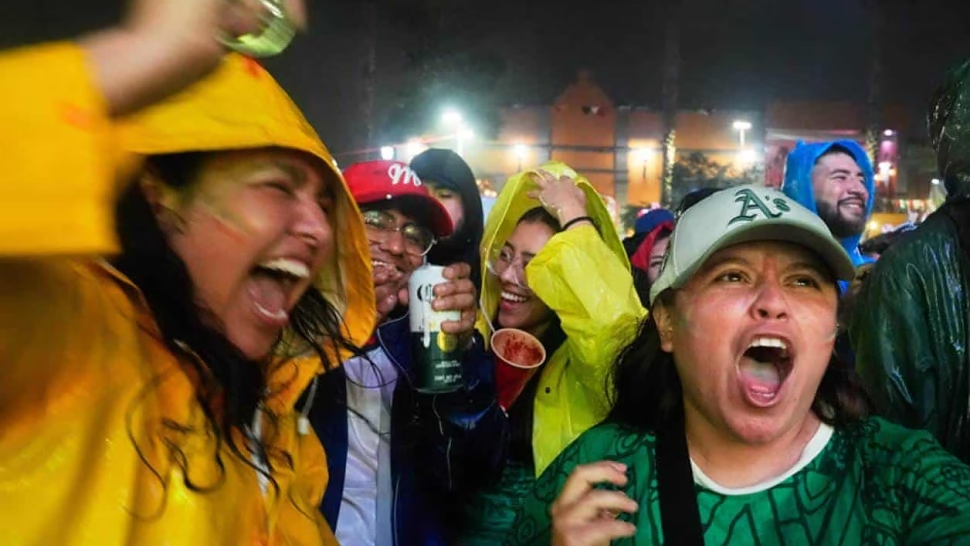
The decision responds to the celebrations of the previous Thursday, when some 700,000 people gathered in the capital after Mexico’s victory over South Korea. Although there were no injuries, nearly 40 tons of garbage were collected in the Ángel de la Independencia and the Zócalo.

The Secretary of Security, Pablo Vázquez, detailed that 7,500 police officers will guard the Azteca stadium. Another 3,275 will be in the Zócalo and 4,200 on Reforma Avenue. The objective is to protect players, referees, authorities and fans.

In addition, the Secretary of Government, César Cravioto, reported that starting at 3 p.m. on June 24, a ban on the sale of alcohol will take effect for sixteen hours. Applies to the Historic Center and five neighborhoods of Cuauhtémoc.

Sales will only be allowed in restaurants, hotels and private clubs, accompanied by food. Convenience stores and supermarkets are excluded. The fines for non-compliance amount to up to 293,275 pesos (about $17,251).

The Mexican Alliance of Transporters Organization (AMOTAC) called for mobilizations on highways in the 32 states and blockades in the capital to protest against the violence. The operation also considers these protests.

Continue reading