Electoral reform: judicial elections are postponed to 2028

Reform postpones judicial election and enables annulment due to foreign interference.

Electoral reform: key changes

The Chamber of Deputies approved the constitutional reforms that delay the judicial elections from 2027 to 2028. They also empower the Electoral Court to invalidate elections if foreign intervention is proven.

The initiative, sent by President Claudia Sheinbaum, was supported by Morena and its allies. It seeks to purify the selection of candidates for judges, criticized after the 2025 vote, where people close to the ruling party were elected.

RelatedElectoral Court orders to restore victory to judicial candidates

In June 2025, Mexico elected some 2,600 federal and local judges. Participation was barely 13%. Originally, by 2027 it was planned to elect 800 federal judges and 2,800 state judges. Now, those elections will be held on June 4, 2028.

The reform creates a coordinating commission with representatives of the three powers. It will verify legal requirements and establish selection mechanisms. It will reduce the list of candidates to four per position, and a public draw will leave only two options.

During a session of more than 14 hours, the ruling party Sergio Gutiérrez proposed that magistrates of the Electoral Chamber could be candidates in 2028. The idea received criticism for extending their permanence up to 17 years, but it was approved.

Sheinbaum justified the delay: in 2026 there will be regional elections in 17 states to renew governors, local congresses, mayors and the Chamber of Deputies.

Debate on foreign interference

The Chamber also approved that the Electoral Court can invalidate elections due to indications of intervention by individuals, organizations or foreign governments. Deputy Ricardo Monreal stated that he seeks to “protect the national elections.”

Experts and opponents describe the measure as “ambiguous.” They warn that it will be difficult to prove interference and could be used to dismiss results with subjective criteria.

Monreal promoted the initiative after the crisis generated in April, when the New York prosecutor’s office accused ten Mexican officials – including the governor of Sinaloa, Rubén Rocha – of drug trafficking. The opposition criticized the ruling party and Sheinbaum.

“In the current circumstance, with this offensive that we are seeing from the outside, it is important that it be clear that in Mexico we Mexicans decide,” declared the president. He pointed out that right-wing sectors have intensified criticism given the proximity of the midterm elections in the United States.

AICM taxi drivers refuse to apply discounts agreed for the World Cup

Three AICM taxi drivers groups refuse to apply discounts of up to 18% during the World Cup.

Three groups of taxi drivers that operate at the Mexico City International Airport (AICM) refused to apply discounts of up to 18% on their rates during the World Cup. The measure contradicts previous agreements announced by airport authorities and part of the union.

The companies Nueva Imagen, Porto Taxi and Sitio 300 issued a statement to clarify their position. They argued that they have no contractual relationship with the Grupo Aeroportuario Marina (GAM), the entity that promoted the benefits for airport users.

According to permit holders, the announced discounts do not represent a direct reduction in rates. They are, they say, adjustments derived from compensation for improper charges and administrative processes for maintenance work at the AICM.

They demand transparency

The taxi drivers asked the AICM authorities to make public the documents that support these measures. They also called on the GAM to make transparent the minutes and contracts where the application of discounts had been agreed upon. They questioned the legal validity of the obligations attributed to them.

The refusal could affect users who expected more affordable rates during the sporting event. Until now, there is no certainty about the real cost of service at the AICM during the World Cup.

Continue reading

Morena opens the door to a coalition with the PVEM in San Luis Potosí

Morena conditions alliance on PVEM ruling out Ruth González for the governorship.

Morena-PVEM Coalition for 2027?

The state leadership of Morena in San Luis Potosí left open the possibility of an alliance with the Green Ecologist Party (PVEM) for the local elections of 2027. The condition: that the PVEM present a different profile from that of Senator Ruth González.

Rita Ozalia Rodríguez Velázquez, state president of Morena, explained that if the PVEM discards Ruth González—wife of Governor Ricardo Gallardo—the green party could lead the coalition, which would also integrate the Labor Party (PT).

The leader clarified that the relationship with the PVEM at the local level does not face a conflict, although she admitted that there is no direct communication between both state leaders. Decisions about alliances, he said, are made by national leaders.

The possible agreement arises in the midst of the debate about nepotism, after Ruth González’s intention to succeed her husband in the state government was questioned. Morena looks for profiles that avoid that controversy.

Rodríguez Velázquez stressed that there is coordination between the party leadership to define the electoral strategy. For now, the panorama in San Luis Potosí remains open.

Continue reading

Morena accuses INE advisors of being ‘ill-wishers’

The Morena leader accuses INE advisors of being 'ill-wishers' and defends her affiliation system.

Morena questions the impartiality of the INE

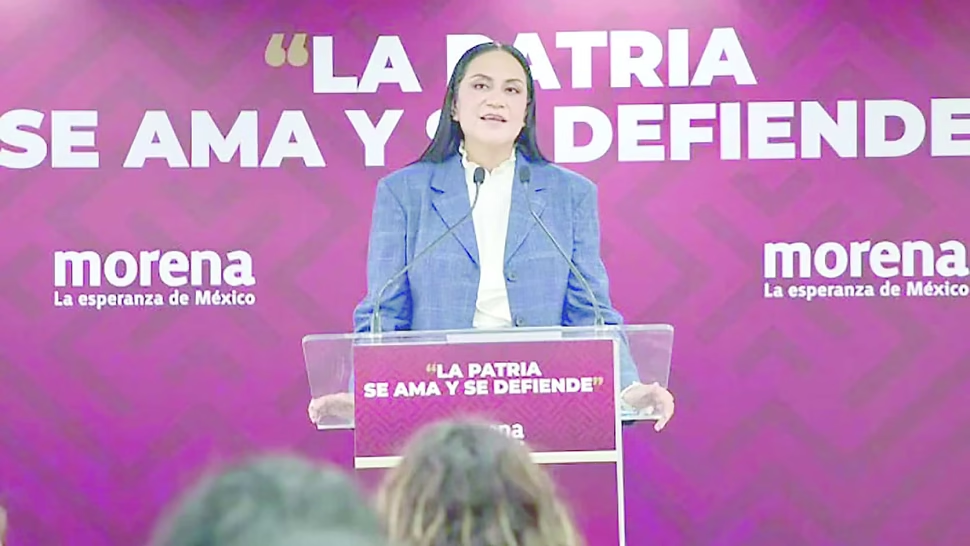
The national leader of Morena, Ariadna Montiel Reyes, pointed out that within the INE there are advisors with critical positions towards her party. He described them as “Morena haters” during a press conference where he addressed recent resolutions on duplicate affiliations.

Montiel affirmed that his party abides by the determinations of the Electoral Court. The authority ordered the elimination of more than 93 thousand affiliate records and leave under review about 19 thousand cases that the INE must verify.

The leader demanded that the institute adhere to the resolutions of the General Council and not to individual opinions. He accused that there are figures close to past electoral administrations who maintain a critical stance towards the movement.

Regarding the affiliation system, Montiel defended that Morena’s application is efficient. He assured that it surpasses that of the INE in functionality, since it allows duplications in the records to be detected.

He also proposed that the INE should have real-time verification mechanisms to cross-check affiliation data. However, he acknowledged that there are different processes between parties and the electoral authority.

Continue reading