Raúl Jiménez and Edson Álvarez analyze Mexico’s group for the 2026 World Cup

The attacker and the captain cautiously and ambitiously analyze the path outlined for the Tricolor in the World Cup.

A meticulous analysis of the Tricolor’s path in the group stage

The draw for the Group Stage of the 2026 FIFA World Cup has outlined the initial outlook for the Mexican Soccer Team. The team led by the Mexican Football Federation will face South Africa, South Korea and the winner of the European Repechage 4, a key that will define the last member. After knowing the result, the reactions of two fundamental pillars of the team, Raúl Jiménez and Edson Álvarez, offer a valuable perspective to evaluate the challenges and the emotional state of the team.

The cautious evaluation and personal ambition of Raúl Jiménez

The center forward, offensive reference and Club América youth player, was the first to pass judgment. His assessment, transmitted to TUDN, was characterized by a balance between realism and optimism. “There is no easy rival, but it could have been worse. It is a good sector and positive things can be achieved, we are already thinking about coming out first,” he stated. This statement underlines a mentality that, without underestimating opponents, identifies a tactical opportunity to aspire to the leadership of group G.

RelatedJulión Álvarez conquers Reynosa with a historic concert

In addition, Jiménez, who currently plays for Fulham of the Premier League, confessed a personal goal of high symbolic value: to be a starter in the opening match of the World Cup, scheduled for June 11. “I have had to watch three opening games from the bench, and now I have my sights set on being able to start,” he explained. This aspiration not only reflects his competitive ambition, but also shows the importance of his performance at the club over the coming months to consolidate his place in the national team’s starting lineup.

The tactical perspective and responsibility of Edson Álvarez

On the other hand, the captain and defensive midfielder, Edson Álvarez, expressed a feeling of contained relief. “I’m happy, they are rivals that we know,” he said, referring to the prior knowledge that the coaching staff and the players have of two of the three opponents. His analysis became more specific when breaking down each opponent: he recalled the 2-2 draw against South Korea in a recent friendly, classified South Africa as an “old acquaintance” from past World Cup events, and highlighted the uncertainty and potential danger that the winner of the European playoff represents, suggesting that it could be “one of the strongest in the group.”

Álvarez, nicknamed “Machín“, also made a constructive self-criticism about the team’s recent performance. He acknowledged that, despite a winless streak, positive parameters such as high possession of the ball have been maintained. However, he precisely identified a key lack: “We lack a little more idea in the last pass, that calmness in front of the goal.” This diagnosis points directly to effectiveness in the offensive phase and definition, crucial aspects that must be polished to transform control of the game into concrete results during the competition.

In conclusion, the statements of Jiménez and Álvarez provide a stratified analysis of the situation. While the forward emphasizes the opportunity and a personal objective that drives his performance, the captain offers a colder tactical evaluation, recognizing both the favorable aspects and the technical deficiencies to be corrected. Both approaches, complementary, reflect a squad aware that, although the draw did not pit them against the most feared powers in the classification, the path to the knockout phase will require maximum concentration, tactical evolution and efficiency from the first minute of the tournament.

Do you share this analysis of the Mexico group?Spread this perspective on your social networks and explore more content about the Tricolor’s preparation for the largest football event on the planet.

Egypt comes back and advances to the round of 16 in the 2026 World Cup

Egypt reverses the score against New Zealand and approaches the round of 16.

Egyptian comeback in Group G

Egypt achieved a key victory against New Zealand, overcoming an adverse score to become the leader of Group G and secure its place in the round of 16 of the 2026 World Cup.

The match started uphill for the Africans. In the 15th minute, Finn Surman put New Zealand ahead with a goal that put the Oceanians in front. However, Egypt remained calm and found an equalizer in the second half.

Mustafa Ziko equalized with a powerful header in the 58th, and shortly after, Mohamed Salah, with his offensive ability, put his team ahead. The Egyptian showed why he is one of the figures of the tournament.

Trézéguet sealed the victory in the 82nd minute, eliminating any possibility of a New Zealand reaction. The victory not only classifies Egypt, but also outlines it as a serious contender in the World Cup.

Continue reading

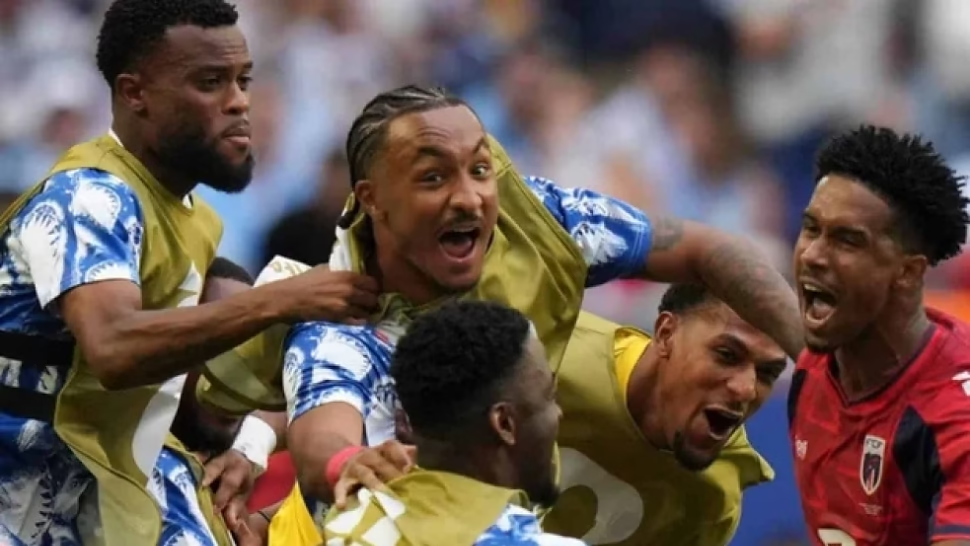
Cape Verde empathizes and dreams; Uruguay suffers from the World Cup surprise

Cape Verde achieves another historic tie; Uruguay gets complicated in Group H.

Two ties, two opposite faces

For Uruguay, two draws with the taste of defeat. For Cape Verde, two results that taste like triumph and mark a milestone in its first World Cup.

The team led by Marcelo Bielsa must now beat Spain to avoid a fiasco. Meanwhile, the African team, which had already surprised by drawing without goals against La Roja, did it again: it tied 2-2 against La Celeste in Miami.

Kevin Pina opened the scoring with a free kick that became Cape Verde’s first goal in a World Cup. Helio Varela, who came on in the second half, tied the game with a long shot that surprised goalkeeper Fernando Muslera.

The controversy and the statements

Maxi Araújo and Agustín Canobbio put Uruguay ahead with two goals in quick succession at the close of the first half. However, the advantage did not last. “The truth is that the goal is of no use… we should have taken care of the result,” said Araújo.

Bielsa took responsibility: “Organizational errors are always the coach’s responsibility. We pay a very high price for that.”

The match also had a special detail: it was the first World Cup match with two goalkeepers over 40 years old. Muslera, who turned 40 on June 16, and Vozinha, 40, faced off on the grass. Vozinha’s mother, who could not travel to the debut against Spain due to lack of visa, was in the stands this time.

Group H is reconfigured: Spain leads with 4 points, Uruguay and Cape Verde have 2, and Saudi Arabia closes with 1. Uruguay will risk their lives against Spain on Friday, while Cape Verde will face the Saudis with their hopes intact.

Continue reading

BMO Field: Toronto’s key stadium for the 2026 World Cup

BMO Field, with capacity for 30,000 attendees, will host the 2026 World Cup.

Key facts about BMO Field

BMO Field is located in Toronto, Canada, and will be one of the venues for the 2026 World Cup. Its capacity of 30,000 spectators classifies it as a medium-capacity stadium, but its natural grass surface aligns it with the traditional standards of national team soccer.

The venue is owned by the City of Toronto, a relevant fact to understand its governance and decisions on adaptations for the tournament. It was inaugurated on April 28, 2007, with a construction cost of 72 million dollars, which places it as a relatively recent infrastructure in North America.

Its exact location (43°37’58″N 79°25’07″W) is key for the logistics of travel, security and access during the event. Although operational details are not specified, these basic elements define its role in the 2026 World Cup.

Continue reading