PT seeks to legalize the resale of World Cup tickets

The PT proposes legalizing and regulating the resale of tickets for the World Cup, with a cap of 100% on the original price.

End to the black market for tickets?

The Labor Party bench in the Senate has just launched a political move with time. Looking ahead to the 2026 World Cup, they presented an initiative to legalize the resale of tickets. It’s not a whim. It is a direct response to the chaos ahead.

Geovanna Bañuelos, senator for Zacatecas and author of the proposal, wants to reform the Federal Consumer Protection Law. The idea is clear: if you can’t beat the black market, regulate it and put limits on it.

“This reform is important in the framework of an event as important as the World Cup… it seems essential to us that we can begin to establish rules,” explained Bañuelos.

The detail that changes everything

The initiative has a central axis: putting a 100% cap on the resale price premium. No selling a 500 peso ticket for 5 thousand. The limit would be double the original value.

RelatedBad Bunny tickets reach 56 thousand pesos in resale for concerts in Mexico

In addition, it proposes creating a mandatory registry for intermediary platforms. Clear obligations for sellers, authenticity verification before publishing and refund mechanisms. They want to bring the sharks out of the shadows and put them under the microscope.

Bañuelos was forceful in rejecting that this encourages resale. For her, absolute prohibition is what feeds the monster.

“The ban only encourages a black market, with fraud and excesses,” he said.

With Mexico hosting 13 matches and more than 800,000 spectators between Mexico City, Monterrey and Guadalajara, the stage is set for a perfect storm of speculation. The PT tries, at least, to distribute umbrellas before it starts to rain.

It is pure theater. A move calculated to position itself as the defender of the common fan against the maelstrom of the big show. We will see if other parties get involved in this work or prefer to remain as spectators.
Mexico and PAHO/WHO sign health strategy 2026-2030

Mexico and PAHO/WHO sign agreement to strengthen the health system and reduce the burden of diseases.

Bilateral agreement to strengthen the health system

The Government of Mexico, through the Ministry of Health, and the Pan American Health Organization/World Health Organization (PAHO/WHO) signed the Country Cooperation Strategy 2026-2030. The goal: strengthen the national health system and reduce the burden of disease.

The agreement includes priority actions to address non-communicable diseases, cancer and mental health disorders. It also promotes prevention strategies and timely care throughout the population’s life course.

In addition, it seeks to strengthen the stewardship of the Ministry of Health and the coordination between the institutions of the National Health System. The goal is to move towards a model of universal access to quality medical services.

Among the central axes are the strengthening of the capacity to respond to health emergencies, the promotion of health self-sufficiency and the strengthening of the national regulatory authority.

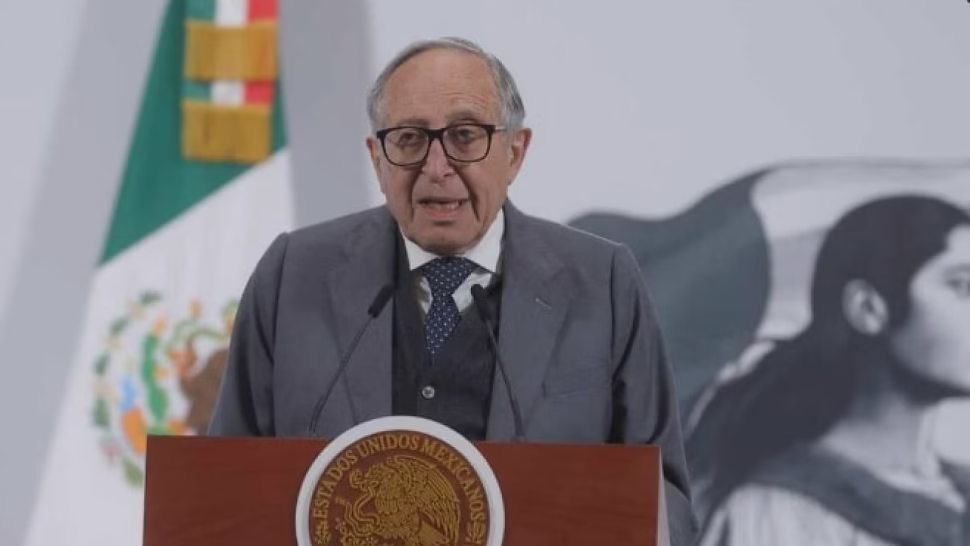
Health Secretary David Kershenobich said:

The strategy will allow national priorities to be aligned with the technical experience of PAHO/WHO, which will contribute to expanding access to health services, with emphasis on prevention, primary care and universal coverage.

The agreement lays the foundations for technical cooperation that addresses the country’s main health challenges in the next five years.

Continue reading

Mexican peso recovers after confirming the validity of the T-MEC

The peso recovers after confirming the validity of the T-MEC until 2036 with annual reviews.

The peso recovers ground against the dollar

The national currency registered an appreciation of 0.4% this Thursday, closing at 17.48 units per dollar in wholesale operations. At bank windows, the greenback stood at 17.91 pesos for sale, breaking a streak of two consecutive days with losses.

The recovery occurs after the continuity of the Treaty between Mexico, the United States and Canada (T-MEC) was confirmed until 2036, under the annual review scheme agreed upon by the three countries.

The details of the official announcement

The Secretary of Economy, Marcelo Ebrard, reported that the first formal review will begin on July 20 with the visit of a US delegation to Mexico. During the virtual meeting with their counterparts from the United States and Canada, Washington’s concern about the trade deficit was addressed.

Ebrard highlighted that more than 80% of Mexican exports to the United States continue to be tariff-free, with no changes to that scheme expected. The next working groups will focus on strengthening regional integration in strategic sectors such as the pharmaceutical industry and semiconductors, with the aim of reducing dependence on imports from other regions.

He specified that negotiations on the future of the treaty are limited exclusively to trade issues and do not include security issues.

Continue reading

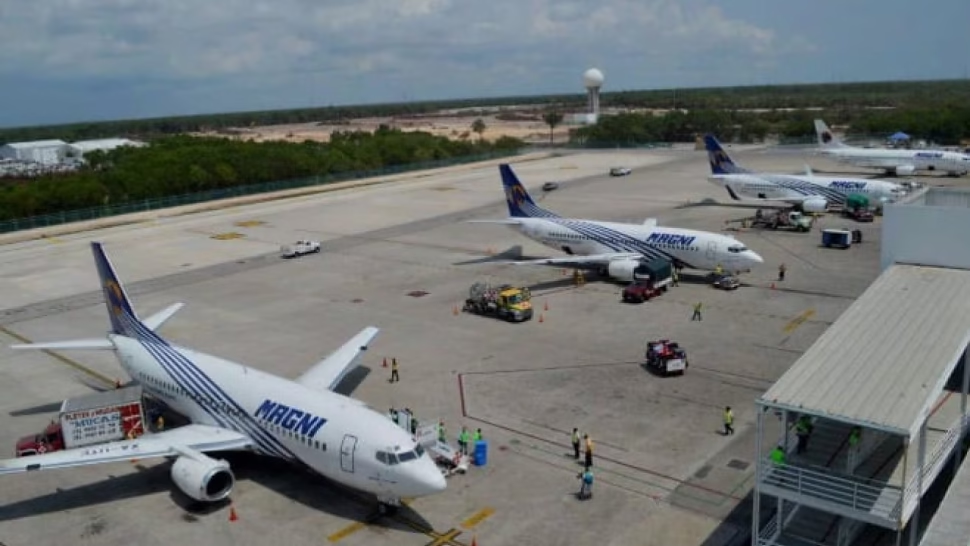
AFAC revokes Magnicharters certificate after non-compliance

The airline could not prove regulatory compliance after an extraordinary verification.

Regulatory decision

The Federal Civil Aviation Agency (AFAC) revoked Magnicharters’ air services operator certificate. The measure was notified on June 29, after a regulatory review process.

The Secretariat of Infrastructure, Communications and Transportation (SICT) reported that the company’s right to a hearing was respected throughout the procedure. It was granted legal deadlines to present information and evidence that demonstrated compliance with current aeronautical regulations.

However, the documentation provided was insufficient. The airline was unable to prove that it met the necessary requirements to continue operating as a provider of passenger air transportation.

Origin of revocation

The decision derives from an extraordinary major verification carried out in January 2026. In it, non-compliance with the regulation of the sector was detected. This led to formal requirements and, subsequently, the temporary suspension of operations in April, as a preventive measure.

The SICT stressed that the revocation is based on the lack of sufficient evidence on the part of Magnicharters to prove its regulatory status. The company now faces the loss of its certificate, which prevents it from offering commercial air services.

Continue reading