Prosecutor’s Office charges former Petro ministers for contract network

Justice advances in a case that reveals an alleged plot to exchange political favors for public contracts, shaking the foundations of the government.

Tax Imputation: An Analysis of the Alleged Contracting Network

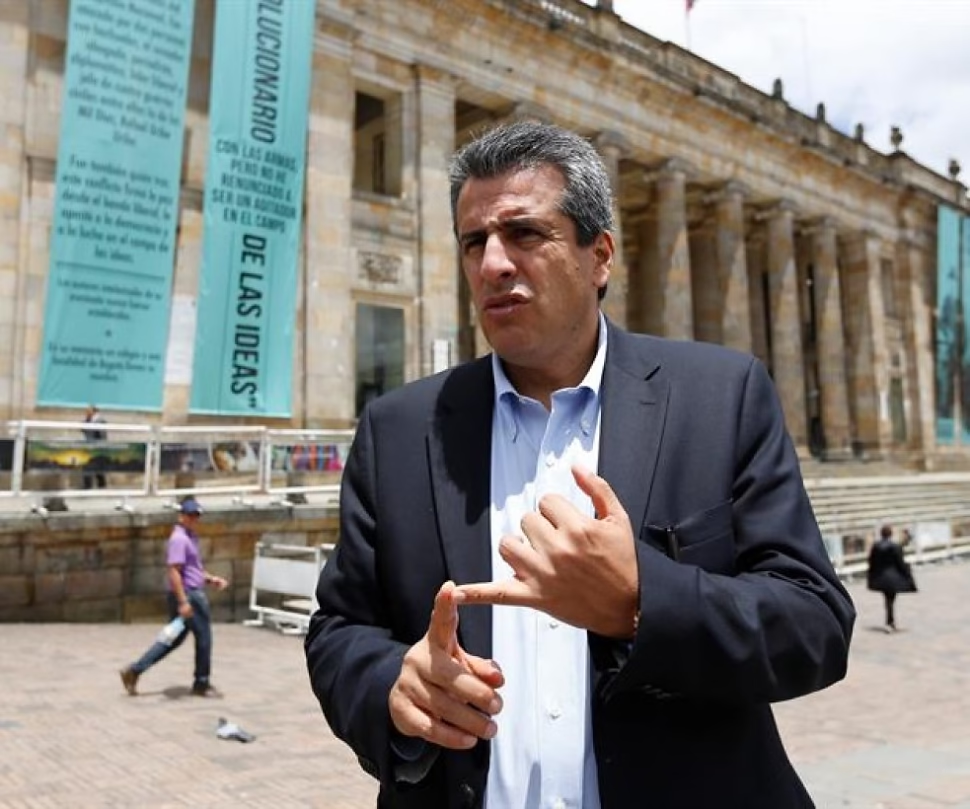
The Attorney General of the Nation of Colombia formalized this Monday an accusation of great political significance by indicting the former ministers Ricardo Bonilla (Treasury) and Luis Fernando Velasco (Interior). The investigation, of a complex nature, focuses on his alleged participation in a directed adjudication structure that would operate within various State entities. According to the hypothesis of the accusing entity, both would have intervened as facilitators to materialize agreements of a political nature through the channeling of projects financed with the public treasury, which would constitute the core of the alleged illegality.

Mechanisms and Scope of the Alleged Illicit Structure

The investigating entity details that the operational mechanism of this network would be based on the strategic and preferential allocation of contracts. These commitments, covering sensitive areas such as public infrastructure, asset procurement and disaster risk management programs, would have been allocated to parliamentarians who, in return, offered legislative support to the government’s agenda. The prosecution claims to have evidence of meetings and direct communications intended to coordinate these exchanges, elements that could constitute crimes such as own bribery (bribery) and criminal conspiracy (illicit association to commit crimes).

RelatedJustice advances against former Petro ministers for corruption

The corruption scandal transcends the two former ministers and also involves former directors of the National Unit for Disaster Risk Management (UNGRD), as well as former presidents of the Senate and the House of Representatives. The fiscal analysis suggests that this plot would have operated for a prolonged period, taking advantage of weaknesses in administrative controls and the urgent need for resources for works in geographical areas with high socioeconomic and environmental vulnerability.

Defense Posture and Political Context

Faced with the signals of the Prosecutor’s Office, both Bonilla and Velasco exercised their right to defense during the hearing, categorically rejecting any participation in illegal negotiations. His defense lawyers argued that the administrative decisions regarding projects and the allocation of public funds were at all times subject to the established institutional protocols and responded to objectives of national interest and development priorities, denying the existence of any political compensation.

This case is framed in a context of recurring scrutiny of state contracting practices in Colombia and puts the risks of the politicization of public administration under focus. The investigation represents a thorough examination of the interface between executive decision-making, allocation of budgetary resources and legislative dynamics, seeking to establish individual criminal responsibilities within an alleged machinery of diversion of public purpose.

Do you consider it crucial to deepen investigations into public procurement to strengthen transparency?Share this analysis on your social networks to expand the debate and explore more content on governance and accountability on our portal.
The rescue that gave hope in the midst of the tragedy in Venezuela

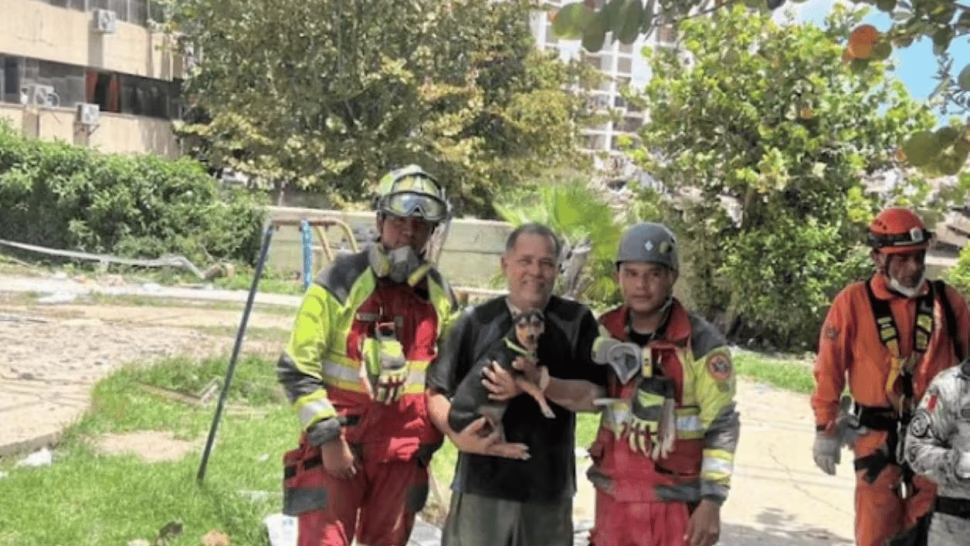
Rescuers celebrate the discovery of a survivor after eight days under rubble in Venezuela.

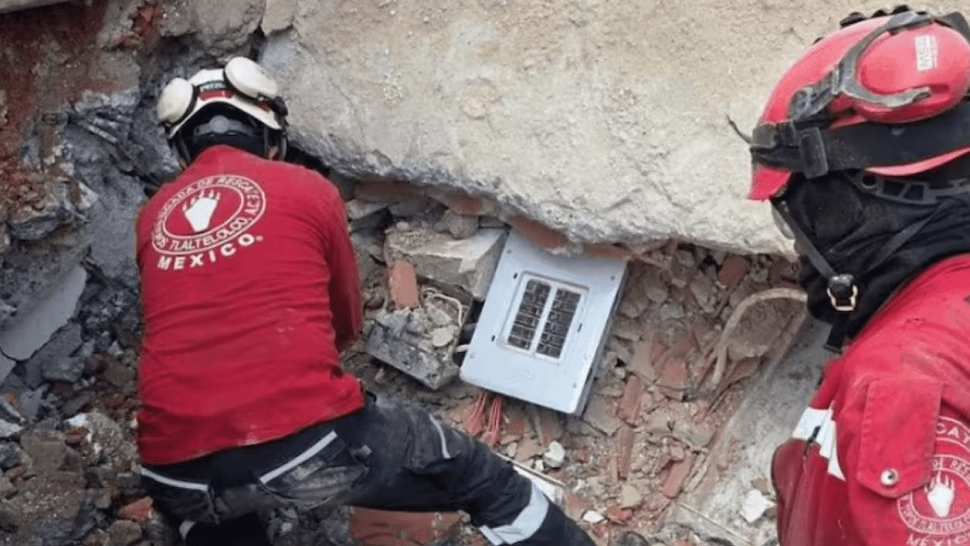
The stench of decomposing bodies spread through the streets of La Guaira as rescue brigades moved from searching for survivors to recovering remains. However, unexpected news restored spirits to the international and local teams.

The rescue of Hernán Alberto Gil Flores

Venezuelan and foreign officials celebrated the discovery alive of a 43-year-old security guard, trapped for almost eight days under the rubble of a shopping center. Television cameras captured the emotional moment when he was extracted and placed on a stretcher, while the crowd burst into applause.

Hernán survived thanks to an air pocket and the food and water that the rescuers sent him through the cracks. It far exceeded the critical threshold of 72 hours, when experts consider it most likely to find people alive.

The other side of tragedy

In other areas of the state of La Guaira, the most affected, the outlook was bleak. The port city of Catia La Mar saw officials moving around carrying body bags and stacking coffins. Equipment with seismic sensors was removed without detecting signs of life.

The government of the interim president, Delcy Rodríguez, reported at least 2,295 deaths and more than 11,000 injuries. His management has been criticized for its slowness and disorganization. Thousands of people sleep in shelters or outdoors, and doctors warn of a health crisis due to infections and untreated injuries.

Among the victims is Daniel Alejandro Núñez Ramírez, 28, deported from the United States hours before the earthquake. He had arrived on a flight with more than a hundred Venezuelans and was transferred to a hotel in La Guaira that his mother, Oswadeliz Núñez, described as a prison. Thirty minutes after a phone call, the building collapsed. His mother collected his ashes in a morgue.

“My son was not a criminal. Why do they treat people with no criminal record as criminals?” —Oswadeliz told The Associated Press.

Support from the United States

Washington supports Rodríguez and has allocated more than $300 million in assistance. John M. Barrett, US chargé d’affaires in Venezuela, assured that funds from Venezuelan oil production will be available for reconstruction. However, organizations such as the Washington Office on Latin American Affairs ask for transparency in the use of that money.

The government’s response remains under scrutiny, as the 180-day term of Rodríguez’s interim presidency expires.

Continue reading

Dog “Sarita” rescued alive from rubble in Venezuela

Mexican rescuers found "Sarita" alive under rubble in La Guaira, giving hope to affected families.

Rescue in La Guaira

During search efforts after the June 24 earthquakes in Venezuela, elements of the Mexican Army and the National Guard located a dog named “Sarita” alive. The discovery occurred in the Vargas municipality, La Guaira state, when a man was looking for his missing daughter. Upon hearing noises among the rubble, he alerted the uniformed officers.

The canine team made up of the national guard Tonantzin Arroyo Sarmiento and the rescue dog “Kai” located the animal. After cutting and removal work, Sergeant Julio César Castro Díaz managed to extract “Sarita” alive. The owner burst into tears when he met her again and expressed that this fact renewed his hope of finding his daughter.

The tasks continue in the area as part of the “Yumare” Humanitarian Aid Group.

Humanitarian support from Mexico

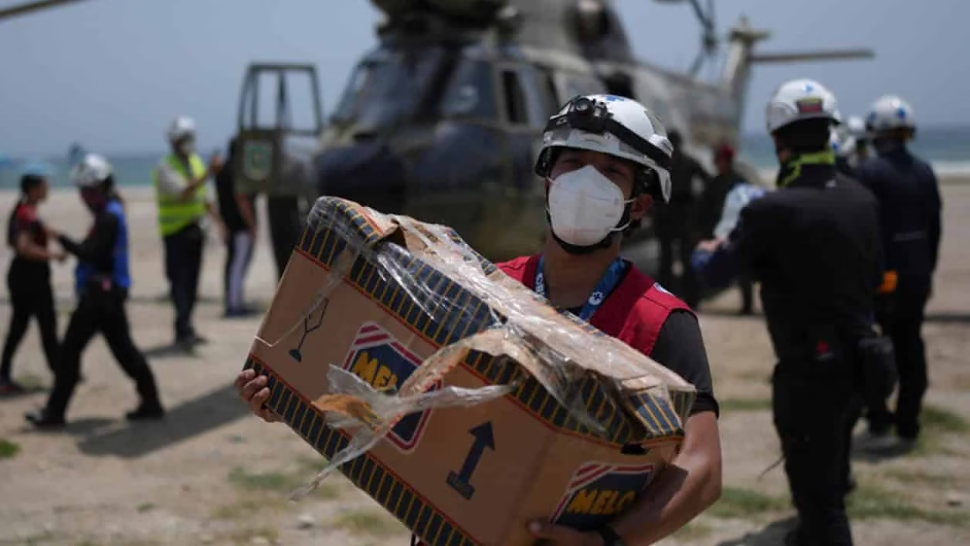
On Wednesday, a C-130 Hercules aircraft of the Mexican Air Force took off from Santa Lucía bound for Maiquetía, Venezuela. It transported medical and electronic supplies, as well as first aid material from the Mexican Red Cross and five electric power generating plants.

Since June 24, there have been five humanitarian aid flights with 240 members of the Army, including 151 rescuers, 60 doctors and health personnel, eight dog lovers from the Army and 10 from the National Guard, 11 from the Mexican Air Force. 13.1 tons of medicines have also been sent – 8.3 from Defense and 4.8 from IMSS-Wellbeing -, four tons of rescue equipment and eight generating plants.

The aid seeks to restore basic services and care for the population affected by the earthquakes that left thousands dead and injured.

Continue reading

Mali: the Belgian shepherd who rescues lives in Venezuela

The Belgian pastor Mali has located four people after the earthquakes in Venezuela.

A Belgian shepherd in the disaster zone

Mali, a seven-year-old Belgian shepherd, is part of the Topos Azteca rescue group. Since the earthquakes of June 24 in Venezuela, their work has been key to locating four people in the rubble. Two of them were found alive, along with a puppy.

Miguel Ángel García, their human guide, explains that rescue dogs speed up searches thanks to their keen sense of smell and hearing. Mali has tirelessly toured the most affected areas of Caracas and other towns.

Behind every find are years of training and unwavering determination. While machines remove debris, Mali searches for the most valuable thing: a sign of life. His work reminds us that hope can also come on four legs.

Topos Azteca rescuers continue at ground zero, searching for more survivors.

Continue reading