They propose guaranteeing decent menstruation in schools

A senator seeks to change the law so that students receive information and support about menstruation in schools.

An initiative that goes beyond speeches

Olga Patricia Sosa Ruiz, senator, put something concrete on the table: modifying the General Education Law. Its objective is for the educational system to recognize and guarantee the right to decent menstruation. It is not just a topic of speech, it is one of hygiene, information and basic conditions.

The proposal seeks to incorporate menstrual knowledge and care within comprehensive sexual education. The idea is that students have access to guidance and support to manage their cycle appropriately. All this, the initiative says, must be coordinated with the health authorities.

“It is time to make substantive equality a reality and dignify women”,

stated Sosa Ruiz during his presentation in the Plenary. He recalled a key fact: organizations such as UNESCO and UNICEF point out that menstrual management continues to be a barrier for many young women to continue their studies.

RelatedSix Mexican states endorse menstrual leave for public employees

The legislator framed this initiative within the National Strategy for Dignified Menstruation of the federal government. A project that, according to official figures, could benefit more than 11.6 million secondary and high school students throughout the country.

He also highlighted that his proposal aligns with the vision of Claudia Sheinbaum, who has described menstrual health as a fundamental right. The central point is clear: information and stigma-free conditions are needed.

Now, the text was turned over to the United Commissions on Education and Legislative Studies of the Senate. There it will be analyzed and ruled. We will see if this time the good intentions manage to translate into real changes in textbooks and school bathrooms.
Key meeting between the US and Mexico to reopen the livestock border

US ambassador and head of Sader agree on steps to reopen border crossings to livestock.

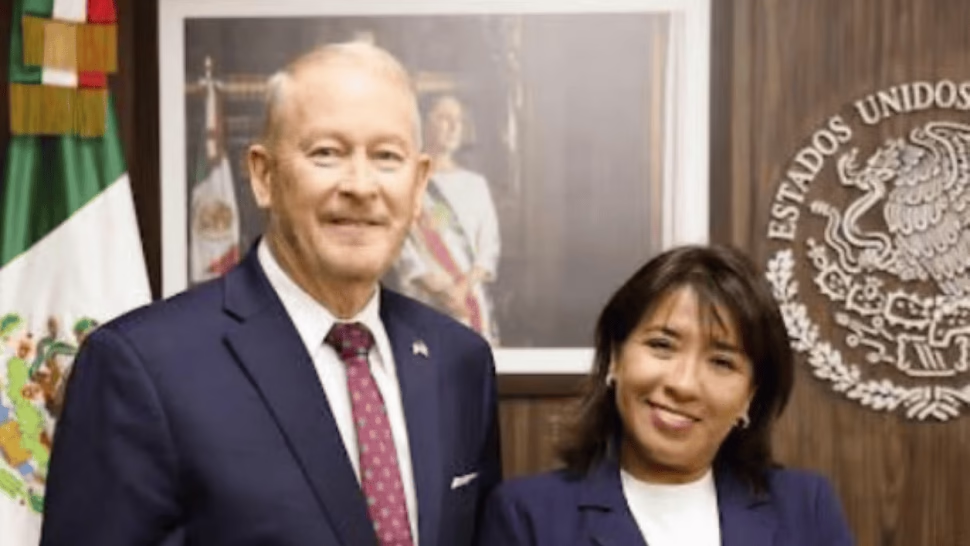
The United States ambassador to Mexico, Ronald Johnson, met with the Secretary of Agriculture, Columba López, following the bilateral agreement to reopen the border to livestock trade, affected by screwworm outbreaks.

Johnson described the meeting as productive and noted that it strengthens high-level cooperation. “Together we continue to generate results for the benefit of ranchers, producers and consumers of both countries,” he published on social networks.

Gradual reopening plan

The reopening will be staggered. It will begin in Sonora and then in Chihuahua, as reported by President Claudia Sheinbaum in her morning conference. The president recognized the work of former secretary Julio Berdegué and current secretary Columba López to achieve this progress.

Sheinbaum detailed the actions against the pest: from artisanal traps to the operation of a plant in Chiapas that produces sterile flies to prevent the spread of the larva. “It is considered that we are quite advanced to open the border in August,” he said.

The president highlighted the technical coordination between both governments. “There are still joint actions to be developed, but it speaks of good collaboration, very technical, to prevent this damage to livestock from spreading,” he concluded.

Continue reading

PAN demands Sheinbaum declassify Pemex audits

PAN deputies demand declassification of Pemex audits reserved for three years.

They demand declassification of Pemex audits

Deputies of the National Action Party (PAN) demanded that President Claudia Sheinbaum declassify the financial reviews and audits of Petróleos Mexicanos (Pemex) during the administration of Víctor Rodríguez Padilla. They considered the argument that it compromises strategic information “vague.”

This, after EL UNIVERSAL revealed that days before resigning from Pemex, Rodríguez Padilla classified the findings of internal audits as “reserved” for three years.

“False, it is about covering the corrupt backs of this man accused by his wife of physical abuse and domestic violence,” declared PAN member Paulina Rubio.

He added that reserving the information is a sign of the President’s “unconditional love and support” for women’s aggressors. “Now the president gives us a new face, her commitment to opacity and corruption in Pemex.”

Shield against corruption

Ernesto Sánchez, federal deputy of the PAN and member of the Transparency and Anti-Corruption Commission, warned that this is “a new attempt to shield corruption from citizen scrutiny.”

He pointed out that access to information is a constitutional right and that reservation is only justified exceptionally, not to hide irregularities or protect “friends” of the regime.

“Morena has turned the exception into the rule. What should be maximum publicity is used to close files and avoid accountability. Transparency cannot be applied only to adversaries. Reserving information of public interest feeds the suspicion of impunity,” said Sánchez.

Federico Döring, GPPAN spokesperson, stated that “all of Víctor Rodríguez’s misdeeds at Pemex before he left will remain hidden.” He pointed out that oil spills and “corrupt” contracts given to companies related to López Obrador’s children will be protected.

“Sheinbaum’s government protects this man so much that they watched his back so that the deals he made under higher instructions would not be known,” added Döring.

Raúl Torres Guerrero, local PAN deputy, assured that Pemex “is practically bankrupt” and reserving information compromises the administrative failure and would turn on red lights for international rating agencies. “For the world, Pemex is no longer a solid company but a burden for the Mexican State.”

Torres criticized that Mexico cannot compete “when it has corrupt companies that do not provide guarantees for investment, send oil to dictatorships like Cuba or give contracts to friends of children of former populist presidents like AMLO.”

Continue reading

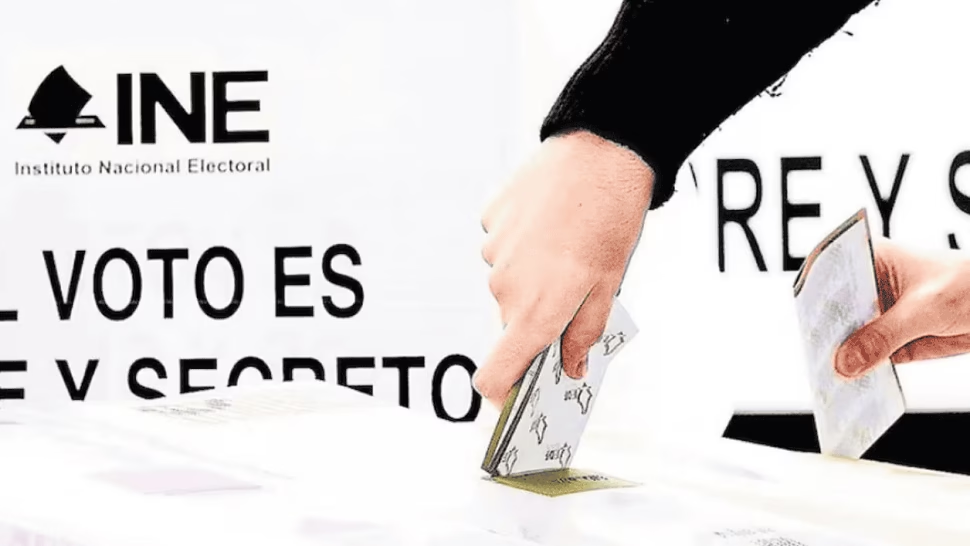
Direct vote for plurinominales: the Espadas proposal in the INE

Councilor Uuc-kib Espadas proposes that citizens directly elect proportional representation deputies.

Two tickets for deputies

The electoral advisor Uuc-kib Espadas Ancona will present a key proposal to the General Council of the INE: allow citizens to vote directly for multi-member deputies in the 2026-2027 federal process.

The initiative proposes dividing the election into two ballots. One will contain the relative majority candidates; the other, the group names of those who the parties nominate as proportional representation.

Espadas announced that he will present his model to his fellow councilors at the end of September or beginning of October.

Cost and logistics

The counselor acknowledged that issuing an extra ballot would imply an additional expense of between 200 and 250 million pesos, within the usual INE printing package. However, he pointed out that, after the experience of the election of the Judiciary in 2025, it would be possible to put both ballots in the same ballot box and do the counting separately, as is already done.

No need for legal reform

Espadas clarified that the INE has the power to implement this change without a legal reform. According to him, the April electoral reform was the right time to legislate it, but the authority can act on its own.

“The electoral authority does have the possibility of implementing two ballots for the election of deputies even without this legal reform, I insist, since this would fully guarantee the freedom of voting through the two current election methods,” he explained.

The debate is just beginning, but the proposal opens the door to a transformation in the way federal legislators are elected.

Continue reading