Producers and transporters lift blockades after negotiation

After 12 hours of tension, the dialogue in the Interior managed to unblock the main roads of the country. Know the agreements.

The government marathon that unblocked the roads

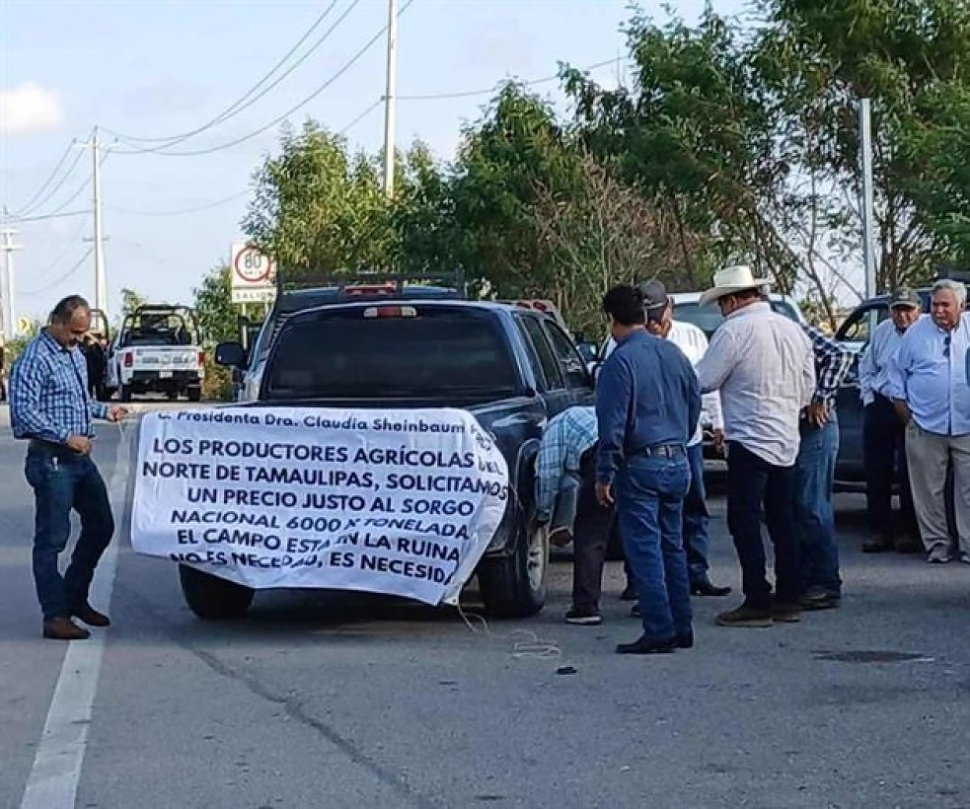
Imagine the scene: the Secretary of the Interior converted into the set of a last-minute reality negotiation show, where the protagonists, producers and transporters, had been stationed in front of the federal authorities for 12 hours. Spoiler alert: at the end, and after a dialogue that tested everyone’s patience, the blockades that had the country more stuck than a trailer on a dirt road began to be lifted. Finally, emergency services could do their jobs again without having to slalom between tractors and cargo trucks.

The agreement, cooked over a slow fire in the offices of Segob, commanded by Rosa Icela Rodríguez, not only promised the immediate clearing of communication routes, but also gave birth to three work tables. Because, let’s be honest, what complex problem in Mexico is solved without creating at least a couple of dialogue tables? The first will be in charge of safety on the roads (a topic that is enough for several seasons of a horror series), the second will clarify doubts about the legal regulations on water matters (or as the producers of Chihuahua call it, “the attempt to take away our water”), and the third will address the existential dramas of the Mexican countryside.

RelatedGovernment boasts 200 meetings while blockades paralyze the country

The caravan of chaos and the aggrieved of Chihuahua

While the National Association of Transporters (Antac) announced with relief that 90% of the roads had already been freed, including hot spots such as the Zinapécuaro booth in Michoacán and La Barca in Jalisco, a group felt like the guest who was given the plane. The Chihuahua producers left Segob with a frown, accusing that no one received them, not even the owner. His disappointment was as palpable as that of a fan whose idol cancels a concert at the last minute.

The PAN mayor of Ciudad Delicias, Jesús ValencianoWater Law, which according to their interpretation, threatens to disappear private property of the vital liquid.

The panorama during Thursday morning was worthy of a crisis map, with blockades reported in states such as Chihuahua, Sinaloa, Guanajuato, Michoacán, Tamaulipas, Tlaxcala, Jalisco and Baja California. In an ironic twist, in Nogales, Sonora, farmers suspended their actions for the American Thanksgiving Day, only to discover that, despite their gesture of goodwill, cargo transporters could not cross the border because Customs and Border Protection (CBP) was also celebrating. Life, sometimes, is sarcastic like that.

The afternoon brought with it a respite. News of a possible deal in the capital began to circulate faster than a viral meme, and most lockdowns were lifted. The roads began to regain their pulse, showing that, sometimes, dialogue (no matter how long and tedious) can be more powerful than pure and simple obstruction.

Do you think that the working groups will solve the root of the problem or will it be just a temporary patch?Share this note on your social networks and stay up to date with the national news that really matters.
PRI accuses Morena of links to organized crime

The PRI leader launches serious accusations against Morena for alleged criminal ties.

The national leadership of the PRI intensified its attack against Morena by pointing out alleged links of the ruling party with criminal groups and possible investigations in the United States.

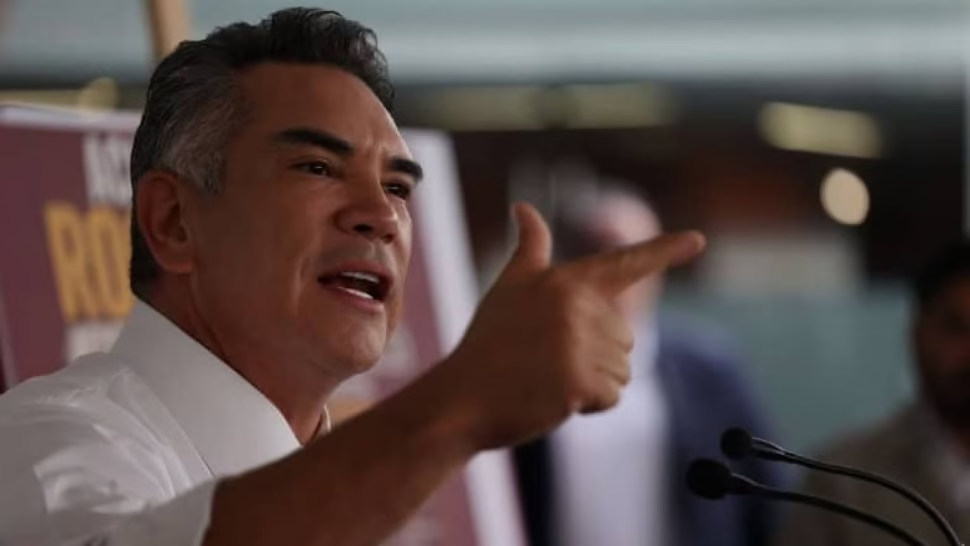
Accusations of Alejandro Moreno

During the XLIII Plenary Meeting of COPPPAL, Alejandro Moreno stated that there are elements that could lead to international actions. The PRI leader maintained that Morena could be considered one:

“terrorist organization that finances organized crime”

He pointed out alleged irregularities in electoral processes in Sinaloa, Tamaulipas and Tabasco.

Moreno also mentioned journalistic versions of alleged investigations by US authorities against Morena politicians. He assured that some party actors would be providing information to agencies in that country, which, he said, anticipates new investigations.

The leader stated that for more than five years he has filed complaints in Mexico and before international organizations for alleged illegal acts by Morena officials, including cases of fiscal huachicol and possible links with organized crime. He assured that these complaints are beginning to have repercussions outside the country.

Continue reading

Citlalli Hernández denies apocryphal list about Morena’s process

The Morenista leader called not to spread false information about the internal process.

Morena’s internal process

Citlalli Hernández Mora, president of the National Election Commission of Morena, denied the authenticity of a list that circulates on the definition of gender for the State Coordinations for the Defense of Transformation and National Sovereignty. He described the document as false and pointed out that it seeks to generate confusion in the internal process of the party.

Through a video broadcast on social networks, Hernández explained that the list dates back to the previous year and is invalid. He reiterated that all official information will be published exclusively through the party’s channels.

“I call on militancy and sympathizers not to share false information and to remain attentive to official statements,” he stated.

The leader indicated that the applicants will be the first to know the next stages of the process, which will then be made known in a transparent manner.

He highlighted that the movement led by President Claudia Sheinbaum seeks to strengthen new ways of doing politics, with dialogue, unity and respect for internal rules. Morena, he said, will continue to make decisions in accordance with its principles and in favor of the transformation project.

He announced that the National Elections Commission will review in the coming days the compliance with the requirements of the 277 candidates registered for the State Coordinations. In addition, a working table is maintained with the Labor Party and the Green Party to discuss the profiles before announcing the next stages.

Continue reading

Mexican banks support those affected by earthquakes in Venezuela

Mexican banks activate support after earthquakes in Venezuela: donations and shipments without commission.

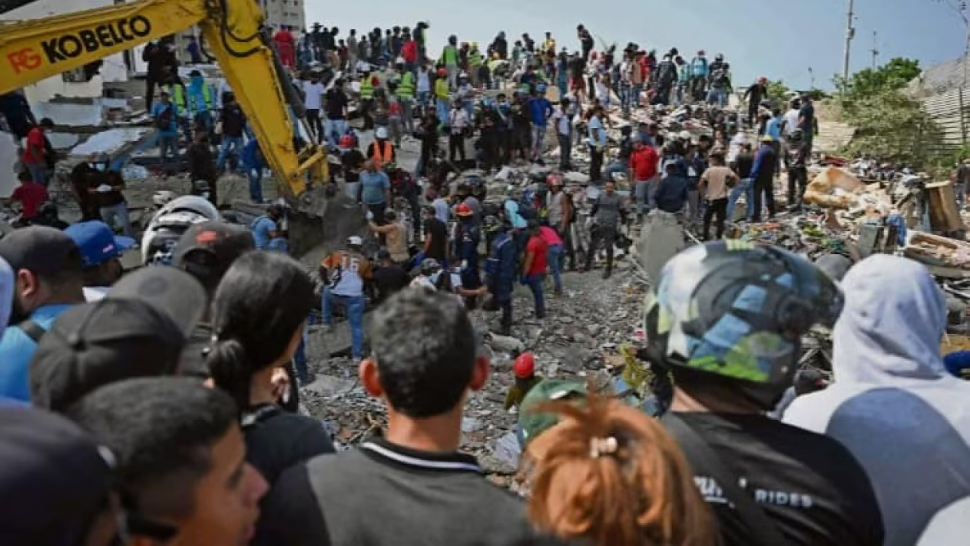
Various financial institutions in Mexico have implemented support measures to address the emergency caused by the recent earthquakes in Venezuela. The earthquakes left damage in several communities in the South American country.

Measures of financial institutions

BBVA México reported that, through its foundation, it made an initial donation of one million pesos to the Mexican Red Cross. In addition, it opened an account to receive contributions from the public. Resources will be channeled towards humanitarian aid work once the critical phase is over.

Banco Azteca announced the elimination of commissions on money transfers to Venezuela until July 10. The measure applies without an amount limit through platforms such as Western Union and MoneyGram, both in branches and in its mobile application.

Santander México announced an extraordinary donation to the Mexican Red Cross for the deployment of the USAR rescue group. This team, made up of specialists and canine pairs, is already in Venezuela supporting search and rescue efforts in collapsed structures.

Continue reading