Pemex would double maximum pension for retirees, according to union

Pemex agreed to double the maximum pension to 134 thousand pesos, but the union sees it as temporary.

The National Union of Petroleum Technicians and Professionals (UNTPP) reported that Pemex committed to doubling the maximum pension for retirees, from 67,145 to 134,290 pesos per month. In addition, the parastatal would refund discounts already applied and restore the fourteenth payments.

However, Pemex has not confirmed the information. At the time of this note, the company did not respond to the query.

RelatedSheinbaum will review cuts to Pemex retirees after reform

What the union says

The UNTPP assured that Pemex “committed to modifying what they calculate as the maximum amount of retirement pensions.” But this adjustment contradicts a presidential decree from last April, which orders that no pension exceed half of the president’s salary (almost 140 thousand pesos per month).

The union described the announcement as “a step backwards” for Pemex and clarified that it is not a gift, but “a product of the political and legal struggle of the UNTPP, retirees and social movements.” In a statement, they noted that the proposal “does not change anything fundamentally, it is a concession to buy time in the current political context.”

“It does not imply a counter-reform of the second paragraph of section IV of Article 127 of the Constitution, which continues to order that the maximum amount of retirement pensions is half of the presidential remuneration. This supposed temporary non-application lacks any legal guarantee.”

The UNTPP also specified that the 134,290 pesos are equivalent to 100% of the president’s ordinary net monthly remuneration, established in the 2026 Expenditure Budget, not 50%.

Legal uncertainty

The union warned that the reform to Constitutional Article 127 is still in force and could be applied in the future. “We must not let our guard down. The only way to have legal certainty is to demonstrate that we are not trusted personnel,” he said. Therefore, they will maintain their legal and political route.

Pemex estimates to meet the commitments in the first 15 days of July. Meanwhile, the UNTPP insists that a fundamental solution is needed for thousands of retirees.
T-MEC negotiations: tariffs and regional content on the table

Third round of dialogue between Mexico and the US addresses labor mechanisms and strategic rules.

Key points from the third round

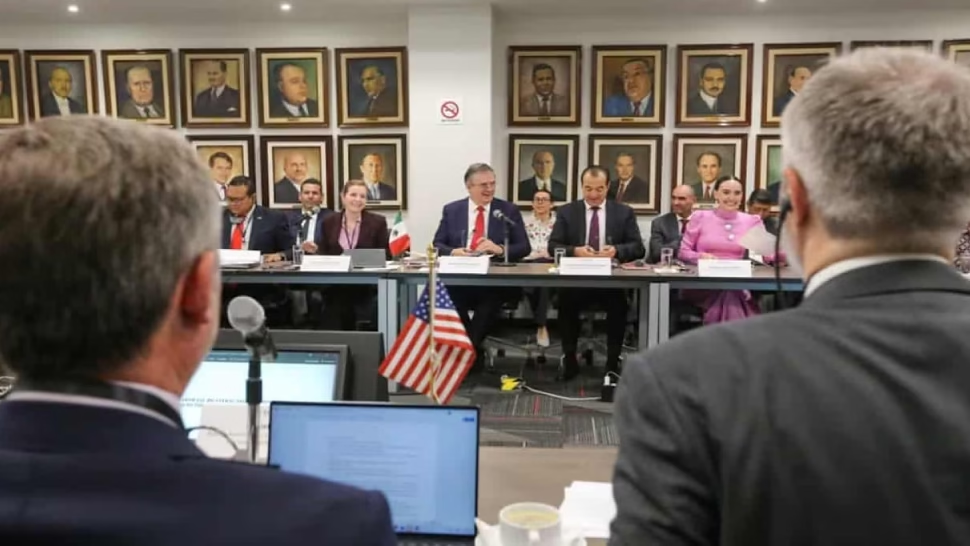
Between July 21 and 23, Mexico and the United States held the third round of negotiations towards the review of the T-MEC. The central issues were tariffs, labor mechanisms, regional content and rules for sectors such as automotive, steel and aluminum.

The president of the Business Coordinating Council (CCE), José Medina Mora, explained that it was proposed to modify the Rapid Response Labor Mechanism to make it reciprocal. Currently, the investigations only apply to companies in Mexican territory.

“It is necessary that the mechanism be applied equitably between both countries,” said Medina Mora.

Another point of discussion was the United States’ intention to increase American content in products made in the region. Mexico defends the concept of regional content and rejects changes that reduce trilateral integration.

The leader added that the seasonality of agricultural products and the impact of tariffs on steel, aluminum and the automotive industry were also reviewed. Some US automakers in Mexico face higher export costs compared to competitors from Japan, Korea and Europe.

For his part, the president of Coparmex, Juan José Sierra, expressed uncertainty regarding the possibility of annual reviews of the treaty, but valued the dialogue between the partners. He indicated that Mexico requires strengthening legal and energy security and the conditions to attract investment.

“It is positive that communication continues, but we need certainty for investors,” said Sierra.

Concamin pointed out that the joint statement between the Secretary of Economy, Marcelo Ebrard, and the US trade representative, Jamieson Greer, confirms that both countries maintain an institutional work path.

Continue reading

Registration of Housing for Wellbeing 2026 begins

Conavi opens registration in 2026 for subsidized housing in 26 states.

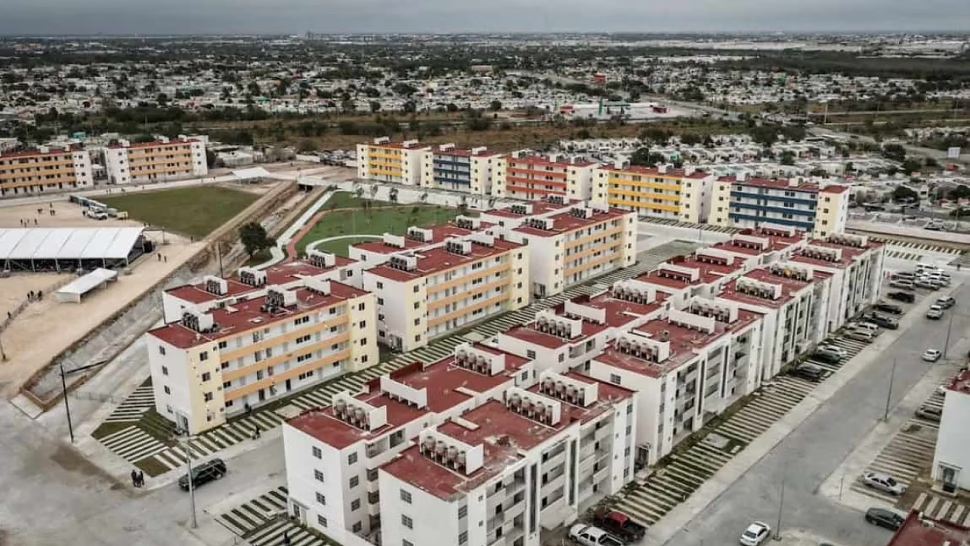
The National Housing Commission (Conavi) launched the 2026 call for the Housing for Well-being Program. The objective: to facilitate access to a decent home for low-income families. Registration will be from July 20 to August 2, in modules installed in 26 entities.

Requirements and financing

The scheme adjusts the monthly payments to the family income, so that the payments are accessible. It is aimed at those who cannot access traditional mortgage loans. Those interested must comply: not have their own home, not have current credit from Infonavit, Fovissste or another institution, and receive less than 17,800 pesos per month. Official identification, CURP, proof of address and income are also required.

Participating municipalities

The modules will only be in locations where Conavi will build projects in 2026. Among them: La Paz (Baja California Sur); Champotón (Campeche); Tapachula and Tuxtla Gutiérrez (Chiapas); Aquiles Serdán (Chihuahua); Piedras Negras and San Pedro (Coahuila); Gómez Palacio (Durango); Axapusco and Cuautitlán Izcalli (State of Mexico); Comonfort, Dolores Hidalgo, Pénjamo, San Diego de la Unión, San Luis de la Paz and Tarimoro (Guanajuato); Acapulco de Juárez, Chilpancingo de los Bravo, Coyuca de Benítez and Técpan de Galeana (Guerrero).

The list also includes municipalities of Hidalgo, Jalisco, Michoacán, Nayarit, Oaxaca, Puebla, Querétaro, Quintana Roo, San Luis Potosí, Sinaloa, Sonora, Tabasco, Tamaulipas, Tlaxcala, Veracruz, Yucatán and Zacatecas. Tepic, Xalisco, Puebla, Tehuacán, Tulum, San Luis Potosí and Valladolid stand out.

The program seeks to serve those who need it most, in a context where access to housing continues to be a challenge for millions of Mexicans.

Continue reading

Five thousand additional agents will reinforce security in southern Sinaloa

They reinforce surveillance in the south of Sinaloa with 5 thousand more elements and an intelligence cell.

Security reinforcement in the southern area of Sinaloa

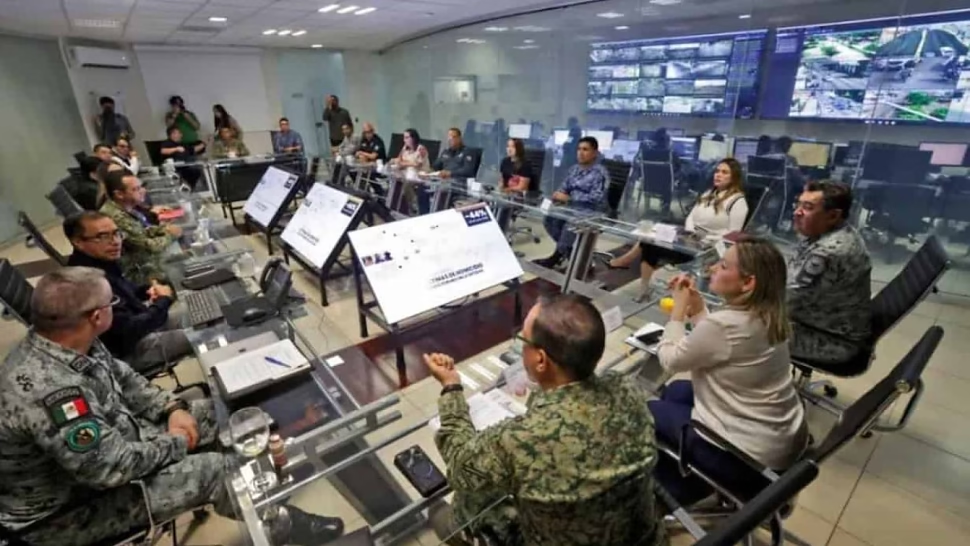
Given the increase in violent incidents in southern Sinaloa, state authorities agreed to redouble surveillance operations. Five thousand security elements will be added, and an intelligence cell will also be installed in Mazatlán to identify those who generate violence.

Strategies defined in the Peacebuilding Roundtable

During the Peace and Security Construction Roundtable, headed by interim governor Yeraldine Bonilla Valverde, the actions of the summer vacation operation were evaluated. New strategies were also defined to address insecurity in the region.

The state Secretary of Public Security, Sinuhue Téllez López, reported that the new deployments will be concentrated in the southern zone. The objective is to strengthen prevention and surveillance, especially in areas with a higher crime incidence.

The Safe Summer operation has more than 18 thousand federal, state, municipal and relief corps members. According to the official, it will be reinforced to better protect residents and tourists who visit Mazatlán on these vacations.

Governor Bonilla assured that coordination between the three levels of government will be maintained to guarantee the safety of Sinaloan families and visitors. At the end of the meeting, he toured an exhibition of paintings, alebrijes and carpentry work made by inmates of state prisons as part of their social reintegration.

Continue reading