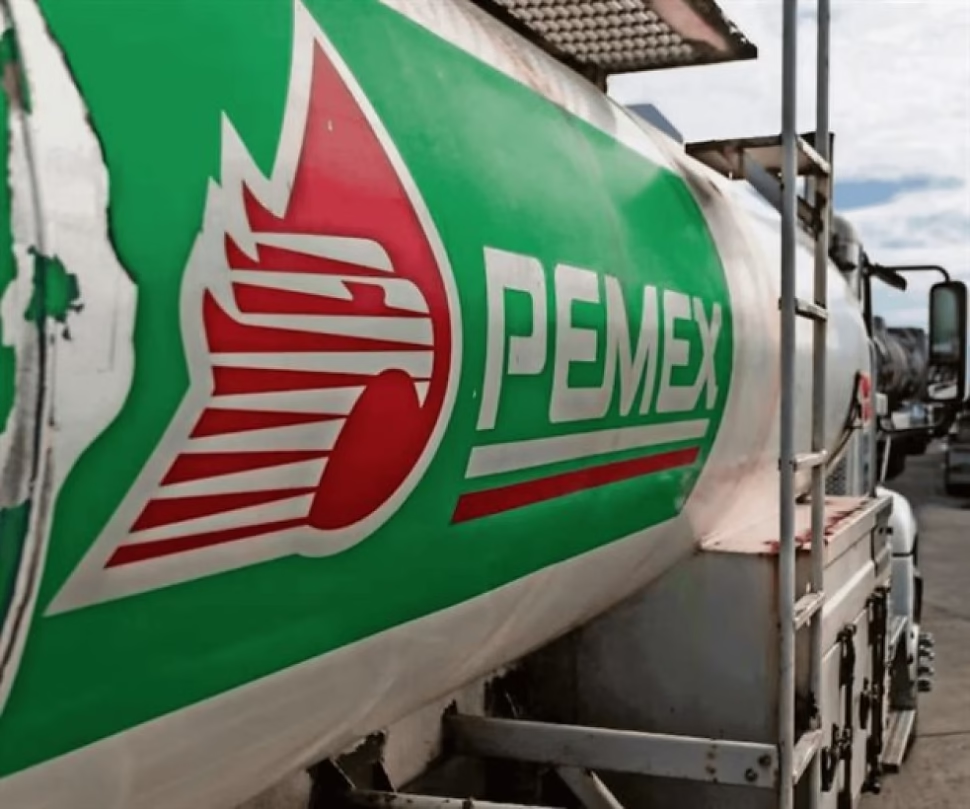
Pemex manages financing to meet suppliers

The national oil company mobilized billions to settle commercial commitments, according to the government audit report.

A Financial Strategy to Maintain Operational Strength

Dear community of achievers, today I want to share with you a powerful lesson about financial resilience and strategic management. The most important energy company in Mexico, Petróleos Mexicanos (Pemex), shows us that when there is vision and determination, there are always ways to strengthen operations and honor commitments. According to the recent report of the Superior Audit of the Federation (ASF), this emblematic institution has implemented innovative financial mechanisms that reflect its unwavering commitment to national progress.

Imagine for a moment the magnitude of this management: in July 2024, Pemex activated an extraordinary line of credit for 2.5 billion dollars with commercial banks. But here comes the most inspiring part: through visionary expansion, this funding grew to $5.301 million. Each resource mobilized represents an opportunity to strengthen the energy value chain and maintain the development momentum that our country deserves.

RelatedPemex suppliers demand payment of debts to reactivate the sector

Transforming Challenges into Growth Opportunities

The beauty of this financial strategy lies in its proactive and transparent approach. The ASF confirmed that the oil company’s debt management was carried out within the established regulatory framework. Of the thirteen results analyzed, ten did not present observations and the remaining three were resolved in a timely manner before the issuance of the final report. This teaches us that when we act with integrity and promptness, any challenge can become a testimony of administrative efficiency.

And do you know what is the most motivating thing about this situation? That these resources were specifically allocated to settle commitments with suppliers – twenty-eight in total – in addition to allocating $600 million for strategic corporate purposes. This decision reflects a deep understanding that sustainable growth is built by honoring each link in the production chain and maintaining strong and mutually beneficial business relationships.

Federal contributions also played a fundamental role in this ecosystem of institutional strengthening. With support of 156,509 million pesos, the federal government demonstrated its confidence in the transformative potential of Pemex. This investment is not just a number on an accounting balance sheet; It represents the collective commitment to national energy development and the belief in the capacity of this institution to lead the economic transformation of Mexico.

Transparent communication with international organizations such as the Securities and Exchange Commission (SEC) through “Form 20-F” reflects Pemex’s commitment to the highest standards of corporate governance and accountability. This information openness builds trust and establishes the foundations for stronger and more lasting global financial relationships.

Remember, every financial strategy, every resource mobilized, every commitment fulfilled, contributes to weaving the extraordinary tapestry of our national energy development. Pemex shows us that with determination, transparency and a clear vision, it is possible to navigate any circumstance and emerge stronger, more united and better prepared for the bright future that awaits us.

Are you inspired to learn how great institutions transform challenges into opportunities for growth? Share this vision of financial resilience on your social networks and join the conversation about the energy future! Explore more content on successful corporate strategies on our portal.

Terms of up to 80 months on cars: the hidden risk

Financing from 60 to 72 months increases. Specialists warn about debt greater than the value of the car.

Long terms for cars: upward trend

Automotive loans of 60 and 72 months gained ground in Mexico. They went from 43.6% of financing in 2022 to 52.5% in 2025, according to the Mexican Association of Automotive Distributors (AMDA). Some institutions already offer plans of up to 80 months.

“Longer terms reduce the monthly payment, but increase the total interest cost,” said Ken Charles, chief digital officer at MStar.

The rise in new car prices after the pandemic drove more buyers towards these schemes.

Risks that cannot be seen with the naked eye

Financing a car for seven years or more involves risks. The buyer may end up owing more than the value of the vehicle due to rapid depreciation. In addition, an adverse economic situation—such as loss of employment or reduction in income—could make it difficult to pay the monthly payments.

Specialists recommend evaluating the total cost of the credit before signing.

Continue reading

Key meeting between the US and Mexico to reopen the livestock border

US ambassador and head of Sader agree on steps to reopen border crossings to livestock.

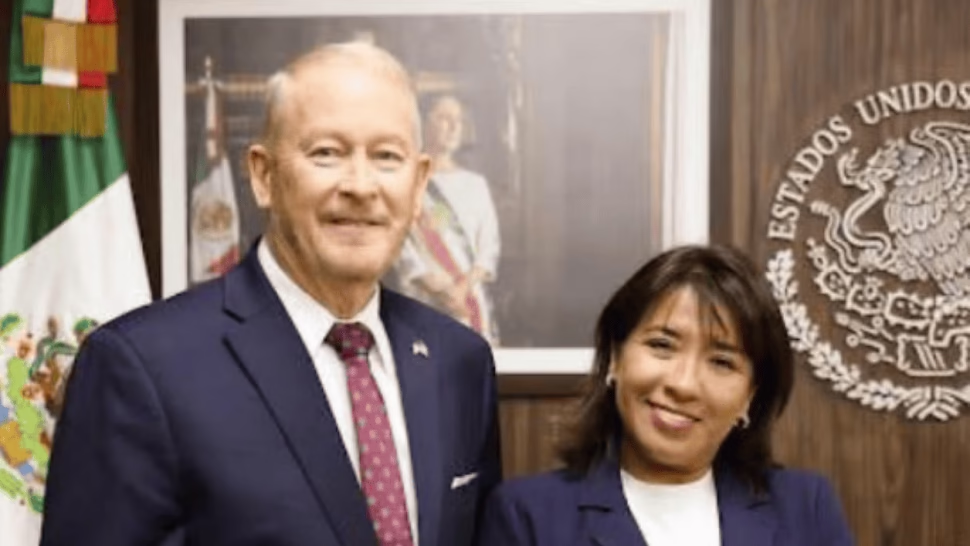
The United States ambassador to Mexico, Ronald Johnson, met with the Secretary of Agriculture, Columba López, following the bilateral agreement to reopen the border to livestock trade, affected by screwworm outbreaks.

Johnson described the meeting as productive and noted that it strengthens high-level cooperation. “Together we continue to generate results for the benefit of ranchers, producers and consumers of both countries,” he published on social networks.

Gradual reopening plan

The reopening will be staggered. It will begin in Sonora and then in Chihuahua, as reported by President Claudia Sheinbaum in her morning conference. The president recognized the work of former secretary Julio Berdegué and current secretary Columba López to achieve this progress.

Sheinbaum detailed the actions against the pest: from artisanal traps to the operation of a plant in Chiapas that produces sterile flies to prevent the spread of the larva. “It is considered that we are quite advanced to open the border in August,” he said.

The president highlighted the technical coordination between both governments. “There are still joint actions to be developed, but it speaks of good collaboration, very technical, to prevent this damage to livestock from spreading,” he concluded.

Continue reading

PAN demands Sheinbaum declassify Pemex audits

PAN deputies demand declassification of Pemex audits reserved for three years.

They demand declassification of Pemex audits

Deputies of the National Action Party (PAN) demanded that President Claudia Sheinbaum declassify the financial reviews and audits of Petróleos Mexicanos (Pemex) during the administration of Víctor Rodríguez Padilla. They considered the argument that it compromises strategic information “vague.”

This, after EL UNIVERSAL revealed that days before resigning from Pemex, Rodríguez Padilla classified the findings of internal audits as “reserved” for three years.

“False, it is about covering the corrupt backs of this man accused by his wife of physical abuse and domestic violence,” declared PAN member Paulina Rubio.

He added that reserving the information is a sign of the President’s “unconditional love and support” for women’s aggressors. “Now the president gives us a new face, her commitment to opacity and corruption in Pemex.”

Shield against corruption

Ernesto Sánchez, federal deputy of the PAN and member of the Transparency and Anti-Corruption Commission, warned that this is “a new attempt to shield corruption from citizen scrutiny.”

He pointed out that access to information is a constitutional right and that reservation is only justified exceptionally, not to hide irregularities or protect “friends” of the regime.

“Morena has turned the exception into the rule. What should be maximum publicity is used to close files and avoid accountability. Transparency cannot be applied only to adversaries. Reserving information of public interest feeds the suspicion of impunity,” said Sánchez.

Federico Döring, GPPAN spokesperson, stated that “all of Víctor Rodríguez’s misdeeds at Pemex before he left will remain hidden.” He pointed out that oil spills and “corrupt” contracts given to companies related to López Obrador’s children will be protected.

“Sheinbaum’s government protects this man so much that they watched his back so that the deals he made under higher instructions would not be known,” added Döring.

Raúl Torres Guerrero, local PAN deputy, assured that Pemex “is practically bankrupt” and reserving information compromises the administrative failure and would turn on red lights for international rating agencies. “For the world, Pemex is no longer a solid company but a burden for the Mexican State.”

Torres criticized that Mexico cannot compete “when it has corrupt companies that do not provide guarantees for investment, send oil to dictatorships like Cuba or give contracts to friends of children of former populist presidents like AMLO.”

Continue reading