Orange alert for rain and hail active in CDMX

The capital is preparing for aquatic chaos tonight. Check out the most affected areas and how to survive the flood.

The Sky is Falling Over (Literally)

It seems that the plan for this Saturday in CDMX has just been canceled by the most unpopular guest of all: total climate chaos. The Secretariat of Comprehensive Risk Management and Civil Protection (SGIRPC), that is, the anonymous heroes who are trying to put order in this disaster, have just activated the orange alert. No, it is not because of a shoe sale, it is because of the intensification of brutal rains and the very probable fall of hail. Basically, the city will become a giant blender during the afternoon and evening today.

The most affected districts, so you know if you should light a candle or run, are Cuauhtémoc and Gustavo A. Madero. Precipitation of between 30 and 49 millimeters is predicted and, the best (or worst), an ice storm that no one asked for. The natural spectacle not suitable for the faint of heart is scheduled between 4:20 p.m. and 11:00 p.m. this Saturday, September 13. Match with the number? We don’t say anything.

RelatedCDMX activates double alert for frost in six municipalities

Yellow Alert: In Case the Orange Drama Wasn’t Enough

But wait, there’s more. Not everything is the color of… well, orange. In order not to feel left out, eleven other municipalities are updated to yellow alert. The list is long: Álvaro Obregón, Azcapotzalco, Benito Juárez, Coyoacán, Cuajimalpa, Iztacalco, Iztapalapa, Magdalena Contreras, Miguel Hidalgo, Venustiano Carranza and Xochimilco. For these areas, the forecast is a little lighter, with estimated rainfall between 15 and 29 mm during the same period. Let’s say it’s the deluge express version.

Faced with this apocalyptic panorama, the authorities, with all the patience in the world, remind us of the basics that, it seems, we always forget. They recommend carrying an umbrella or a raincoat. Thanks, captain obvious. But then come the gems: don’t put grease or garbage down the drain. Seriously, does it need to be said? Apparently so, because every time it rains the city turns into Venice, but with dirty water and angry chilangos.

They also ask to sweep the drains and keep them free of garbage. That is, doing the work for which we already pay taxes. And please, do not pour grease down the drain (yes, they say it twice, because we know it’s hard work).

Urban Survival 101: How Not to Die Trying

If your plan is to go out, the SGIRPC asks you to avoid traveling on puddled or flooded roads. In other words, don’t try to cross the Pineapple River (or the one that forms in your neighborhood) with your car because you will end up trending on Twitter for the wrong reasons. Drive with extreme caution, because the street may be full of remains of trees and objects that the water swept away as if it were nothing. And stay away from places close to walls, trees, power lines and billboards that look more unstable than your long-distance relationship.

In case things get really bad (which, let’s be honest, is quite likely), here are the emergency numbers. Dial 911, 555658 1111 for Locatel, or 555683 2222 for the SGIRPC itself. Keep them on hand, because in the middle of an aquatic apocalypse, looking for the contact in your calendar is not the best idea.

In short, get ready for a disaster movie night, but without the Hollywood budget. Extreme weather is fashionable in the city and the best strategy is to stay home, watch a series and wait for everything to pass. Or pray. Or both.

Ready for the flood? Share this info with your friends so that no one is left out of the loop (or drowns). And don’t miss more weather updates that seem straight out of a catastrophic script.

T-MEC: Mexico, the US and Canada resume negotiations in July

Sheinbaum announces virtual and in-person meetings to review the T-MEC in July.

President Claudia Sheinbaum confirmed that on July 1 economic authorities from Mexico, the United States and Canada will hold a virtual meeting to advance the review of the T-MEC.

Scheduled meetings

“In any case, on July 16 or 20 there is a meeting here, in Mexico, to continue the talks,” declared the president. Sheinbaum specified that, although Washington has requested bilateral talks, Mexico insists on a trilateral format.

“The treaty is very good for the three countries; those who defend it the most are even the American, Mexican and Canadian companies themselves,” he added.

The president highlighted that Mexico and Canada have strengthened their trade and investment relationship. He mentioned a relevant project in the port of Altamira, Tamaulipas.

Canadian mining cases

Sheinbaum also referred to two cases of alleged irregularities by Canadian mining companies in Mexico, which are being analyzed by the Security Cabinet. He stressed the importance of complying with environmental laws, a topic he discussed with Prime Minister Mark Carney.

“Alicia Bárcena sent a list of problems of Canadian mining companies in Mexico that have not fully complied with remediation, environmental impacts or mitigation; they should comply,” he stated.

Profepa and Semarnat are working on these non-compliances.

Security and reduction of homicides

The president also highlighted a decrease in homicides during her administration, attributing it to the security strategy based on attention to the causes.

The July meetings will define the course of the review of the T-MEC, in force since 2020 and key for the regional economy.

Continue reading

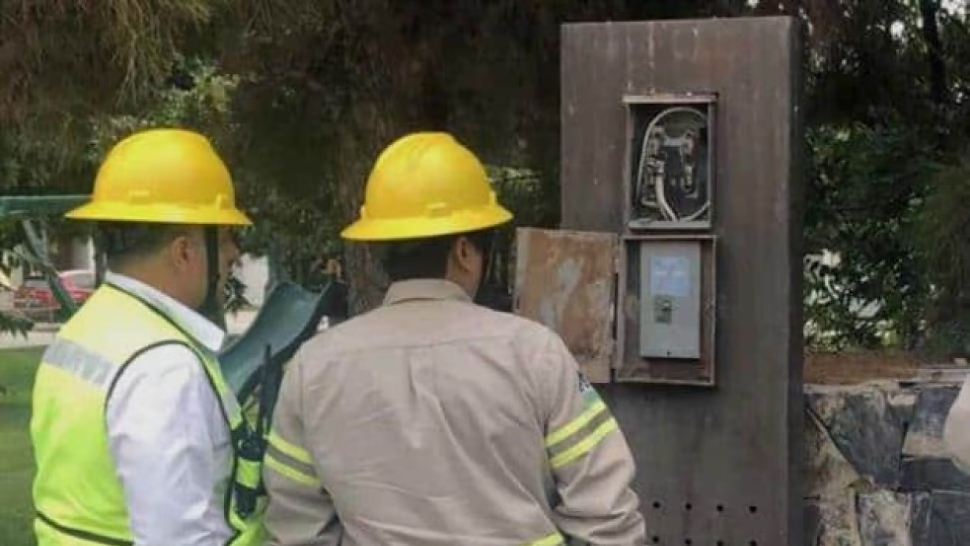
Labor trials against the CFE double in 2025

Litigations against CFE double in 2025, totaling 20,036 cases.

Labor litigation in the CFE: doubling in 2025

New labor lawsuits against the Federal Electricity Commission (CFE) doubled during 2025. According to the company’s annual report, 20,036 cases were reached.

In 2024, 9,944 processes were registered. In 2023 there were only 2,206. Specialists attribute the increase to tensions over working conditions, layoffs and benefits.

The CFE recognizes this scenario as a liability due to legal contingencies. It allocated 14,478 million pesos in 2025 to face possible adverse resolutions.

According to the report, the lawsuits include requests for reinstatement, recognition of seniority, pension adjustments, application of collective contracts and claims for benefits.

The company affirms that it has strengthened conciliation mechanisms. However, specialists warn that the increase in demands could reflect structural problems that affect the productivity and operation of the energy sector.

Continue reading

How to prevent illnesses and falls with low-cost changes

WEF study proposes simple changes in homes and physical activity to save billions.

Small actions, big savings

Reducing diabetes, preventing falls, and preventing dementia is possible with minimal home adjustments, physical activity programs, and accessible technology. This is stated by the World Economic Forum (WEF) in its study “The longevity dividend”.

The report estimates that shifting policies toward prevention would free up $6.4 trillion globally. These resources today are used to treat diseases that could be avoided.

Concrete strategies

To prevent falls, experts recommend grab bars and lighting on stairs. With an investment of less than 400 billion dollars, almost 400 million falls would be avoided by 2040. This would generate more than 5 trillion in health savings.

In diabetes, community physical activity programs could stop 8.5 million cases of type 2 diabetes by 2040. The cost per person ranges between one and 40 dollars, and the gains in productivity would exceed 125 billion.

Hearing loss has a direct link to dementia. Expanding access to hearing aids would prevent 2.4 million cases of dementia and save more than 325 billion in health.

Economic benefits

The study, applied in 21 countries by the WEF and Marsh, indicates that companies and governments address health, finances and work separately. If integrated, they would unlock 5.8 trillion in healthcare savings and 645 billion in productivity gains.

“Poor health strains health systems and personal finances, affecting financial resilience and generating broader economic costs,” the report warns.

Impact on women

A relevant fact: women who dedicate a year to care work see their retirement savings reduced by 24% due to absence from work and the wage gap. Institutions often treat these problems separately, despite their consequences.

The WEF concludes that there is a window of opportunity to align health, finance and employment policies. The key: allocate budgets to prevention and care for the elderly population with public-private collaboration.

Continue reading