Noroña defends AMLO’s children against accusations of huachicol

A judicial protection unleashes a political storm with crossed accusations and unexpected names in the crosshairs.

A Political Storm Breaks Up in High Efforts

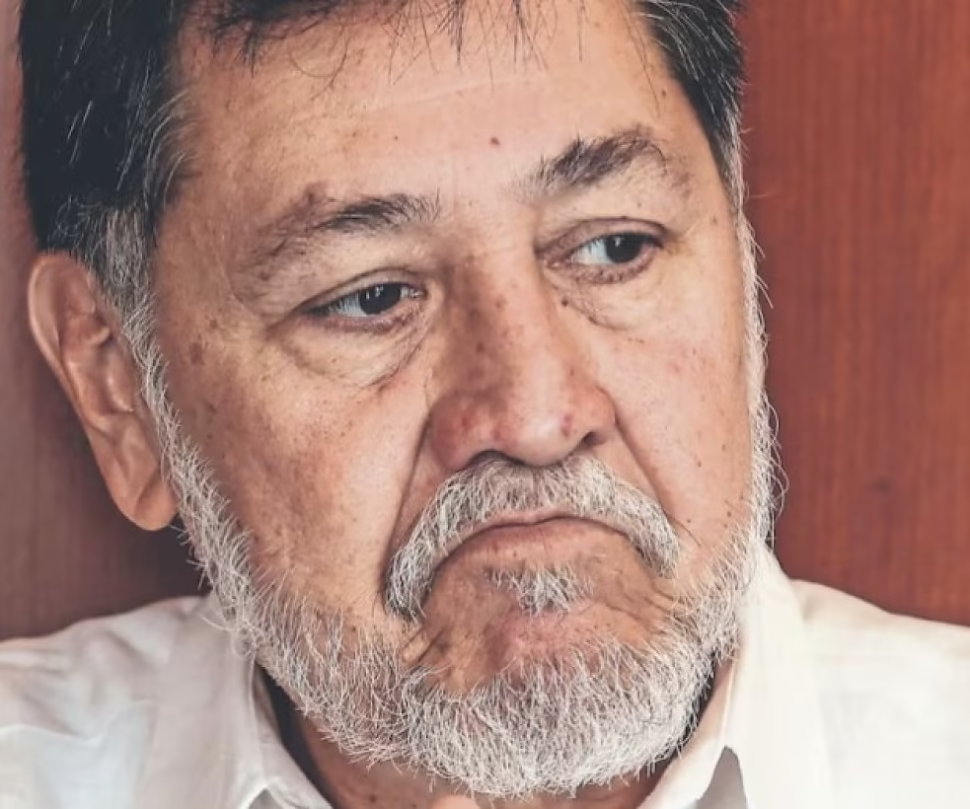
Former Senate President Gerardo Fernández Noroña emerged as a titan in the political arena, launching a fierce and passionate defense of brothers “Andy” and “Bobby” López Beltrán. This epic counterattack was triggered after the explosive revelation by journalist Claudio Ochoa, who uncovered the granting of a federal judicial suspension that, supposedly, protected them against any capture. The stage was set for a clash of titans, where truth and misinformation would clash in a duel to the death.

With the conviction of a prophet denouncing a heresy, the Morena senator declared that the information about this alleged protection was, simply, a monumental absurdity. “That type of protection does not exist!” he proclaimed vehemently, as if unmasking a deception hatched in the shadows. For Noroña, this was not a simple miscarriage of justice; It was the thunderous echo of a “new coup” orchestrated against the offspring of the former Tabasco president, Andrés Manuel López Obrador. Every word of his resounded like a thunderclap of indignation.

RelatedSheinbaum demands investigation of false protections against AMLO’s children

The Machinery of the Right in Motion

“The efforts made by the right to hit fellow president Andrés Manuel López Obrador are grotesque,” the legislator condemned, painting a picture of an epic struggle between light and darkness. In his narrative, the opposition would stop at nothing, doing “everything possible” to weave a web of guilt that would link the Tabasco native with the dark world of illegal fuel imports, the infamous huachicol. He recognized that AMLO has many strengths, but he elevated one above all: his unwavering and “unbeatable” honesty, a shield against which, according to him, all slander would crash.

But the plot twist of this novel was provided by the journalist Claudio Ochoa himself. He revealed that an individual named Francisco Javier Rodríguez Smith Macdonald had been the promoter of this mysterious protection before the second district court in Zacatecas. The mystery deepened: the strange thing, Ochoa whispered in disbelief, was that “he didn’t sign it.” And the plot thickened even more, since the protection not only involved the López Beltrán, but also dragged a gallery of sinister characters linked to networks of huachicol fiscal, such as rear admiral Fernando Farías Laguna and the enigmatic Roberto Blanco Cantú, known as “The Lord of the Ships.” An explosive and suspenseful association.

The tangible evidence, file number 2098/2025, confirmed on the website of the Federal Judiciary Council, added a chilling air of verisimilitude to the plot. There, in the cold legal letter, appeared the names registered in the reception of the lawsuit “against acts of the head of the Prosecutor’s Office of the State of Zacatecas and other authorities.” A list that read like the cast of a high-octane political thriller, where each name was a piece in a puzzle of power, corruption and ambition.

The list of those involved sounded like the reading of a fatal destiny: Andrés Manuel López Beltrán, Gonzalo López Beltrán, César Reyna Carrillo, Juan Carlos Madero Larios, Miguel Ángel Solano Ruiz, the intriguing Diana Heleyn Foullon Gómez “Lady G”, the aforementioned Roberto Blanco Cantú “The Lord of the Ships”, Fernando Farías Laguna, Carlos Estudillo Villalobos, Sergio Varela, Bertha Elizabeth Castro, Elvira Xóchitl Palomo, Ismael Ricardo Matías, Anatalia Joselín Gutiérrez, Raúl Mendoza and Raúl Torres. A mosaic of intertwined destinies in a game where the stakes could not be higher.

This story, loaded with passion, intrigue and veiled accusations, weaves a narrative where nothing is what it seems and each revelation shakes the foundations of the public sphere. The battle for narrative, reputation and power has just found a dramatic new chapter that promises to leave the nation on the edge of its seat, wondering what surprise the next episode of this political saga will reveal.

Do you think you know all the details of this intricate case? Share this explosive story on your social networks and stay tuned so you don’t miss a second of this exciting story and continue browsing to explore more content related to the ins and outs of national politics.

Somos México reserves 20% of candidates for activists

The new party will allocate a fifth of its spaces in Congress to seeking mothers and human rights defenders.

Nominations for activists

The leader of Somos México, Guadalupe Acosta Naranjo, announced that the party will allocate 20 percent of its candidacies to the Congress of the Union for seeking mothers and other social activists. None of the members of the National Executive Committee will hold a popularly elected position, he reiterated.

In the party’s first public event—approved by the INE on June 25—Acosta Naranjo pointed out that parties must serve society, not their bureaucracies.

“Somos México is going to reserve 20 percent of its majority and proportional representation candidacies so that searching mothers can come to the Chamber of Deputies, so that human rights defenders can come… representatives of farmers, transporters, fishermen, environmentalists, young people. They are not going to see us,” he stated.

Open selection process

Before hundreds of supporters at the Monument to the Revolution, the leader announced that a third of the candidates will be for those under 35 years of age. No candidate will be appointed by the leadership.

“None of us is going to be a candidate using the position that was given to us today for personal gain. I am not going to be a candidate for anything… When there are two or more candidates, we are going to put ballot boxes in public squares. The citizens will choose those who represent us,” he declared.

Acosta Naranjo warned that they will defend until the last moments the name, colors and emblem of the party, approved by the INE, despite the fact that the authority today asks to modify them. He argued that being called “Mexico” is valid, since there is the Green Ecologist Party of Mexico and before Fuerza por México.

On July 25, the first session of the National Council of Somos México will be held to define its country project.

Continue reading

Edomex reinforces health prevention in eight eastern municipalities

Eight municipalities in Edomex join a health prevention strategy with a focus on obesity and teenage pregnancy.

Expanded coordination in the Eastern Zone

The Government of the State of Mexico intensified its work with eight municipalities in the Eastern Zone to strengthen health prevention. The priorities: combat overweight, obesity and reduce teenage pregnancies. The strategy is part of the Comprehensive Plan for the Eastern Zone and the national preventive medicine policy.

At a working table, state, federal and municipal authorities agreed to advance in the integration of the Mexican Network of Municipalities for Health, as well as in the certification process of Health Promoting Municipalities.

The state Secretary of Health, Celina Castañeda de la Lanza, explained that the objective is to coordinate actions between the three levels of government. This includes measures against addictions, vector-borne diseases and the aforementioned problems of weight and early pregnancy.

The Network will allow municipalities to exchange experiences to address local needs. Daniel Aceves Villagrán, general director of Public Health Policies of the Government of Mexico, highlighted that the model incorporates care for people with disabilities and those living with chronic diseases, especially in areas of high population density.

Representatives from Nezahualcóyotl, Naucalpan, Chimalhuacán, Valle de Chalco, Ixtapaluca, Ecatepec, Texcoco and Chicoloapan participated. These municipalities began the procedures to obtain certification as Health Promoting Municipalities, which will expand preventive actions throughout the region.

Continue reading

Pemex cuts investment and production deviates from the goal

Pemex reduced its investment by 5.9% in the first quarter; crude oil production is moving away from the goal.

Pemex adjusted its spending again. The exploration and production subsidiary received a 5.9% cut in its investment capital during the first quarter compared to what was scheduled.

The approved budget was 86.7 billion pesos, but the company reported to the US Securities and Exchange Commission that it invested 81.6 billion. The difference directly affects the production platform.

Currently, Pemex extracts 1.6 million barrels per day, far from the goal of 1.8 million. Gonzalo Monroy, director of GMEC, warned:

“We are flying directly and non-stop at 1.2 million barrels per day in 2027, which means that once the water is discounted, we would be at a million extraction levels during the next year.”

Drilling rigs also decreased: from 32 to 25 between January and May, according to data from the consulting firm. So far this six-year term, 10 mixed contracts have been awarded, seven in a first block (fields such as Macavil and Tamaulipas) and three recently (Rabasa, San Ramón and Cinco Presidentes). Pemex plans to produce up to 450 thousand barrels per day with these contracts, but the developments would take place beyond 2033.

Oil vocation in question

Miriam Grunstein, an academic at the Mexico Center at Rice University, said that the situation is alarming in the short term. Pemex loses income from lower exports and from privileging feeding the National Refining System, instead of extracting more crude oil.

“Sheinbaum’s government is betting on renewable electricity generation projects. Meanwhile, the budget cut in crude oil extraction indicates that the country no longer has a conviction or vocation for oil,” he said.

Grunstein added that the difference in investment between renewable energy and exploration is enormous: “At some point we are going to face a very harsh reality. The abandonment of extraction has been so much that it is alarming.”

Agreement with Petrobras, but without teeth

The Mexican government signed a collaboration agreement with the Brazilian Petrobras to acquire extraction techniques in deep waters, where Pemex has minimal activity. It includes exchange of knowledge and best practices, but the pact is non-binding, valid for two years and renewable.

Both Monroy and Grunstein agreed that the agreement was weak. Moody’s, when lowering Mexico’s rating on May 20, expressed greater concern about government debt and support for Pemex. The agency estimated that the government provided support for 35 billion dollars in 2025, equivalent to 1.9% of GDP, and budgeted another 14 billion for 2026. An improvement in the rating will depend on reducing the deficit and contingent risks of the oil company.

Continue reading