New water law in Mexico generates polarization and national debate

The regulations that seek to order the use of the resource confront authorities with communities and experts, who warn about its possible effects.

Analysis of the new water regulation and its implications

The recent approval of the General Water Law in Mexico has triggered an intense national debate, marked by a deep division between the government’s vision and the warnings of civil society. The regulations, promoted by the administration of President Claudia Sheinbaum and quickly endorsed by the ruling legislative majority, aim to establish a renewed framework for the management of water resources in the country. According to the official position, represented by the Secretary of the Interior, Rosa Icela Rodríguez, the legislation will provide “support and certainty to productive areas” and is essential to “bring order” in the management of concessions and the use of water in productive processes, guaranteeing its availability for the entire population.

However, this discourse clashes head-on with the perspective of environmental activists, researchers and directly affected communities. Critics argue that the legislative process was rushed and exclusive, without genuine consultation with the peasant and indigenous sectors whose livelihoods depend on access to water. For these voices, far from solving structural problems, the law consolidates a model that benefits large industrial and agroindustrial consumers.

RelatedReform to the National Water Law recovers powers of the State

The core of the conflict: control, concessions and consequences

The technical and social disagreement focuses on several critical points. On the one hand, the government emphasizes the need to combat the misuse of the vital liquid, its transfer for profit and any practice that violates the human right to water. On the other hand, experts such as Cuauhtémoc Jacobo Femat, from the Yucatán Autonomous Water Comptroller’s Office, point out that the regulations fail to address root problems such as “over-concessioning” and “hoarding of water” by large corporations. According to this analytical view, the law does not establish robust mechanisms for these industries to repair the environmental, economic and social damage they generate, leaving vulnerable communities without compensation.

The political dimension of the conflict is unavoidable. Opposition figures, such as Senator Manuel Añorve Baños of the PRI, have described the regulation as an instrument created “to control the people“, reflecting distrust of the central government’s intentions. This perception is fueled by the speed of the legislative process and the farmer protests that, in previous days, took their discontent to the doors of Congress. The government’s promise to maintain work tables with rural producers seeks to mitigate these tensions, although without completely dispelling fears of greater state control and a possible impact on food sovereignty.

In essence, the polarization around the General Water Law transcends a simple legal discussion. It represents a confrontation between two management models: one that prioritizes legal certainty and centralized regulation from the State, and another that demands community and sustainable management, with a focus on water justice and damage repair. The true impact of this legislation will be measured in its practical implementation, in its ability to balance economic development with the protection of the resource and, above all, in guaranteeing equitable access to water in a country that faces increasing water stress and social inequality.

Are you interested in understanding how environmental policies affect your region?Share this analysis on your social networks and explore more specialized content on sustainable development and community rights on our site.
Sheinbaum announces 42 CT scanners and telemedicine to strengthen health

The president detailed investments in medical equipment, telemedicine and improvement of clinics.

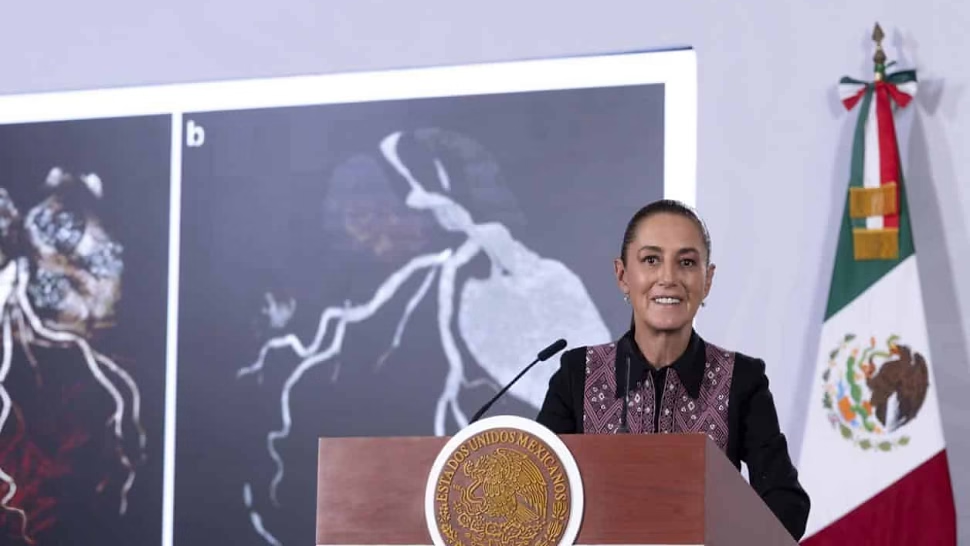
President Claudia Sheinbaum reported on advances in the public health system, with investments in equipment, telemedicine and improvement of clinics. He affirmed that the State must guarantee access to health from prevention to care for complex diseases.

“We are compensating for the profound damage that neoliberalism caused in the health system,” he said at the morning conference.

Equipment and telemedicine

The IMSS installed 42 state-of-the-art CT scanners in 40 hospitals in 19 states. Of these, 41 are from 256 cuts. They allow early detection of tumors and bleeding, perform up to 50 studies per day and reduce waiting times. They were acquired for 29 million pesos each, below the 40 million in the past.

The ISSSTE expanded telemedicine from 239 to 859 units. It offers consultations in 15 specialties, such as cardiology and dermatology, from 118 second and third level units to 741 first level.

The Clinic is Ours

The La Clínica es Nuestra program delivered 4,608 million pesos in 2025 to 8,483 medical units, with the participation of 67,864 people. 42 thousand improvement actions were carried out in infrastructure and equipment. The 2026 call will begin in July, including for the first time 153 units from Yucatán with 80 million pesos.

Sheinbaum added that progress is being made in the House to House Health program, with more than 20 million consultations with older adults and people with disabilities. Starting in August-September, you will be able to collect medications at Farmacias del Bienestar, health centers and a network of pharmacies. Next year the Universal Health Service will begin with a single credential.

Continue reading

Massive security reinforcement and alcohol ban at the Azteca

56,000 police officers and alcohol restriction for the game at the Azteca.

Measures for the Mexico-Czech Republic match

The government of Mexico City announced an unprecedented security operation for this Wednesday’s game at the Azteca stadium. 56,000 personnel will be deployed, five times more than the 11,219 employed last week.

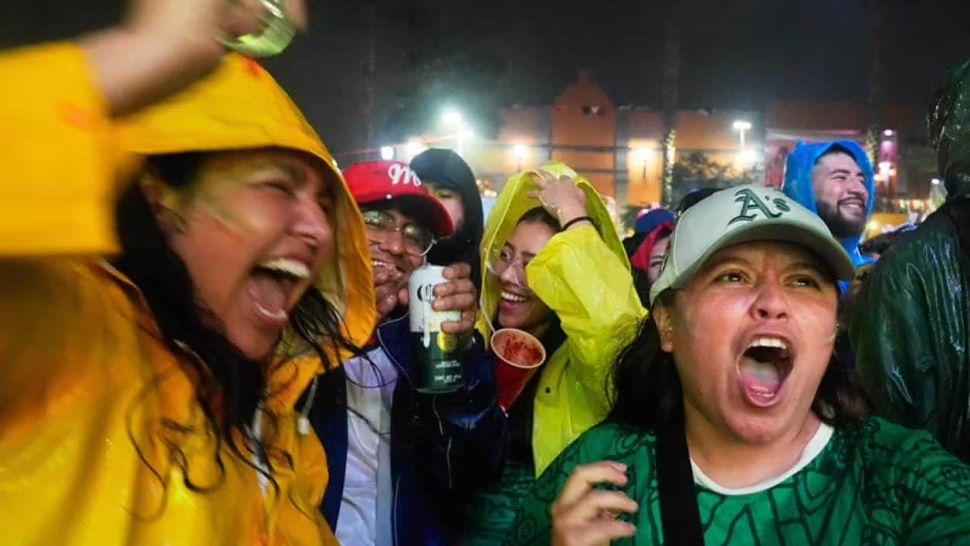
The decision responds to the celebrations of the previous Thursday, when some 700,000 people gathered in the capital after Mexico’s victory over South Korea. Although there were no injuries, nearly 40 tons of garbage were collected in the Ángel de la Independencia and the Zócalo.

The Secretary of Security, Pablo Vázquez, detailed that 7,500 police officers will guard the Azteca stadium. Another 3,275 will be in the Zócalo and 4,200 on Reforma Avenue. The objective is to protect players, referees, authorities and fans.

In addition, the Secretary of Government, César Cravioto, reported that starting at 3 p.m. on June 24, a ban on the sale of alcohol will take effect for sixteen hours. Applies to the Historic Center and five neighborhoods of Cuauhtémoc.

Sales will only be allowed in restaurants, hotels and private clubs, accompanied by food. Convenience stores and supermarkets are excluded. The fines for non-compliance amount to up to 293,275 pesos (about $17,251).

The Mexican Alliance of Transporters Organization (AMOTAC) called for mobilizations on highways in the 32 states and blockades in the capital to protest against the violence. The operation also considers these protests.

Continue reading

UNAM, new WHO collaborating center in oral health

The WHO recognizes UNAM as a reference in oral health and aging.

International recognition for UNAM

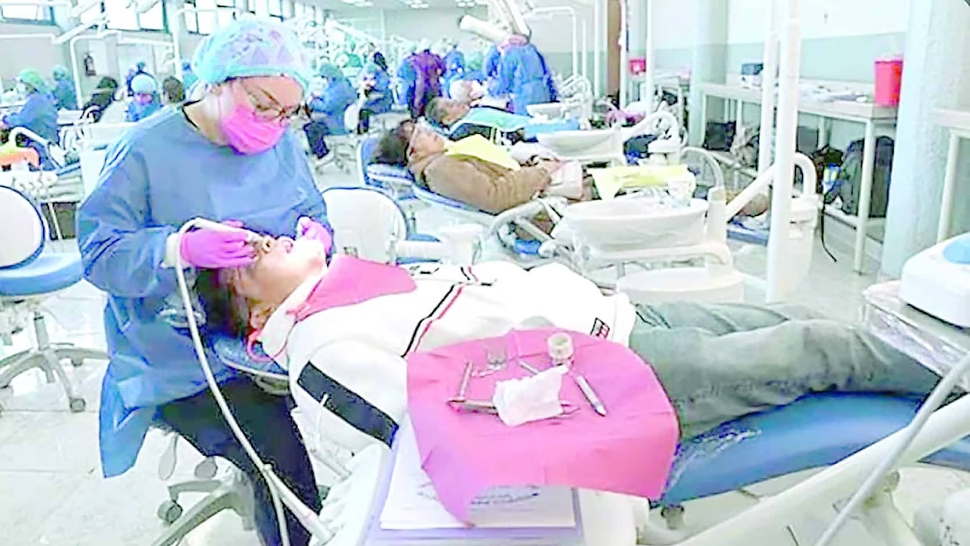
The World Health Organization (WHO) designated the Department of Oral Public Health of the UNAM Faculty of Dentistry as a Collaborating Center in Oral Health and Aging. The distinction is valid for four years.

With this appointment, the highest educational institution consolidates itself as a regional reference in the comprehensive care of older adults.

Implications of the appointment

The recognition will allow university specialists to participate in the development of public policies focused on improving the quality of life of the elderly.

In addition, they will promote strategies to promote among older adults and caregivers the importance of maintaining adequate oral health as an essential part of general well-being.

The designation places UNAM on a level of technical cooperation with the WHO, which opens opportunities to influence global guidelines on aging and oral health.

Continue reading