MrBeast builds schools to combat global lack of education

YouTube's biggest influencer finances the construction of schools in vulnerable communities in several countries, including Mexico.

The B side of MrBeast: when the show becomes classrooms

The news came as just another video on his channel, but the impact is real. James “MrBeast” Donaldson, the American content creator, temporarily swapped extreme challenges for cement and blackboards. His new project: build schools in areas where access to education is almost a luxury.

“It breaks my heart that more than 200 million children do not have access to a safe education, which is why we spend months building schools around the world,”

Donaldson detailed in his announcement.

RelatedPrince Andrew loses his last royal titles after scandal

From YouTube to Ghana: the geography of aid

The initiative covers five countries: Ghana, Ecuador, the United States, India and Mexico. They are not random places. They are regions with “greater economic scarcity and poor sanitary conditions,” as the project itself describes. The goal was clear: ten schools to start.

In Mexico, the work took place in San Andrés Tepetitlán, a rural community in the State of Mexico. There, middle school and high school students shared a single campus due to lack of space. MrBeast and his team built a Higher Secondary School from scratch.

But they didn’t just stay in the classrooms. The project included:

  • A soccer field
  • Administrative offices (teachers used to work from their cars)
  • Departments for teachers in India (who spent a third of their salary on transportation)
  • Drinking water wells to prevent diseases
  • School lunch kitchens

The icing on the cake: a five-year commitment to free meals for every school.

“We do not simply come to build schools, we come to completely change the life of communities,”

stated the influencer.

Behind the effort there are big names: Fundación Televisa, T-Mobile, Lowe’s and even the Rockefeller Foundation contributed support. Even the Mexican actor Eugenio Derbez appeared in the final images of the project.

The question that remains – and that no official statement answers – is how long this type of intervention lasts after the cameras are turned off. Collective memory is fragile with these spectacular gestures. But for now, in San Andrés Tepetitlán, the desks are new and the children have bathrooms where they can wash their hands.
Earthquake in La Guaira: 2,295 dead and thousands missing

Families seek to identify their loved ones in the rubble before mass graves.

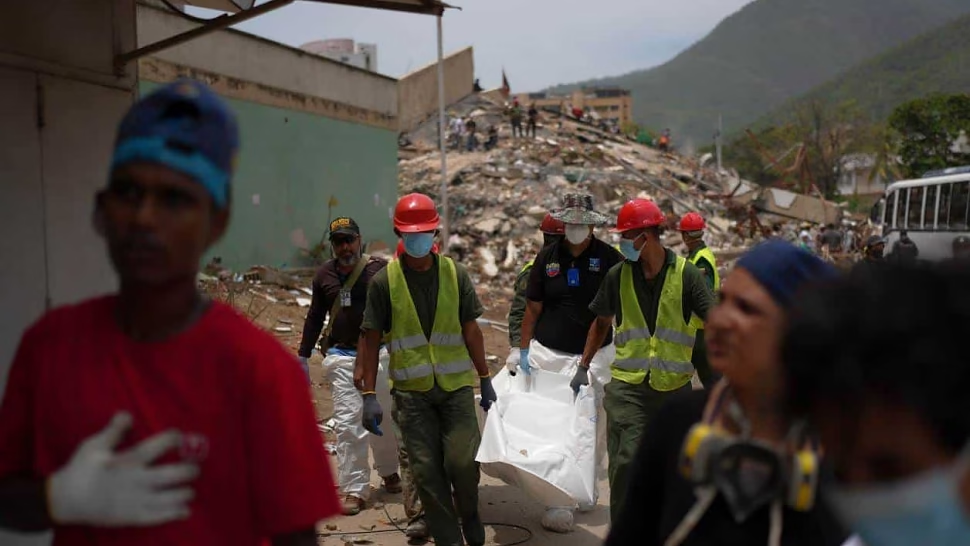
The tragedy of the June 24 earthquake in the Venezuelan state of La Guaira leaves at least 2,295 dead. Thousands of people remain missing. Hundreds of families tour hospitals and makeshift morgues to identify bodies before they are sent to mass graves.

Number of victims and rescue efforts

The forensic teams, led by technician Joel Mirabal, work tirelessly. According to specialists, between 60 and 70 percent of the victims are recognized by family or neighbors. The advanced state of decomposition complicates tasks. Refrigerated containers have been installed due to the increase in bodies. The authorities do not rule out opening mass graves.

Around the port of La Guaira and the temporary morgues, dozens of families remain formed for hours. They use tattoos, scars or clothing to confirm identities. The uncertainty about the fate of the missing aggravates the pain.

The drama of families

Rosa López recounted the difficult process of finding the body of her son-in-law, José Antonio Toledo, who died when the building where he worked as a security guard collapsed. After visiting several sites, the family managed to identify his remains. Without resources for a funeral service, the mayor’s office gave them a free space to bury him.

Rescuers estimate that recovery efforts will last at least three months due to the number of collapsed buildings. Thousands of volunteers have joined the search, hoping that families can say goodbye to their loved ones.

Continue reading

Sheinbaum announces investment of 4 billion pesos for the Purépecha people

The president detailed new commitments in health, education and security during her visit to Michoacán.

Justice Plan for the Purépecha people

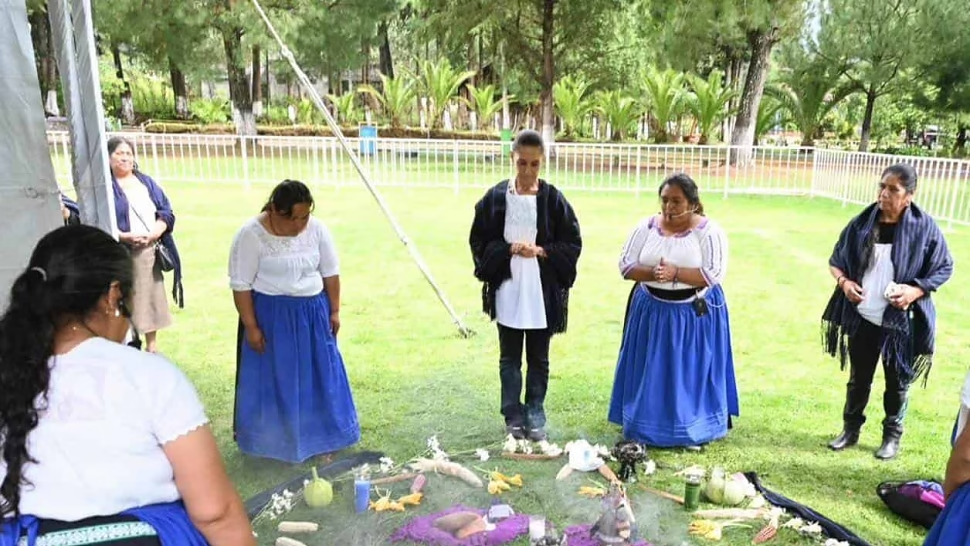
From Cherán, Michoacán, President Claudia Sheinbaum highlighted the progress of the Justice Plan for the Purépecha people. One year and two months after its implementation, more than 4 billion pesos (mp) have been allocated for health, education, roads and security.

“How are the Justice Plans made? With you. They are not made in an office of the federal government, of the State Government, they are made in assemblies,” said Sheinbaum.

The president recalled that, with the Second Floor of the Fourth Transformation, the Constitution was modified to recognize indigenous and Afro-Mexican peoples as subjects of public law. In addition, the Contribution Fund for the Social Infrastructure of Indigenous and Afro-Mexican Peoples (FAISPIAM) went from 12 thousand million pesos in 2025 to 13 thousand 500 million pesos by 2026, with the objective that this resource is established in the Constitution so that it increases each year.

The director of INPI, Adelfo Regino Montes, detailed the distribution of the investment: 27 artisanal paths (74.34 km, 485.01 million pesos), School Houses and Canteens for 527 children, 21 Community Houses of Indigenous Languages, and 161 communities benefited from FAISPIAM (212.74 million pesos in 2025 and 234.47 mdp in 2026).

Sheinbaum announced new commitments: improve the Cherán Hospital with a hemodialysis area, fix the Sports Unit, open degrees in Medicine and Nursing, strengthen community businesses, build a C2 in the community and hold a meeting on security in Mexico City.

The Undersecretary of Sciences and Humanities, Violeta Vázquez-Rojas, reported other advances: construction of an ISSSTE hospital, studies for an IMSS Bienestar hospital, hiring of 646 doctors and more than a thousand nurses, a National Guard barracks for 150 elements, remodeling of 17 highway sections, delivery of 27 thousand efficient stoves, and translation of the Women’s Booklet into Purépecha.

The governor of Michoacán, Alfredo Ramírez Bedolla, supported the initiative and highlighted the defense of the uses and customs of the native peoples.

Continue reading

Colombians arrested for training in the manufacture of explosives in Michoacán

Colombian detainees linked to the manufacture of explosives in Michoacán.

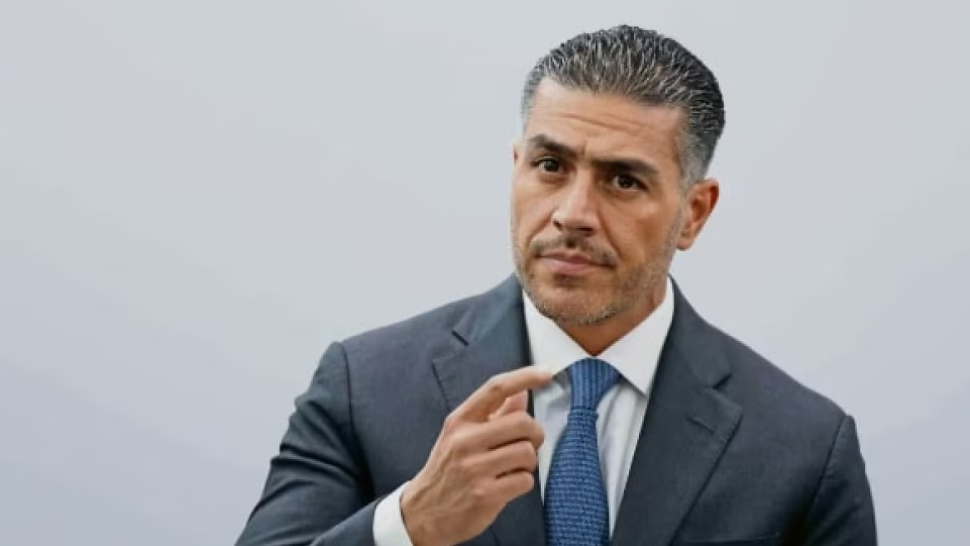
The Security Cabinet has arrested Colombian citizens linked to the training and manufacturing of improvised explosive devices in Michoacán. This was reported by the Secretary of Security and Citizen Protection, Omar García Harfuch, during the morning conference on Friday, July 3 in Morelia.

These arrests are part of investigations that identified the entry of several people involved into the country, mainly through the Mexico City International Airport and other air entry points. The National Intelligence Center monitored these movements.

The entry of foreign people by land was also detected, who allegedly collaborate in the training of members of criminal groups to install these devices. García Harfuch pointed out that there is an ongoing investigation to locate the leaders of these networks in Michoacán, including alleged high-level members of the Jalisco Nueva Generación Cartel.

The head of the SSPC confirmed the participation of citizens from different countries, mainly from Colombia. We are working in coordination with Colombian authorities to strengthen the investigations. In the coming days, the exact number of people arrested related to the manufacture and use of these explosives will be specified.

Continue reading