
Morena deploys its territorial machinery in Tamaulipas

The party machinery is put into motion with a display of assemblies and committees to consolidate the base.

The Perfect Choreography (or the Art of Assembling a Committee)

It seems that August 17 was not just any day on the Morenoist calendar. No, gentlemen. That day marked the great strategic deployment for the integration of the Morena Committees in Tamaulipas. A titanic task, without a doubt, that fell on the shoulders of the senator and mentor Olga Sosa. Because in this party, one is not simply a member; You are an apostle, spiritual guide and territorial organizer, all in one.

The senator, in an act of partisan devotion that almost borders on the mystical, met with the national president of the executive committee, Luisa María Alcalde. The setting: the sacred national offices. The objective: receive the tables of the law, sorry, the expressed parameters for the mission. Imagine the scene: unfolded maps, flow charts and the solemnity of someone planning the Normandy landings, but to place booth coordinators.

RelatedTamaulipas promotes Mexico’s energy sovereignty with strategic projects

The Second Floor of Transformation and Its Weekly Assemblies

And what would a good movement be without its weekly assemblies? It seems that Senator Sosa has been more than busy detailing the information work in these meetings. There, he becomes aware of the reforms and laws passed, an exercise that must undoubtedly be as exciting as reading an instruction manual aloud. But hey, it’s for the cause: the management of President Claudia Sheinbaum Pardo in matters of well-being, justice and education. What they call, with a pomp that deserves a golden globe, the second floor of the fourth transformation. It sounds like a new level of a video game, but in real life.

The Morenoist senator, with the precision of a Swiss watch, specified that all this effort of affiliation and participation in the committees is nothing more than an example of work to strengthen the movement from its base. She said it herself, with the conviction of someone who discovers gunpowder: “it represents the greatest effort of territorial structure that we have ever undertaken.” Sure, because organizing a family barbecue is one thing, but coordinating a network of committees across an entire state is quite another. Almost, almost, like putting together an army of ideologically pure volunteers.

Loyalty, Legacy and Closeness: The Morenista Holy Grail

Of course, the obligatory mention of work in the territory, that characteristic hallmark of the country’s transformation movement, could not be missing. In Tamaulipas, they tell us, Sheinbaum’s management is strongly supported. And not only that: the legacy of President Andrés Manuel López Obrador is cared for with a sacred trinity: unity, organization and ideological loyalty. It sounds like an oath of knights of the round table, but with colorful t-shirts and batons.

To close with a flourish, Senator Sosa launched the phrase that sums it all up: “We will continue walking closely with the people of Tamaulipas”. A statement that conjures up images of epic hikes, baby hugs, and endless selfies. Because at the end of the day, what would politics be without a good dose of theatrics and the promise of closeness that, who knows, might include a hug or a warm greeting?

In summary, while the rest of the world worries about the climate or the economy, in Morena they have a clear mission: to weave a network of committees with the precision of a spider constructing its ideological web. And Tamaulipas is the perfect canvas for this organizational work of art.

Did you like this sarcastic look at partisan politics? Don’t stay curious: share this article on your social networks and provoke a smile (or a debate) among your contacts. And of course, explore more of our content to continue laughing at the grandiose realities of power.
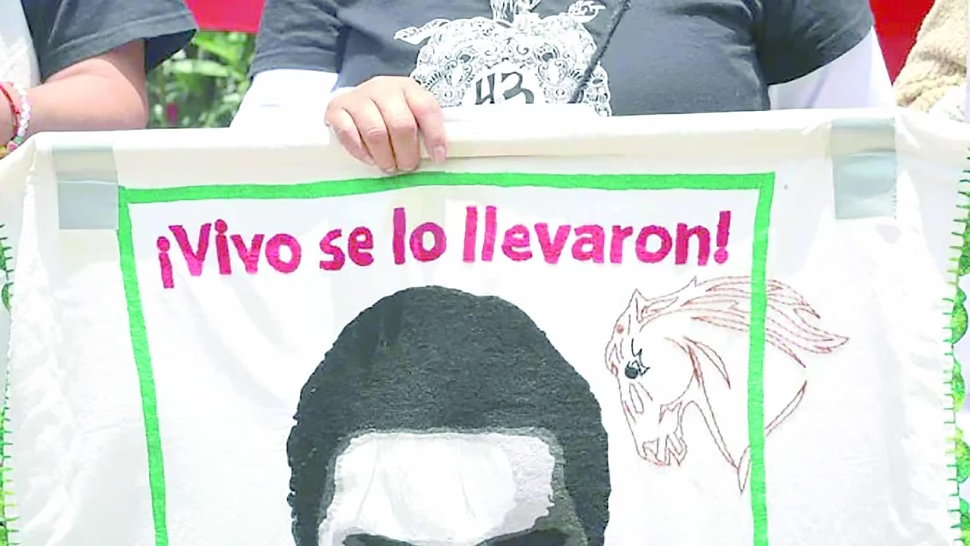
Court analyzes whether a judge can order a Truth Commission in Ayotzinapa

The SCJN will review whether a judge can create a Truth Commission in the Ayotzinapa case.

Unanimous decision of the Plenary Session

The Supreme Court of Justice of the Nation (SCJN) agreed unanimously by eight votes to attract an extraordinary review resource. The objective: to determine if a judge can order the creation of a Truth Commission as an exceptional investigative mechanism within an amparo trial related to the Ayotzinapa case.

The Plenary will evaluate whether this judicial power violates principles such as the division of powers or the relativity of sentences. A minister will prepare the draft resolution that will be discussed later.

Excuse due to conflict of interest

Minister Sara Irene Herrerías Guerra excused herself from participating in the analysis and resolution. He argued a conflict of interest for having previously headed the unit of the Attorney General’s Office of the Republic in charge of investigating the Ayotzinapa case.

In addition, the Court attracted four appeals linked to the 2018 ruling that rejected the so-called “historical truth” about the disappearance of the 43 normalistas. That ruling ordered the investigation to be reinstated through the creation of a Commission for Investigation and Truth in the Iguala case.

Reactions of organizations

The Miguel Agustín Pro Juárez Human Rights Center questioned the decision. He considers that it reopens the debate on a key resolution for clarifying the case. The organization recalled that, almost 12 years after the disappearance of the students, pending issues persist, such as access to relevant military information and progress in extraditions essential for the investigation.

Continue reading

Mexico records the day with the fewest homicides in eight years

25 deaths in one day: the lowest number in eight years in Mexico.

Day with the least deprivation of life since 2018

Monday, July 6, 2026, became the day with the fewest deaths due to intentional homicide in Mexico during the government of President Claudia Sheinbaum and in the last eight years. The Executive Secretariat of the National Public Security System (SESNSP) counted only 25 victims.

Fourteen states did not report any intentional homicide that day. The figure exceeds the minimum recorded during the previous administration, which was 39 victims on January 20, 2022.

Where did the homicides occur?

52% of the cases were concentrated in six entities: Michoacán (3), Sinaloa, Puebla, Tabasco, Chiapas and Morelos (2 each). The rest was distributed in other regions.

The report shows other days with low rates in 2026: 28 victims on June 7 and July 3; 29 on May 15; 31 on various dates in February, April and May. Also on March 21, 2026 and September 26, 2025, 32 deaths were reported, figures that are now exceeded.

Security specialists warn that a single day does not reflect a permanent trend. The evaluation should be based on monthly and annual averages to measure structural changes in violence.

Continue reading

Senator proposes eliminating mandatory cell phone registration with CURP

Seeks to repeal the obligation to register cell lines with CURP.

Initiative to protect personal data

The senator from Movimiento Ciudadano, Alejandra Barrales, announced that she will promote an initiative to eliminate the obligation to register mobile telephone lines with personal data such as the Unique Population Registration Code (CURP). Considers that this measure violates fundamental rights of users.

The proposal will be presented to the Permanent Commission of the Congress of the Union. It proposes repealing provisions of the Law on Telecommunications and Broadcasting that establish the mandatory registration of cellular lines as a requirement to activate or maintain the service.

Barrales explained that he seeks to eliminate articles 103, 164 section III and the Thirtieth Transitory article of said legislation. The objective is to annul the scheme that forces users to provide personal information to keep their lines.

Destruction of collected data

The initiative also contemplates the definitive destruction of data collected through this mechanism. The idea is to prevent the information from being reused, transferred or used for different purposes by authorities or individuals.

The senator maintains that access to information technologies and telecommunications services is a right recognized in the Constitution. Therefore, any measure that conditions its use must be analyzed under criteria of protection of privacy and citizen rights.

If implemented, this initiative would represent progress in the protection of personal data and the defense of user rights in telecommunications.

Continue reading