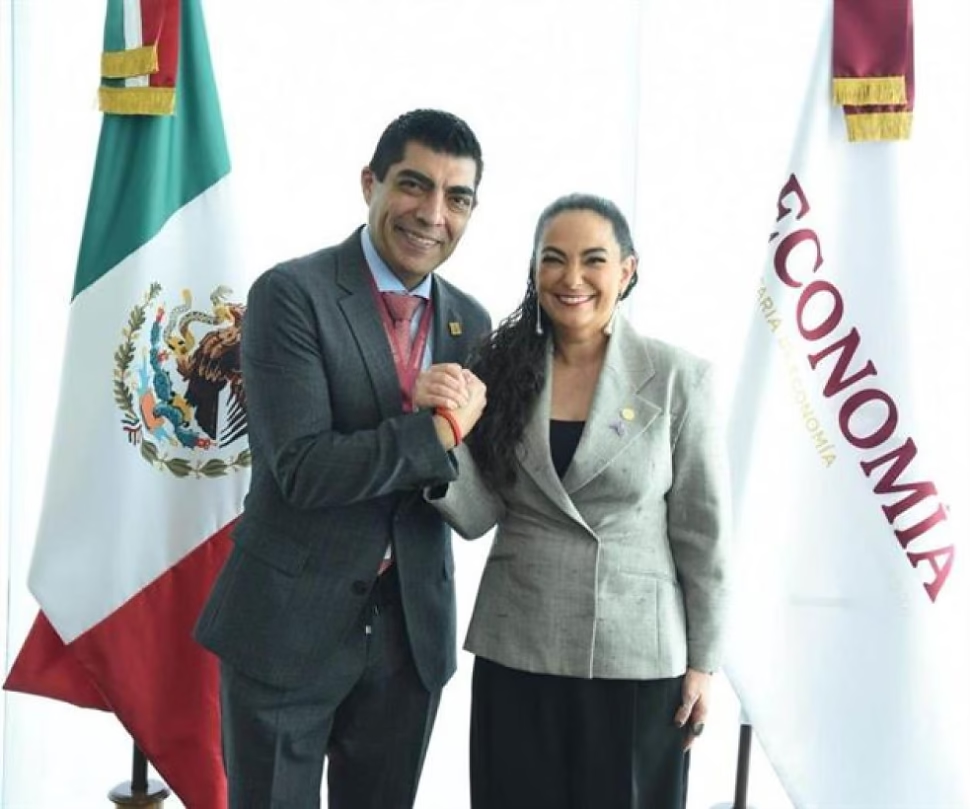
Sosa analyzes investments for Tamaulipas in key meeting

The senator meets with a federal official to analyze strategic projects and the impact of the trade agreement on the entity.

The official photo and what is not seen

Senator Olga Patricia Sosa sat down with Carlos Candelaria López, the head of the brand new State Investment Committees. The official reason: analyze progress in economic projects for Tamaulipas. Sounds good, right? It always sounds good.

Candelaria is touring the country promoting public consultations. The results, they say, show “confidence” in the T-MEC. The right word that every official wants to hear.

“…coordination and good will to detonate potential sources of employment…”

That’s what Sosa said, who is also secretary of the commission that monitors the trade agreement. He spoke about the Wellbeing Pole in Altamira and these new committees that replace the old economic corridors. They change names, they change structures. The goal sounds familiar: bond with those who produce.

RelatedMorena deploys its territorial machinery in Tamaulipas

For her part, Candelaria shared the “efforts” on the instructions of President Sheinbaum and through Marcelo Ebrard. Maintain a close presence with states and the productive sector. Dialogue about the T-MEC, investments and challenges.

Petrochemicals was especially mentioned as a “vocation of southern Tamaulipas.” A strategic industry that always promises development.

The predictable growth script

The meeting highlighted the need to align everything with Plan Mexico. Produce more here, attract investments, consolidate chains. They agreed on the advantages of Tamaulipas: location, infrastructure, industrial vocation.

Sosa highlighted the “Made in Mexico” seal. Strengthen national production and integrate the state into high-value sectors: semiconductors, technological innovation, sustainable energies. The key words of any modern economic discourse.

The data could not be missing: Tamaulipas concentrates manufacturing and is on the border that moves about 60% of the trade with the United States. A strategic role in continental supply chains.

They talked about coordination, will, efforts and potential. The photos were taken. The bulletins were written. The wheel keeps turning.


Court analyzes whether a judge can order a Truth Commission in Ayotzinapa

The SCJN will review whether a judge can create a Truth Commission in the Ayotzinapa case.

Unanimous decision of the Plenary Session

The Supreme Court of Justice of the Nation (SCJN) agreed unanimously by eight votes to attract an extraordinary review resource. The objective: to determine if a judge can order the creation of a Truth Commission as an exceptional investigative mechanism within an amparo trial related to the Ayotzinapa case.

The Plenary will evaluate whether this judicial power violates principles such as the division of powers or the relativity of sentences. A minister will prepare the draft resolution that will be discussed later.

Excuse due to conflict of interest

Minister Sara Irene Herrerías Guerra excused herself from participating in the analysis and resolution. He argued a conflict of interest for having previously headed the unit of the Attorney General’s Office of the Republic in charge of investigating the Ayotzinapa case.

In addition, the Court attracted four appeals linked to the 2018 ruling that rejected the so-called “historical truth” about the disappearance of the 43 normalistas. That ruling ordered the investigation to be reinstated through the creation of a Commission for Investigation and Truth in the Iguala case.

Reactions of organizations

The Miguel Agustín Pro Juárez Human Rights Center questioned the decision. He considers that it reopens the debate on a key resolution for clarifying the case. The organization recalled that, almost 12 years after the disappearance of the students, pending issues persist, such as access to relevant military information and progress in extraditions essential for the investigation.

Continue reading

Mexico records the day with the fewest homicides in eight years

25 deaths in one day: the lowest number in eight years in Mexico.

Day with the least deprivation of life since 2018

Monday, July 6, 2026, became the day with the fewest deaths due to intentional homicide in Mexico during the government of President Claudia Sheinbaum and in the last eight years. The Executive Secretariat of the National Public Security System (SESNSP) counted only 25 victims.

Fourteen states did not report any intentional homicide that day. The figure exceeds the minimum recorded during the previous administration, which was 39 victims on January 20, 2022.

Where did the homicides occur?

52% of the cases were concentrated in six entities: Michoacán (3), Sinaloa, Puebla, Tabasco, Chiapas and Morelos (2 each). The rest was distributed in other regions.

The report shows other days with low rates in 2026: 28 victims on June 7 and July 3; 29 on May 15; 31 on various dates in February, April and May. Also on March 21, 2026 and September 26, 2025, 32 deaths were reported, figures that are now exceeded.

Security specialists warn that a single day does not reflect a permanent trend. The evaluation should be based on monthly and annual averages to measure structural changes in violence.

Continue reading

Senator proposes eliminating mandatory cell phone registration with CURP

Seeks to repeal the obligation to register cell lines with CURP.

Initiative to protect personal data

The senator from Movimiento Ciudadano, Alejandra Barrales, announced that she will promote an initiative to eliminate the obligation to register mobile telephone lines with personal data such as the Unique Population Registration Code (CURP). Considers that this measure violates fundamental rights of users.

The proposal will be presented to the Permanent Commission of the Congress of the Union. It proposes repealing provisions of the Law on Telecommunications and Broadcasting that establish the mandatory registration of cellular lines as a requirement to activate or maintain the service.

Barrales explained that he seeks to eliminate articles 103, 164 section III and the Thirtieth Transitory article of said legislation. The objective is to annul the scheme that forces users to provide personal information to keep their lines.

Destruction of collected data

The initiative also contemplates the definitive destruction of data collected through this mechanism. The idea is to prevent the information from being reused, transferred or used for different purposes by authorities or individuals.

The senator maintains that access to information technologies and telecommunications services is a right recognized in the Constitution. Therefore, any measure that conditions its use must be analyzed under criteria of protection of privacy and citizen rights.

If implemented, this initiative would represent progress in the protection of personal data and the defense of user rights in telecommunications.

Continue reading