Morelos celebrates with a white balance despite four executed

The bullets do not respect the calendar of official celebrations, but the authorities do have a very particular accounting for homicides.

The macabre accounting of the “white balance”

Ah, the national holidays. Time to decorate the streets with flags, to eat pozole and, at least in the idyllic state of Morelos, to count homicides with a creativity worthy of an accounting juggler. It turns out that during Monday and Tuesday, four men decided to spoil the party by being murdered in different armed attacks. A total lack of consideration, don’t you think? But fear not, the state Secretary of Public Security, Miguel Ángel Urrutia Lozano, came to the rescue of the official narrative with the speed of a bureaucratic superhero. He stated, with a seriousness that is almost convincing, that these crimes do not correspond to national celebrations. Therefore, and here comes the great thing, it confirmed a glorious white balance. Because, of course, the bullets have an integrated calendar and only count if they hit during the official celebration hours.

The awkward details that almost ruined the party

The first act of this tragicomedy took place in the municipality of Huitzilac. On Monday afternoon, two men were brutally shot in the Tres Marías neighborhood. A third lucky man, only injured, had the privilege of being sent to an emergency hospital to tell the story. At the scene, agents collected more than 15 .223 caliber shell casings, because nothing says “patriotic celebration” like a shower of molten metal. But the show didn’t end there.

RelatedSheinbaum boasts a reduction in homicides in his first year

This Tuesday morning, in Temixco, the residents of the Alta Palmira neighborhood were surprised to find a lifeless body next to a ravine. The victim, with an impressive post-mortem elegance, lay face down decorated with several impacts from firearms. A few hours later, in Tepalcingo, another individual received the same dose of “patriotism” with bullets. The murderers, detail-oriented to the end, kindly left a piece of cardboard with a message. Presumably from organized crime, because even drug traffickers have something to say these days.

And as if to demonstrate that criminal inspiration does not wane, minutes later, again in Temixco, the inhabitants of Alta Palmira enjoyed a symphony of gunshots. The Morelos Police, in a fit of efficiency, found a house with the doors open, which unleashed a strong police and military operation. One can almost imagine the scene: Did they come in? Didn’t they come in? The suspense was palpable.

The art of redefining reality from a desktop

Faced with this parade of violence, our hero, Secretary Urrutia Lozano, took out his magic wand of public security and declared that, in effect, there was a white balance. Their logic is impeccable: these cases are “unrelated to the celebrations.” It’s like saying a hurricane doesn’t count as bad weather because it didn’t occur during “official hurricane season.” He ruled out any incident in the entity on the occasion of the Cry of Independence, which, technically, is true if you completely ignore the four corpses. Did they perhaps expect the criminals to shout “Long live Mexico!” before pulling the trigger?

To finish off the move, the official not only enlightened us with his peculiar arithmetic of death, but also highlighted the tourist influx in the 36 municipalities. Because nothing attracts vacationers more than the promise of a stay with homicides that do not stain official statistics. And he announced that in the next few hours an operation will be deployed for the return of vacationers. A moving detail. As four families plan funerals, the government worries that tourist traffic returning home will flow smoothly. Priorities, as always, in perfect order.

In summary, Morelos offers us a master lesson in how to govern with optimism. Four deaths are just an anecdote if you manage to tag them outside the perimeter of your celebrations. It is a strategy as absurd as it is brilliant. What’s next? Declare a “white balance” on earthquakes that occur on a Sunday because there is no work that day? Cynicism, it seems, is also cause for celebration.

Do you agree with this peculiar vision of security? Share this gem of government logic on your social networks and help us make the absurdity viral. Explore more content about the surreal notes of national news.
US Commander meets with Sedena and Semar in Veracruz

Senior military commanders of Mexico and the United States review joint strategies against organized crime.

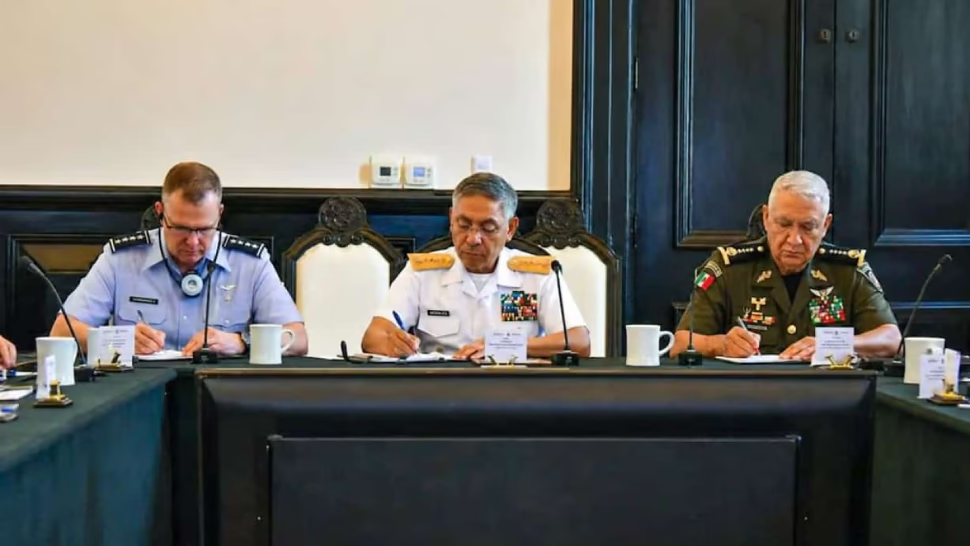
The commander of the United States Northern Command, General Greg Guillot, visited Mexico to meet with senior officials from the Secretariat of National Defense (Sedena) and the Secretariat of the Navy (Semar). The meetings occurred on July 22 in Veracruz.

Bilateral security cooperation

Guillot met with the head of the Sedena, General Ricardo Trevilla, and with the Secretary of the Navy, Admiral Raymundo Pedro Morales. The US embassy described the meetings as progress in the defense relationship between both countries.

Among the topics addressed are specialized training in special operations and against organized crime, the exchange of information, and cooperation to counter unmanned aerial systems. The North American Maritime Security Initiative was also reviewed.

“The security of North America depends on the strength of its alliances and the ability of its members to act with common objectives,” said General Guillot.

Both nations reiterated their commitment to expanding cooperation, respecting sovereignty, territorial integrity and shared responsibility for security.

Continue reading

T-MEC negotiations: tariffs and regional content on the table

Third round of dialogue between Mexico and the US addresses labor mechanisms and strategic rules.

Key points from the third round

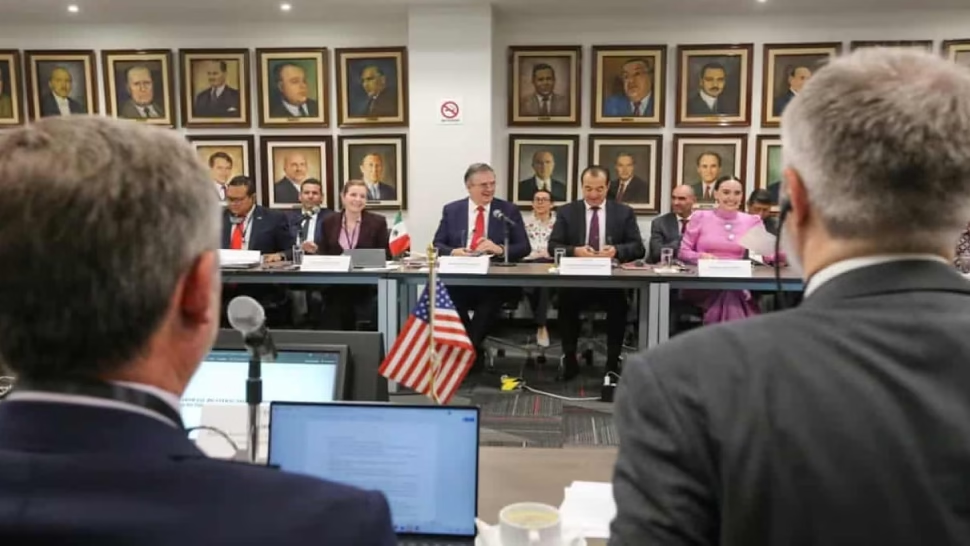
Between July 21 and 23, Mexico and the United States held the third round of negotiations towards the review of the T-MEC. The central issues were tariffs, labor mechanisms, regional content and rules for sectors such as automotive, steel and aluminum.

The president of the Business Coordinating Council (CCE), José Medina Mora, explained that it was proposed to modify the Rapid Response Labor Mechanism to make it reciprocal. Currently, the investigations only apply to companies in Mexican territory.

“It is necessary that the mechanism be applied equitably between both countries,” said Medina Mora.

Another point of discussion was the United States’ intention to increase American content in products made in the region. Mexico defends the concept of regional content and rejects changes that reduce trilateral integration.

The leader added that the seasonality of agricultural products and the impact of tariffs on steel, aluminum and the automotive industry were also reviewed. Some US automakers in Mexico face higher export costs compared to competitors from Japan, Korea and Europe.

For his part, the president of Coparmex, Juan José Sierra, expressed uncertainty regarding the possibility of annual reviews of the treaty, but valued the dialogue between the partners. He indicated that Mexico requires strengthening legal and energy security and the conditions to attract investment.

“It is positive that communication continues, but we need certainty for investors,” said Sierra.

Concamin pointed out that the joint statement between the Secretary of Economy, Marcelo Ebrard, and the US trade representative, Jamieson Greer, confirms that both countries maintain an institutional work path.

Continue reading

Registration of Housing for Wellbeing 2026 begins

Conavi opens registration in 2026 for subsidized housing in 26 states.

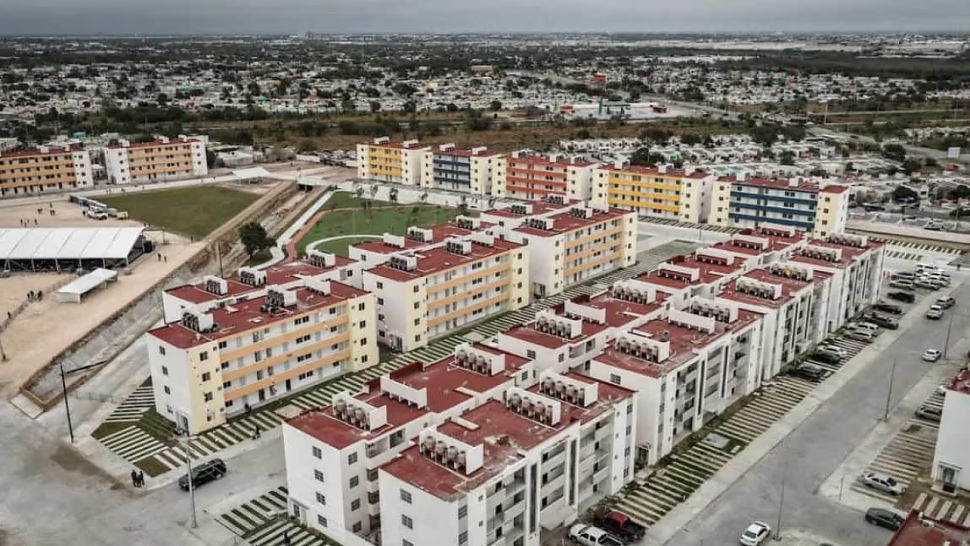
The National Housing Commission (Conavi) launched the 2026 call for the Housing for Well-being Program. The objective: to facilitate access to a decent home for low-income families. Registration will be from July 20 to August 2, in modules installed in 26 entities.

Requirements and financing

The scheme adjusts the monthly payments to the family income, so that the payments are accessible. It is aimed at those who cannot access traditional mortgage loans. Those interested must comply: not have their own home, not have current credit from Infonavit, Fovissste or another institution, and receive less than 17,800 pesos per month. Official identification, CURP, proof of address and income are also required.

Participating municipalities

The modules will only be in locations where Conavi will build projects in 2026. Among them: La Paz (Baja California Sur); Champotón (Campeche); Tapachula and Tuxtla Gutiérrez (Chiapas); Aquiles Serdán (Chihuahua); Piedras Negras and San Pedro (Coahuila); Gómez Palacio (Durango); Axapusco and Cuautitlán Izcalli (State of Mexico); Comonfort, Dolores Hidalgo, Pénjamo, San Diego de la Unión, San Luis de la Paz and Tarimoro (Guanajuato); Acapulco de Juárez, Chilpancingo de los Bravo, Coyuca de Benítez and Técpan de Galeana (Guerrero).

The list also includes municipalities of Hidalgo, Jalisco, Michoacán, Nayarit, Oaxaca, Puebla, Querétaro, Quintana Roo, San Luis Potosí, Sinaloa, Sonora, Tabasco, Tamaulipas, Tlaxcala, Veracruz, Yucatán and Zacatecas. Tepic, Xalisco, Puebla, Tehuacán, Tulum, San Luis Potosí and Valladolid stand out.

The program seeks to serve those who need it most, in a context where access to housing continues to be a challenge for millions of Mexicans.

Continue reading