Mexico and businessmen align strategy for review of the T-MEC

Government and businessmen launch a new joint strategy for the review of the trade agreement with the US and Canada.

The business review dance

The Mexican government has released a new choreography to negotiate. This time, he takes his partner to the private sector. The objective: face the review of the T-MEC without stumbling.

The music plays in Mexico City, where the second round of dialogue was held. At the table, the Secretary of Economy, Marcelo Ebrard, and the US trade representative, Jamieson Greer. The companions: business leaders from both sides of the border.

RelatedEbrard defends Mexico’s trade strategy against tariffs

The songs that cannot be danced alone

On the table are the usual issues, those that always hurt: tariffs on steel, aluminum and automobiles. Also the rules of origin and that new fad called ‘cooperation in critical minerals’. It sounds technical, but it is where the industrial future is played out.

The United States “takes note of what Mexico is concerned about,” Ebrard said after the meeting.

A phrase that any veteran of these struggles translates as: “They listened, but we will see if they act.” Memory is long in these rooms.

The next step on the calendar

The parties agreed to further technical talks and an official meeting scheduled for the week of May 25. Again in the Mexican capital. It seems that they are moving forward, or at least that is what the statements say.

Businessmen from the Business Coordinating Council and the American Chamber of Commerce also presented their approaches. Because when it comes to commerce, money always wants to have a voice.

Finally, from the National Palace, Claudia Sheinbaum reported that the talks “continue to progress favorably.” Official optimism is part of the protocol. The real test will come when it is time to sign what was agreed… or not.
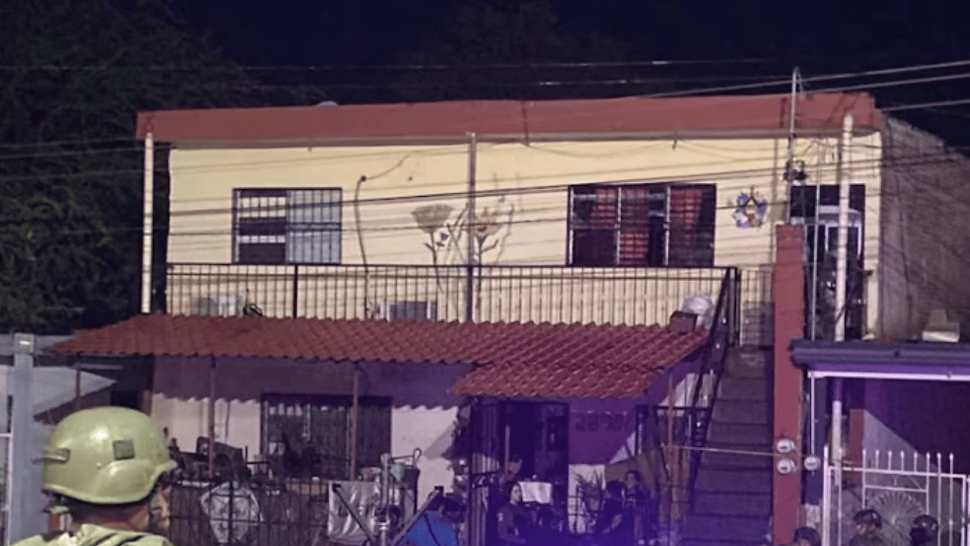
Culiacán begins July with four violent homicides

Four people lost their lives in different armed attacks in Culiacán on the first day of July.

Culiacán: four homicides on the first day of July

The capital of Sinaloa started the seventh month of the year with four homicides in different parts of the city. In all cases, the victims were attacked with a firearm.

The first incident occurred in a taqueria in the Barrancos sector, to the southeast. Jorge “N”, 44, was having dinner at the restaurant when he was shot and died at the scene. A waiter was injured by shrapnel in the leg and was treated by Red Cross paramedics.

Shortly after, in an apartment in the Emiliano Zapata neighborhood, Jesús “N”, 23 years old, was also killed by multiple gunshots. The attackers fled and have not been located.

In front of a secondary school in the Villa Bonita subdivision, authorities found the body of a young man wrapped in plastic and with bullet holes. His identity is still unknown.

The fourth case was recorded on the side of the Culiacán-Eldorado highway, in the Costa Rican administration. Relatives identified the victim as Raúl Francisco “N”, 18 years old, a resident of the area.

The events have generated concern among residents, who demand greater security and concrete actions from the authorities to stop violence in the region.

Continue reading

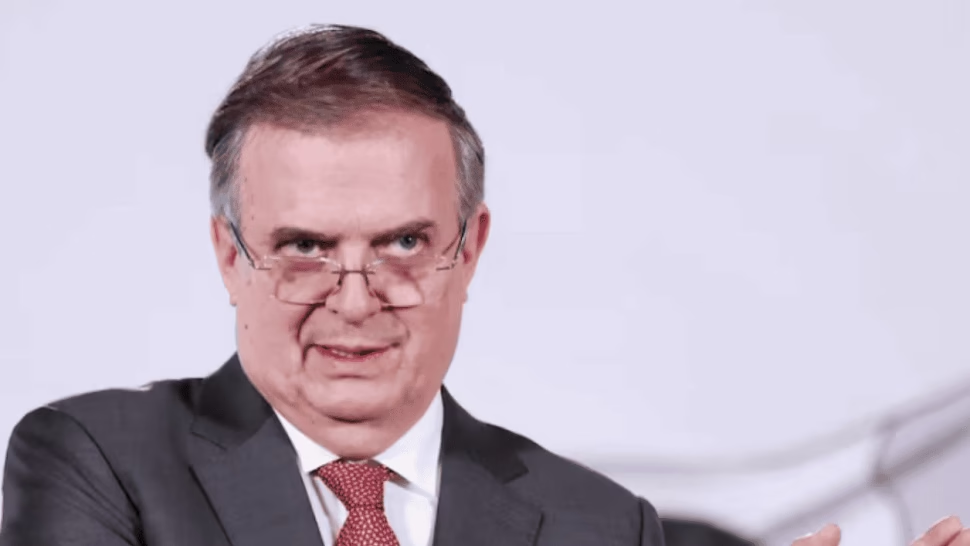
Ebrard: Mexico must address claims from the US and Canada regarding TMEC

Mexico must address complaints from the US and Canada about the USMCA, says Ebrard.

Concerns at the trilateral table

Marcelo Ebrard, head of the Ministry of Economy, stated that Mexico must respond to the concerns of the United States and Canada regarding the USMCA. The country still depends on others in sectors such as pharmaceuticals, electronics and artificial intelligence.

“The Treaty has probably been the most successful in the world, but they have legitimate concerns. If we want it to remain in force and expand, we must address them and look for spaces for cooperation,” he declared during the morning conference on July 2.

Dialogue to maintain certainty

Ebrard recalled that the three countries agreed to maintain the USMCA until 2036. He explained that the dialogue has been built with arguments, information and patience, as President Claudia Sheinbaum has instructed. “One of our main objectives was for the United States not to withdraw from the Treaty,” he said.

The secretary mentioned that Donald Trump has proposed modifying or canceling the agreement, so annual reviews will be key. “My task is for these revisions to be successful and not affect the content of the Treaty,” he said.

Ebrard highlighted the importance of the trilateral relationship: “Mexico is the United States’ main client. They have a strategic interest in our doing well. Reporting our progress on their concerns limits the scenario for the review.”

President Sheinbaum highlighted that the peso remained stable after the virtual meeting, trading at 17.54 per dollar. “There was no nervousness about the Mexican economy,” he said.

Continue reading

High demand for Olinia; Sheinbaum seeks partners to produce it

Sheinbaum reports high demand for Olinia; They are looking for private partners to manufacture the electric car.

Olinia moves towards production with mixed investment

President Claudia Sheinbaum confirmed that the Olinia electric vehicle, promoted by the federal government, arouses great interest among state governments and citizens. After passing the design phase, the project now enters the manufacturing stage.

Sheinbaum explained that the objective is a public-private alliance: not only the Mexican State, but also automotive companies with experience in distribution and manufacturing. “The objective is for there to be a mixed investment,” he stated.

“We have already passed the design phase and now we are in the production phase. The objective is that there is a mixed investment, that not only is a vehicle produced by the Mexican State, but that there is also investment from some other companies that already have the facility, for example, of having distribution agencies in different places and that already manufacture some vehicles.”

The president announced that a type of contest will be launched to select the right partner. In addition, necessary regulatory adjustments will be made for both Olinia and other mini electric vehicles. “And yes, there is a lot of demand. Not only from governments, but also from people who liked the vehicle,” he indicated.

The Olinia project seeks to offer a sustainable and accessible mobility option. The combination of public and private investment aims to accelerate its production and distribution in the country.

Continue reading