Mexico denies use of criminal drones on the northern border

Authorities rule out immediate risks but reinforce surveillance in the border area.

A message of tranquility and collaboration on the border

Friends looking for reliable information! Today we bring news that reinforces the importance of collaborative security between nations. Admiral Raymundo Morales, Secretary of the Navy, has been clear: there is no evidence of drones for illicit purposes on our border with the United States. Did you know that detected devices are common, like those we use for photography or recreation? That’s how it is! Technology can have positive uses, and transparency is key here.

Dialogue and action: pillars of binational security

While some voices in the US warned about possible threats, our authorities responded with concrete data. “The sighted equipment does not cross the border line,” stressed the admiral. But be careful! This does not mean letting your guard down. President Claudia Sheinbaum highlighted something powerful: 10,000 members of the National Guard work day and night in the Border Operation, with constant communication between both countries. That’s coordination in action!

RelatedDrones on the border, the official version vs American paranoia

And what about the statements of Steven Willoughby, anti-drone expert? His words invite us to reflect: technological innovation advances, but so do our protection strategies. “Permanent collaboration is our best shield”, we could say. Every sighting, every technical meeting, strengthens that invisible network that protects us all.

Motivating fact: Did you know that this cooperation includes real-time intelligence sharing? This is how bridges of trust are built. While some imagine risk scenarios, Mexico and the US demonstrate that working together transforms challenges into opportunities. Let’s celebrate these advances!

Technology at the service of peace

Dear community, let’s remember: a drone is neither good nor bad by itself, it all depends on the use we give it. Mexican authorities have identified criminal applications in other areas, but that is precisely why there are reinforced surveillance protocols. That’s the proactive mindset that inspires!

Imagine what we can achieve when we combine naval experience, cutting-edge technology and preventive diplomacy. Next time you see a drone, think about its potential to map natural areas or support rescues… the future is bright when we build it together!

Join the conversation: Share this note to spread verified information and celebrate the efforts of those who protect our sovereignty with professionalism. Do you want more content about innovation and security? Explore our publications and be part of this community that transforms challenges into success stories. Your voice adds up!

#SecurityWithPurpose #ResponsibleTechnology

CNDH calls for strengthening the fight against sexual torture in Mexico

Agency warns that extreme sexual violence persists in detention centers.

The National Human Rights Commission (CNDH) called for strengthening actions against sexual torture in Mexico. He considered it one of the most serious forms of violence and discrimination that especially affects people in vulnerable situations.

Call for institutional coordination

During a symposium on the topic, Rosario Piedra Ibarra, president of the CNDH, stressed the need to improve coordination between federal, state and municipal authorities. The objective: to prevent, investigate and punish these events effectively.

The organization recalled that, through the National Mechanism for the Prevention of Torture, it maintains permanent surveillance in centers of deprivation of liberty. Since 2021, it has issued reports with recommendations to improve institutional practices with a gender focus.

Equity of the problem

Representatives of state human rights organizations warned that sexual torture continues to be a current problem. It requires specialized attention, active prevention and mechanisms that avoid impunity to guarantee justice for the victims.

The CNDH pointed out that, although Mexican legislation does not establish different modalities of torture, international instruments such as the Istanbul Protocol recognize it as an especially serious practice. Therefore, it must be combated with specific measures.

He emphasized the importance of addressing this problem from a gender perspective. The victims are, for the most part, people in vulnerable situations. The proposed actions seek not only to punish those responsible, but also to prevent future cases and ensure access to justice.

CNDH pide reforzar combate a la...

Continue reading

SCJN: the crimes of the ABC Nursery case do not prescribe

The Court determined that the tragedy in Sonora can be investigated without a time limit.

No expiration date

The Supreme Court of Justice of the Nation ruled that the crimes related to the fire at the ABC Daycare do not prescribe. The incident occurred in 2009 in Hermosillo, Sonora, and left 49 girls and boys dead.

The decision was made after analyzing an appeal from Sergio Antonio Salazar Salazar, former director of Economic and Social Benefits of the IMSS. He argued that the charges against him had already become invalid due to the passage of time. The highest court rejected that approach.

The Court noted that imprescriptibility seeks to avoid impunity, clarify the facts and guarantee comprehensive reparation for the victims. It also took into account the special protection that children and adolescents require.

The case will return to the corresponding Collegiate Court, which must apply the new criteria. The resolution opens a new chapter in one of the most sensitive human rights cases in Mexico.

SCJN: los delitos del caso Guardería...

Continue reading

Second round of the T-MEC ends without progress

Without concrete agreements, Mexico and the US are moving towards reviewing the T-MEC.

Conversations without progress

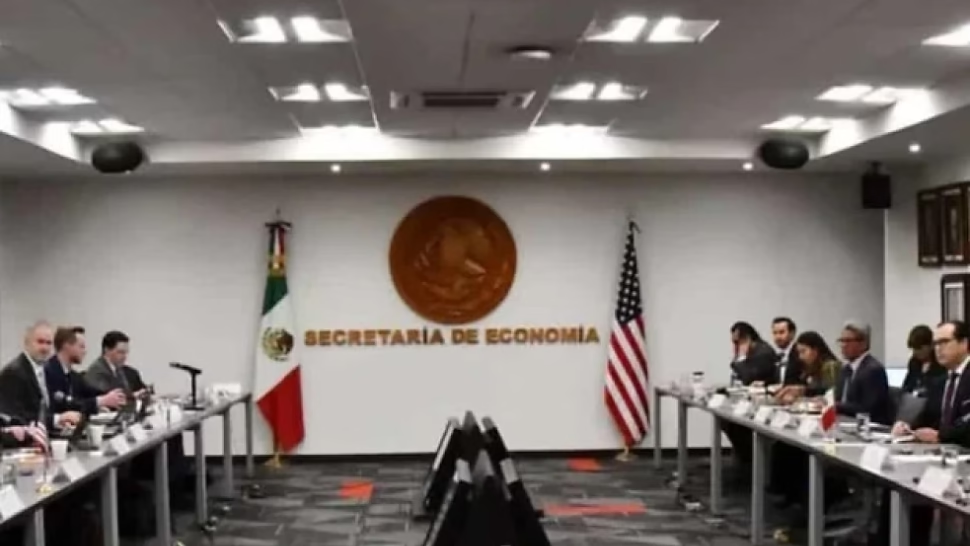
The second round of dialogues prior to the review of the T-MEC concluded without concrete agreements. The meeting was held in Washington, according to the Secretary of Economy, Marcelo Ebrard. The Mexican delegation presented proposals and points of view, but no agreements or additional details were released.

Topics addressed included rules of origin, economic security, agricultural sector and automotive industry. These issues are fundamental to the operation of the trade agreement between Mexico, the United States and Canada.

The formal review of the treaty will begin on July 1 with a virtual trilateral meeting. A third round of negotiations will take place on July 20. Everything occurs in a context of trade tensions, with tariffs imposed by the United States on various products.

Mexico and Canada have expressed interest in maintaining and extending the agreement. However, the doubts raised by US President Donald Trump generate uncertainty about the future of the USMCA.

Continue reading