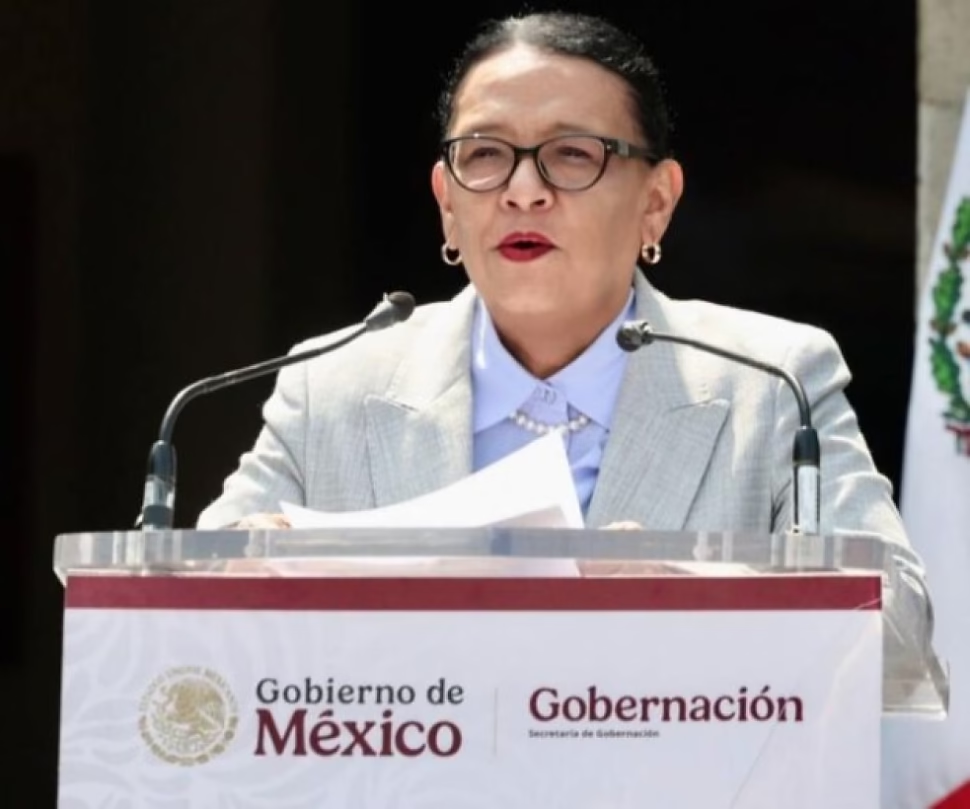
Mexico grants 479 amnesties in one year, transforming lives

A year of decisions that changed lives: the figure that reveals a profound transformation in the Mexican justice system.

A Decree that Changed Destinies: The Power of Clemency

In a dramatic turn that seems taken from the most intense pages of legal history, the Secretary of the Interior has unveiled a report that contains figures capable of stopping your breath. Under the watchful eye of the Senate of the Republic, it has been revealed that, in a period of twelve months full of hope and deliberation, 479 amnesty benefits have been granted. Each of these numbers represents a life, a family, a destiny that was rewritten with the ink of mercy and redemption.

Since the dawn of the corresponding law in 2020, a torrent of 2,391 pleas for forgiveness has flooded the Amnesty Commission. Of this ocean of hope, 2,024 have been scrutinized with a magnifying glass in 16 epic sessions, where the future of hundreds of souls was decided. However, 275 petitions still lie in the shadows, awaiting their final verdict in a heart-wrenching suspense.

RelatedSheinbaum concludes historic tour with 535 thousand supporters

Among these, 214 are in the eye of the hurricane, undergoing an exhaustive analysis that will determine their fate. Another 52 remain in a distressing limbo, in reserve due to the cruel absence of information, while nine have been sent to the depths of Segob and the Security Secretariat, as they are intertwined with requests for pre-release or with the dark ghosts of torture.

The Triumph of Freedom: When the Chains Are Broken

But here is where the narrative reaches its climax: of the 479 amnesties granted, an army of 411 has already been consecrated as legal by federal judges, those titans of justice. This act of validation has allowed the unthinkable: extinguishing criminal action, erasing judicial records forever and restoring the political and civil rights of the beneficiaries, thus giving them back their place in society.

As a consequence of this legal miracle, 411 people regained their freedom, escaping the clutches of the fate that seemed sealed. The rest of the applications, however, navigate turbulent waters: 45 were declared non-legal, nine await judicial qualification in a tense interlude, 11 were left without matter and three could not be ruled on, abandoned in a vacuum due to the lack of sufficient parameters.

The distribution of this epic forgiveness has woven a tapestry of diversity: 159 women, 319 men and one person from the LGBTTTIQ+ community have seen their world transformed. Among them, 44 indigenous people (12 women and 32 men) have received the gift of a second chance.

The geography of redemption extends beyond borders: 444 Mexican souls, 12 Ecuadorian, 10 Colombian souls, eight Guatemalans, two Peruvians, one American, one Honduran and one Salvadoran have been touched by this unprecedented act of grace.

The Reasons Behind Forgiveness: A Mosaic of Vulnerability

The causes that drove this wave of clemency form a moving portrait of human vulnerability. 430 cases due to a situation of extreme poverty, 11 due to a permanent disability that marked their destinies, 10 due to having acted under the shadow of someone else’s instructions, seven due to a well-founded fear that paralyzed the will, seven due to the lack of access to justice that afflicts indigenous peoples, six due to the ghost of simple robbery without violence, five due to the scourge of the condition of discrimination, two for drug use and one for coercion by criminal groups.

The settings of this drama are located mainly in Sinaloa, with 120 amnesties that resonate like thunder; Mexico City, with 64; and Chiapas, with 50. Segob has revealed that the vast majority of these benefits are linked to crimes against health entangled in the networks of low-scale drug trafficking, as well as cases of simple robbery without violence and the tragic lack of access to justice for indigenous communities.

This is not just a report; is a testament to how the machinery of state can, in an act of monumental humanity, bend to offer a way out for those trapped in the most desperate of circumstances. Each number is a heartbeat, each statistic a sigh of relief in an endless saga of fight for justice and human dignity.

Do you think these stories deserve to be known? Share this story of transformation and redemption on your social networks so that it reaches every corner. Explore more content about justice and human rights on our portal.

Update your INE credential: requirements for change of address

Documents and steps to modify your address in the INE without setbacks.

If you moved this year, updating the address on your voter registration card is a key step. The INE recommends doing so to participate in decisions in your new area and maintain an official document with true data.

What do you need?

Go to an INE module with these documents:

  • Legable birth certificate or Naturalization Letter (if you were not born in Mexico).
  • Recent proof of address: electricity, property or water bill.
  • Identification with valid photo: passport, professional ID card, driver’s license, military card, previous credential or school ID with photo.

Schedule your appointment

To speed up the process, the institution suggests scheduling an appointment on its official site. Go to www.ine.mx/credencial/, complete the required information with your CURP and full name. If you do not know your CURP, you can access it with name, date of birth and place of origin. There you will also locate the nearest module.

Continue reading

Three are linked to trial for kidnapping Indians in Juárez

Three alleged members of the Northeast Cartel, arrested for the kidnapping of five Indians in Juárez.

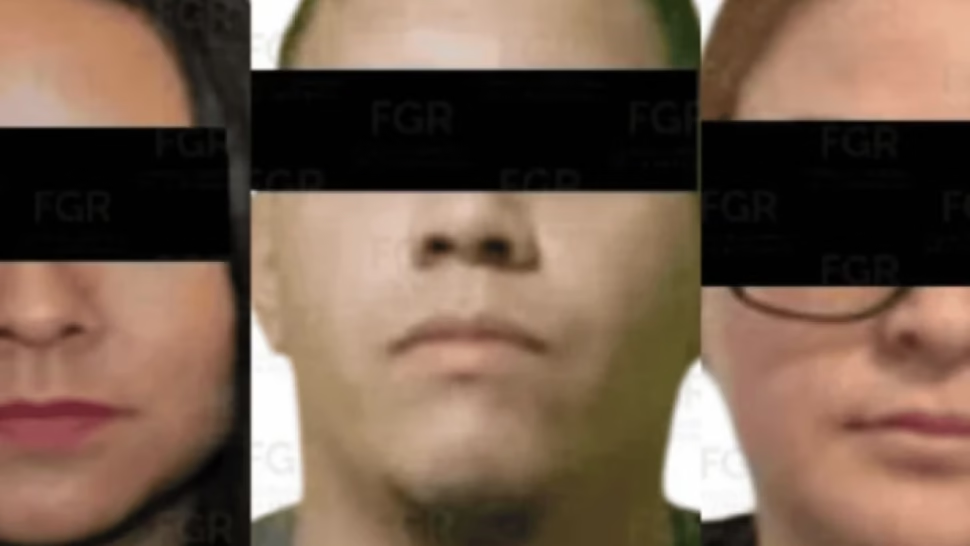
A Control judge linked Tomás “N”, Diana “N” and Jaqueline “N” to the trial for their probable responsibility in organized crime crimes for the purposes of kidnapping and aggravated kidnapping. The victims were five citizens of India, kidnapped in June 2025 in Ciudad Juárez, Chihuahua.

As a precautionary measure, the three defendants were placed in informal preventive detention in State Prisons 2 and 3 of the entity. The judge granted four months for the complementary investigation.

Investigation and capture

The case began when the Consul of the Indian Embassy in Mexico reported via email that five compatriots were deprived of their liberty. Based on that notice, the Special Prosecutor’s Office for Organized Crime (FEMDO) began the investigations.

Days later, agents of the Federal Ministerial Police, experts from the Federal Forensic Expert Center and elements of the National Guard executed a search warrant in five homes in Ciudad Juárez. Before these operations, the victims had already been released. During the investigations, they located the three men identified, who had current arrest warrants; They were secured and placed at the disposal of the judge.

Regional context

The connection to the process of these individuals—presumably linked to the Northeast Cartel—evidences the challenge that organized crime represents in the border area. The authorities have indicated that this type of crime affects both Mexican citizens and foreigners, and they maintain operations to dismantle kidnapping networks.

Continue reading

Families celebrate Father’s Day in the Zócalo with a calm atmosphere

Parents and children enjoyed the Fan Fest in the Zócalo on Sunday.

This Sunday, the plaza of the capital’s Zócalo welcomed families who came to celebrate Father’s Day. The Fan Fest, installed in the Historic Center, was the meeting point for those looking to mingle and watch the Mexican National Team match.

Roberto arrived accompanied by his wife Paola and his baby Ramsés. With the National Team shirt, they sought to follow the game and have a pleasant time.

“I think it’s nice to spend the day together as a family. We came prepared to watch the game and have a nice time. We wanted to take advantage of Father’s Day to be together,” he commented.

Despite the enthusiasm, Roberto pointed out that the turnout was smaller than expected.

“We thought there would be many more people because of the game and the date, but it was calmer than we imagined,” he added.

Víctor Manuel came with his son – of the same name -, his sister-in-law and two grandchildren. The family considered the experience positive to live together and share activities.

“It’s cool that they do this type of events because you can come with your family, watch football and have a good time without spending so much,” he commented.

The grandchildren enjoyed the atmosphere and the activities available. Víctor Manuel also noticed fewer visitors than expected.

“Yes, it caught our attention that there were few people; we thought it would be much more crowded for Father’s Day and the game,” he said.

The day passed without any reported incidents. Families took advantage of the public space to celebrate in a festive environment but with smaller attendance than at similar events.

Continue reading