Mexico faces arms trafficking with data that points to the US

Revealing data exposes the routes and figures of the illegal flow of weapons from the US to Mexican cartels.

The illegal flow of weapons and its impact on bilateral security

The tension regarding border security between Mexico and United States during the second administration of Donald Trump has highlighted an imbalance in shared responsibilities. While Washington points to fentanyl and migration as priority problems, arms trafficking into Mexican territory continues to receive the necessary attention. According to analysts, each year approximately 200,000 firearms enter Mexico from the US, many of which end up in the hands of criminal organizations classified as terrorists by the US government itself.

Critical paths and lack of action

A report from the Mexican Secretary of Citizen Security identified that 74% of illicit weapons comes from the states of Arizona, California and Texas. These findings coincide with data from the US Department of Justice, which adds New Mexico as another key point. The lack of budget and stricter controls on the northern border suggests that combating weapons smuggling is not a priority for US authorities.

RelatedYuri relives five musical decades in Texas with his Icónica Tour

Alejandro Celorio, an expert in international law, highlights the inconsistency: “Mexico has been pointing to Texas as the origin of the problem for years, but there is no reinforcement of operations or greater presence of the ATF.” U.S. laws protect gun manufacturers, limiting Mexico’s ability to take effective legal action.

Figures that reveal a constant pattern

Between 2022 and 2023, 73% of the guns seized in Mexico were traced to buyers in the same three states. In addition, the Mexican report reported the seizure of 5,869 weapons, 31,000 magazines and more than 1.2 million cartridges in just six months. Texas continues to be the main point of origin (43%), followed by Arizona (22%). These findings reinforce the US’s negligence in stopping the flow towards cartels such as Sinaloa and Jalisco Nueva Generación.

John Lindsay Poland, an activist with the Stop US Arms to Mexico project, says: “If Trump wanted to take down the cartels, he should focus on guns, but he is cutting the ATF budget and relaxing controls.” The former president’s plan includes eliminating 66% of inspectors and destroying records of gun owners after 20 years.

Implications and future challenges

Although traceability data is limited, its disclosure is crucial to sustain the Mexican position in future legal disputes. However, Celorio rules out legal action in Texas, a state with legislation favorable to the arms industry. The solution, experts agree, requires diplomatic pressure and greater bilateral cooperation, something unlikely in the current political scenario.

Are you interested in learning more about regional security? Share this analysis and explore other content on arms control policies on our platform.

La lucha estéril de México contra el tráfico de armas

Audit detects control failures in the Women’s Secretariat

Failures in hiring and lack of manuals in the Women's Secretariat, according to official audit.

Failures in internal controls

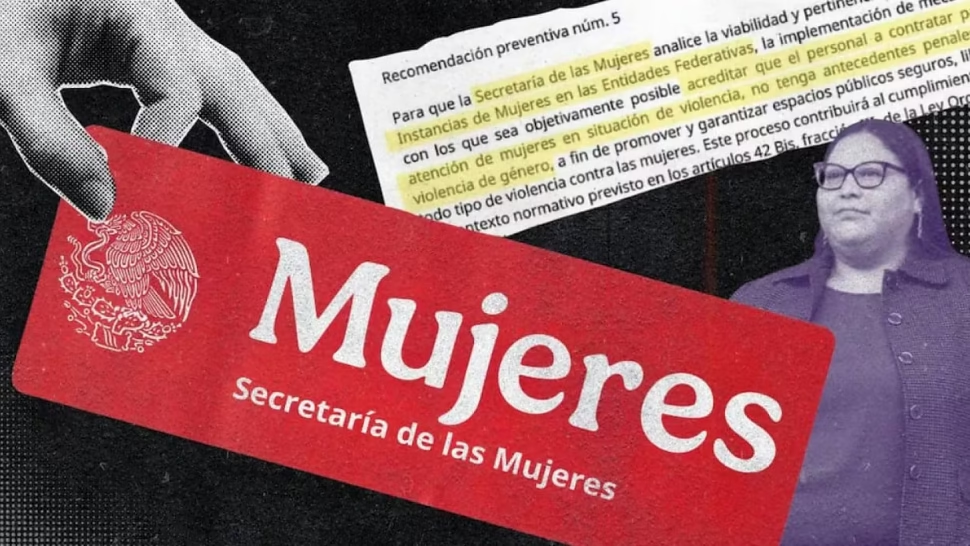
An audit of the Anti-Corruption and Good Government Secretariat identified multiple deficiencies in the Women’s Secretariat. Among them, the absence of mechanisms to verify that the personnel in charge of caring for victims of violence did not have a criminal record or gender violence record.

The report “A PROCESO-006-074-2025” also indicates that there were no clear hiring procedures in the Women’s Instances in the Federal Entities (IMEF). For this reason, a preventive recommendation was issued to strengthen entry filters.

Pending manuals and organization

The agency lacked an updated General Organization Manual and a Procedures Manual, mandatory documents for its operation. The audits recommended developing and updating them.

Although the Secretariat reported that several areas had already sent projects to integrate these manuals, until now their complete implementation has not been accredited. In addition, another review detected inconsistencies in job profiles in the Information Technology area.

These observations occur in a context of institutional transition: the Women’s Secretariat has not had a head since April 2026. This situation has generated administrative and operational pending issues in the new structure of the federal agency.

Continue reading

Harfuch products dominate sales at WTC

Itinerant merchants find a new business in the image of the official.

Blankets and keychains with the face of Omar García Harfuch

Outside the World Trade Center, where Morena holds its internal catwalk of aspiring state candidates, street vendors have found a gold mine: the image of the Secretary of Citizen Security.

Prices range from 50 pesos for key chains to 200 for blankets. According to merchants, these items are the most in demand at the event. They even surpass those of Andrés Manuel López Obrador and Claudia Sheinbaum.

The popularity of the official is reflected in sales. The sellers adapted their offer to the interest of the attendees. The variety of products has captured the attention of those who come to the venue.

The Morenoist catwalk not only moves politics. It also generates a direct impact on street commerce in the area. Sellers take advantage of each trend to increase their income.

Continue reading

UAT students win bronze for gum against HPV

Natural gummy project against HPV wins bronze medal in Ibero-American final.

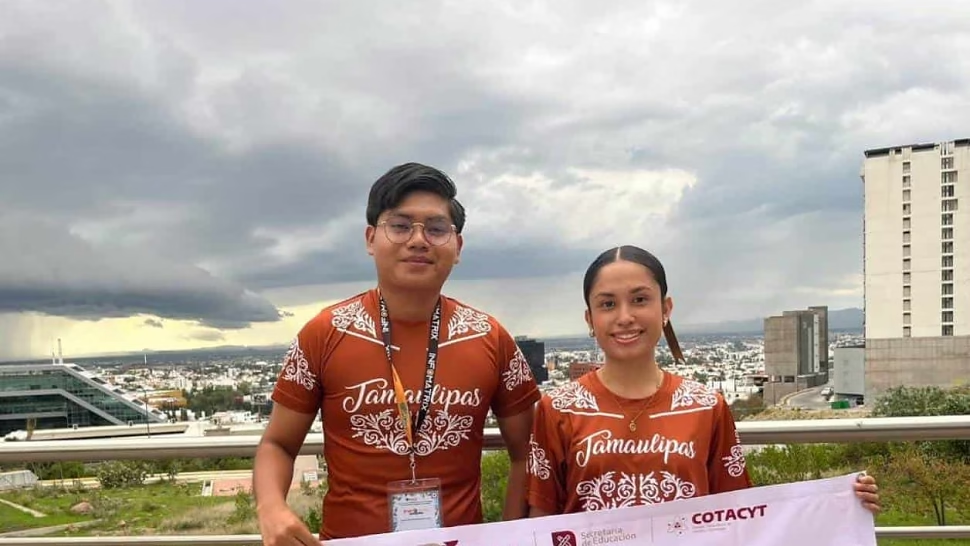
Two students from the Autonomous University of Tamaulipas (UAT) achieved third place in the Ibero-American Final of Infomatrix 2026, one of the most important science and technology competitions in the region.

Juan Pablo Hernández Hernández and Yuridia Guadalupe Ruiz García, from the Tampico Faculty of Nursing, presented “V-Guard Gummies”, a gummy made with natural extracts that seeks to strengthen the immune system and support the prevention and treatment of the human papillomavirus (HPV).

High level competition

The event was organized by the Latin American Society of Science and Technology (SOLACYT) at the Tecnológico de Monterrey, San Luis Potosí Campus. It brought together 610 exhibitors and representatives of 250 finalist educational institutions from all over Latin America.

The young people reached this stage after obtaining the gold medal in the Gulf North regional phase. Their project received direct accreditation to the international phase thanks to the high score, quality and medical impact of the prototype.

The rector of the UAT, Dámaso Anaya Alvarado, promotes research and academic excellence as part of university education. This result reflects the work of students and teachers in developing accessible solutions to public health problems.

Continue reading