Mexico exchanges more than 9 thousand weapons in a national crusade for peace

Thousands of weapons go out of circulation while communities are transformed with comprehensive actions that go beyond metal.

An Epic Exchange that Writes a New Chapter in the History of Mexico

In the heart of a nation thirsty for tranquility, a silent but monumental battle was fought. Not with bombs, but with hope; not with threats, but with opportunities. The Secretary of the Interior, Rosa Icela Rodríguez, stood as herald of news that resonated like a thunderclap of optimism: from October 2024 to December 2025, an army of 9,081 instruments of violence were voluntarily surrendered, exchanged for a better future under the banner of the Yes to Disarmament, Yes to Peace strategy. This federal crusade, a daring commitment to attack the very roots of the conflict, achieved what seemed impossible: converting lethal metal into seeds of concord.

Behind the cold statistics lay a powerful narrative: of that total, 2,642 were long weapons, ghosts of past conflicts; 5 thousand 297, short weapons, silent witnesses of daily tragedies; and 1,142 grenades, along with cartridges and magazines, whose destructive power was neutralized forever. This titanic undertaking was not the work of a single hero, but of a sacred alliance between the Secretary of National Defense and the Catholic Church, weaving a bridge between authority and faith to heal deep wounds.

RelatedMexico exchanges more than 8 thousand weapons in a crusade for peace

The Offensive in the Territories where Hope Was a Luxury

By presidential mandate, the mission focused with surgical precision on 61 priority municipalities, spread across 12 states. There, the strategy was not satisfied with receiving weapons; launched an invasion of light with community, preventive actions and reconstruction of the social fabric. In Tijuana, Baja California, the figure of 126,729 services is not a number, but a mosaic of lives touched: home visits in 33 neighborhoods, 30 peace fairs that were festivals of rebirth, the formation of 21 peace committees and the reconquest of 54 public spaces that previously belonged to the fear.

The south of the country wrote its own epic. In Chiapas, in municipalities such as Amatenango de la Frontera and San Cristóbal de las Casas, 120,909 services were provided through 73 peace fairs and 79 community assemblies. Meanwhile, on the northern border, Ciudad Juárez, Chihuahua, scored a victory of 136 thousand attentions and the creation of 43 peace committees, demonstrating that the transformation knows no geographical limits.

The Impact: Where the Streets Recovered Their Laughter

The phenomenon was unstoppable. In Colima and Manzanillo, more than 22 thousand services set the tone. The State of Mexico, in strongholds such as Ecatepec and Nezahualcóyotl, witnessed an astonishing record of 317,351 services. But it was in Guanajuato where the epic reached its zenith: 463 thousand services, 99 peace fairs, 72 committees and 45 public spaces recovered in cities like Celaya and León. Guerrero, Jalisco, Michoacán, Sonora and Tabasco added their own legends to this chronicle of redemption.

The coordination with the Secretariat of Agrarian, Territorial and Urban Development (Sedatu) materialized the dream in concrete and steel, promoting 14 community infrastructure projects: development centers, parks and fields that were erected as monuments to the new era. At the same time, 7 thousand days for peace brought together more than 900 thousand young people throughout the country, while programs like Ponte Pila reached 1.4 million young souls, sowing in them the antidote to hopelessness.

Rodríguez’s voice, full of the solemnity of someone who sees the birth of a dawn, resonated with an unbreakable promise: “We will continue working in a coordinated and grateful manner with the neighbors and public servants of all agencies in addressing the causes that generate violence.” It was not a closing, but the prologue to the next chapter. The battle for peace is a constant war, but every weapon exchanged, every space recovered, every young person involved, is an irrevocable victory in the soul of the nation. The road is long, but for the first time, the destination seems written in the ink of hope.

Do you think these actions will really transform security in your community? Share this story of change on your social networks and help us make hope viral. Explore more content on peace initiatives and reconstruction of the social fabric on our site.

Update your INE credential: requirements for change of address

Documents and steps to modify your address in the INE without setbacks.

If you moved this year, updating the address on your voter registration card is a key step. The INE recommends doing so to participate in decisions in your new area and maintain an official document with true data.

What do you need?

Go to an INE module with these documents:

  • Legable birth certificate or Naturalization Letter (if you were not born in Mexico).
  • Recent proof of address: electricity, property or water bill.
  • Identification with valid photo: passport, professional ID card, driver’s license, military card, previous credential or school ID with photo.

Schedule your appointment

To speed up the process, the institution suggests scheduling an appointment on its official site. Go to www.ine.mx/credencial/, complete the required information with your CURP and full name. If you do not know your CURP, you can access it with name, date of birth and place of origin. There you will also locate the nearest module.

Continue reading

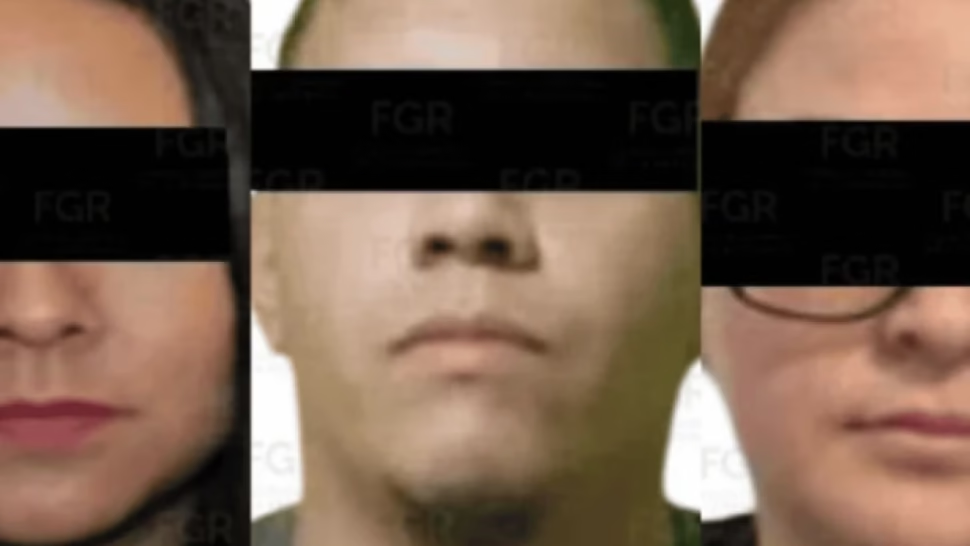
Three are linked to trial for kidnapping Indians in Juárez

Three alleged members of the Northeast Cartel, arrested for the kidnapping of five Indians in Juárez.

A Control judge linked Tomás “N”, Diana “N” and Jaqueline “N” to the trial for their probable responsibility in organized crime crimes for the purposes of kidnapping and aggravated kidnapping. The victims were five citizens of India, kidnapped in June 2025 in Ciudad Juárez, Chihuahua.

As a precautionary measure, the three defendants were placed in informal preventive detention in State Prisons 2 and 3 of the entity. The judge granted four months for the complementary investigation.

Investigation and capture

The case began when the Consul of the Indian Embassy in Mexico reported via email that five compatriots were deprived of their liberty. Based on that notice, the Special Prosecutor’s Office for Organized Crime (FEMDO) began the investigations.

Days later, agents of the Federal Ministerial Police, experts from the Federal Forensic Expert Center and elements of the National Guard executed a search warrant in five homes in Ciudad Juárez. Before these operations, the victims had already been released. During the investigations, they located the three men identified, who had current arrest warrants; They were secured and placed at the disposal of the judge.

Regional context

The connection to the process of these individuals—presumably linked to the Northeast Cartel—evidences the challenge that organized crime represents in the border area. The authorities have indicated that this type of crime affects both Mexican citizens and foreigners, and they maintain operations to dismantle kidnapping networks.

Continue reading

Families celebrate Father’s Day in the Zócalo with a calm atmosphere

Parents and children enjoyed the Fan Fest in the Zócalo on Sunday.

This Sunday, the plaza of the capital’s Zócalo welcomed families who came to celebrate Father’s Day. The Fan Fest, installed in the Historic Center, was the meeting point for those looking to mingle and watch the Mexican National Team match.

Roberto arrived accompanied by his wife Paola and his baby Ramsés. With the National Team shirt, they sought to follow the game and have a pleasant time.

“I think it’s nice to spend the day together as a family. We came prepared to watch the game and have a nice time. We wanted to take advantage of Father’s Day to be together,” he commented.

Despite the enthusiasm, Roberto pointed out that the turnout was smaller than expected.

“We thought there would be many more people because of the game and the date, but it was calmer than we imagined,” he added.

Víctor Manuel came with his son – of the same name -, his sister-in-law and two grandchildren. The family considered the experience positive to live together and share activities.

“It’s cool that they do this type of events because you can come with your family, watch football and have a good time without spending so much,” he commented.

The grandchildren enjoyed the atmosphere and the activities available. Víctor Manuel also noticed fewer visitors than expected.

“Yes, it caught our attention that there were few people; we thought it would be much more crowded for Father’s Day and the game,” he said.

The day passed without any reported incidents. Families took advantage of the public space to celebrate in a festive environment but with smaller attendance than at similar events.

Continue reading