Mexico deploys its economic plan to the BRICS with million-dollar investments

The ambitious project that seeks to transform Mexico into a global magnet for investments and tourism.

A Historical Moment: Plan Mexico Breaks into the BRICS Summit

In the vibrant heart of Rio de Janeiro, where the fate of emerging economies is decided between sighs of power and ambition, Foreign Minister Juan Ramón de la Fuente raised his voice as a herald of transformation. Before the watchful eyes of the BRICS giants, he deployed Plan Mexico, a strategy so bold that it could redefine the nation’s future. 277 billion dollars at stake! A figure that resonates like thunder in the corridors of international diplomacy.

The Battle for Investment: Simplification and Opportunities

It’s not just about cold numbers. This plan, woven with golden threads and pragmatism, promises to destroy bureaucracy, turn Mexico into a paradise for investors and catapult it into the top 5 of global tourist destinations. Can you imagine the streets of Cancun or CDMX bustling with millions more visitors? The chancellor, with the elegance of a strategist, made it clear: “Mexico does not wait, it acts.”.

RelatedMexico participates as an observer in the BRICS summit in Brazil

But the drama didn’t end there. Between meetings that could alter the continental economic balance, De la Fuente engaged in a key dialogue with Sergio Díaz-Granados, the strong man of the Development Bank of Latin America. They talked about binational projects, the newcomer Guatemala to the bank, and how the Mexican southeast could flourish under this alliance. The suspense was palpable!

Sheinbaum and the Master Move: Pharmaceuticals and Brazil

Meanwhile, President Claudia Sheinbaum, from the shadows but firmly, hatched her own plot: strengthening the Mexican pharmaceutical industry with the help of India and weaving deeper ties with Brazil. Could this be the missing piece to consolidate Mexico as a regional power? Undersecretary María Teresa Mercado and consul Héctor Valezzi, present in Rio, were witnesses of this diplomatic epic.

And in the center of this hurricane of strategies, Altagracia Gómez, the coordinator of the Advisory Council, pulled the strings with surgical precision. Its mission: to relocate companies and attract capital like a magnet. The message was clear: Mexico is ready for the world, but is the world ready for Mexico?

The stage is set. The chips, in motion. The only question left is: will this colossal plan manage to keep its promises, or will the weight of expectations make it falter? One thing is certain: the world will not take its eyes off what happens next.

Share this story and join the debate about Mexico’s economic future! #PlanMexico #BRICS
Prostate cancer rises 10% in Yucatán during 2026

Yucatán reports 179 cases of prostate cancer in 2026, 10% more than the previous year.

10% increase in cases of prostate cancer in Yucatán

Prostate cancer continues to increase in Yucatán. Data from the National Epidemiological Surveillance System (Sinave) indicate that in the first half of 2026, 179 cases of malignant prostate tumor were confirmed. This represents an increase of 10% compared to the 163 cases registered in the same period of 2025.

The report from the Federal Ministry of Health shows an upward trend that Yucatán has maintained in recent years. The entity far surpasses Campeche and Quintana Roo, which reported 19 and 2 cases, respectively.

With these figures, Yucatán is ranked as the state with the highest incidence in the Peninsula and in seventh place nationally. Below are Jalisco, Mexico City, Puebla, Chiapas, Sonora and Chihuahua.

Risk factors and call for early detection

The federal agency warns that prostate cancer is the most common malignant tumor among men and one of the main causes of death from cancer in Mexico.

The risk increases with age, especially after age 50, and also when there is a family history of the disease. The authorities recommend periodic checks for timely detection.

Continue reading

Finding of 10 bodies in Zacatecas; including a former mayor

Ten bodies located in three municipalities; Among the victims are a former mayor and two public servants.

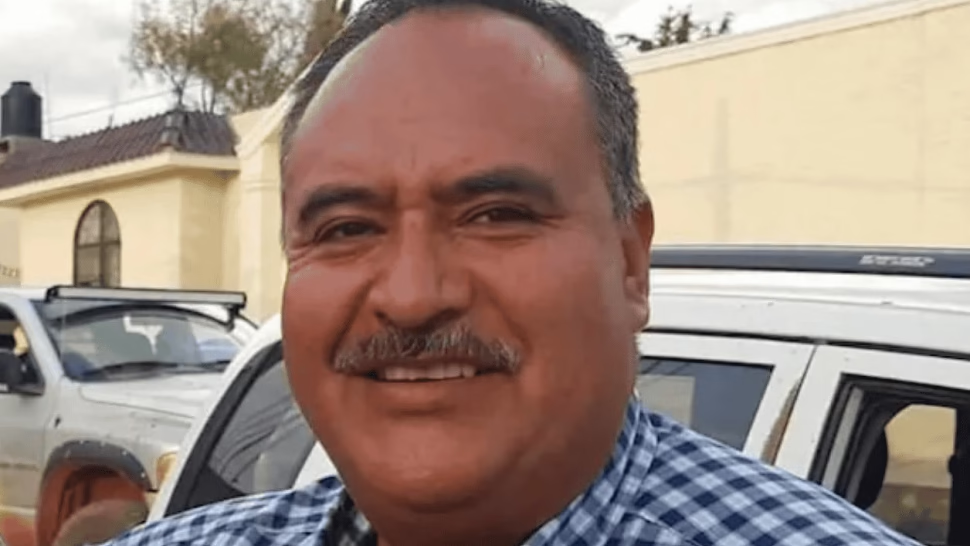
The location of ten bodies in the municipalities of Morelos, Pánuco and Sain Alto has reactivated the violence alerts in Zacatecas. Among the identified victims is Ignacio Castrejón Valdez, former mayor of Sombrerete (2016-2018), as well as two officials of the Fresnillo city council: Fidel Alvarado de la Torre, secretary of Municipal Development, and Jesús Gerardo Muñetón Hernández.

The facts

According to official reports, five of the bodies were abandoned on a vehicle bridge in the Pozo de Gamboa community, in Pánuco. Four others appeared in Morelos and one more in Sain Alto, which corresponded to the former mayor. Castrejón would have been deprived of his freedom in Sombrerete; His body was located with signs of violence on the side of Federal Highway 54.

Relatives and acquaintances confirmed the identity of the former mayor. Meanwhile, the Fresnillo city council issued a statement in which Mayor Javier Torres Rodríguez requested the state government and the prosecutor’s office:

“that the work be expedited to clarify the facts and provide justice to the families.”

Rodrigo Reyes Mugüerza, general secretary of the state government, reported that nine of the ten bodies have already been identified: eight from Zacatecas and one from Durango. He confirmed the presence of Fresnillo officials among the victims.

The state Attorney General’s Office – Reyes noted – “already has a robust line of investigation that will be made known at the due procedural time.” The official described the event as something “that has not been recorded in our state for a long time.”

Federal and state forces deployed a coordinated operation to find those responsible. Specialized investigation and intelligence teams collaborate with the Zacatecas prosecutor’s office.

The discovery caused an impact due to the dissemination of images of the bodies hanging from the vehicle bridge, semi-naked and with blankets. The authorities reiterated their commitment to clarifying the facts.

Continue reading

First locomotives of the Mayan Freight Train arrive; would start in 2027

The first 12 locomotives of the Mayan Freight Train are already in Mexico; The system would begin operations in 2027.

Advance of the Mayan Cargo Train

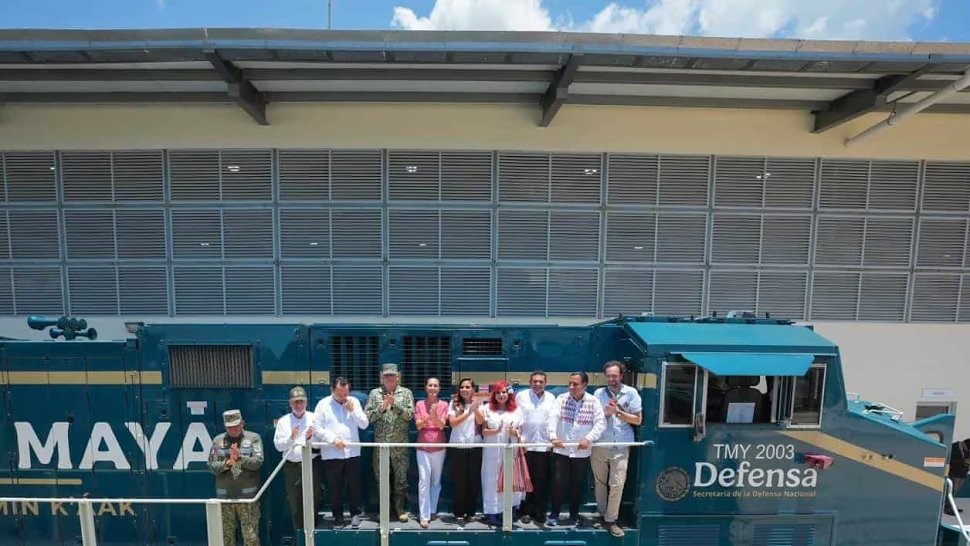
President Claudia Sheinbaum announced the arrival of the first 12 locomotives of the Mayan Freight Train. The rail system, which will complement the passenger system, aims to begin operations in 2027.

“We have great news for you: the first 12 locomotives of the Mayan Freight Train have already arrived, which already has very important progress. In fact, part of the material for construction is already being transported with these locomotives,” he declared from Puerto Morelos, Quintana Roo, in a video broadcast on social networks.

Sheinbaum supervised the “Puerto Morelos” station accompanied by the Secretary of National Defense, General Ricardo Trevilla Trejo; the commander of the “Felipe Ángeles” Group of Engineers, General Gustavo Ricardo Vallejo Suárez; the director of the Mayan Train, General Manuel Jaime Ramírez Camacho; and the head of the Trains and Integrated Public Transport Agency, Andrés Lajous Loaeza.

Also present were the governors of Quintana Roo, Mara Lezama, and of Campeche, Layda Sansores; as well as the governors of Yucatán, Joaquín Díaz Mena; Tabasco, Javier May; and Chiapas, Eduardo Ramírez. The five entities traveled by the Mayan Passenger Train will also be the ones connected by the cargo system.

“Great news for the southeast of Mexico and for the entire country. Long live the Mayan Train!” added the president.

Invitation to the 2026 World Cup final

In another order, the president reported that she will attend the final of the 2026 Soccer World Cup, which will be held on Sunday, July 19 in New York. The invitation was from US President Donald Trump; The Prime Minister of Canada, Mark Carney, will also attend.

Sheinbaum described the event as relevant in diplomatic terms, since the three World Cup host countries will be present. “It is an example of good coordination, good collaboration with the United States government, so we are going to represent Mexico,” he said.

Continue reading