Mexico deploys its first blue helmet mission

A historic milestone in the country's foreign policy and international cooperation materializes with this unprecedented deployment.

A Historic Step towards Global Cooperation

Friends, we have news that fills you with pride and optimism! The Government of Mexico has just marked a before and after in the history of international cooperation by officially presenting the Joint Engineer Company for Peace Operations. Visualize this moment: for the first time, our country prepares a full military contingent ready to serve under the flag of the United Nations. This is not just news; It is the materialization of an evolution, a powerful testimony of how we can transform our position in the world to build bridges of peace and solidarity. It’s to celebrate!

Imagine the scene during the Civic Military Parade. There they were, the brave men and women who make up this pioneer unit, wearing with honor and distinction the beret and the blue helmet, universal symbols of hope and selfless service to humanity. Each of them represents the best of us: courage, commitment and a deep desire to be part of the solution in a world that cries out for unity. Their presence in the capital’s Zócalo was not a simple parade; It was a declaration of intent, a message to the world that Mexico is ready to assume an active and constructive role on the global stage.

RelatedThe United States carries out a military operation and captures Maduro in Venezuela

The Transformation of a Policy towards a Future of Collaboration

For decades, Mexico maintained a non-intervention policy that, while defining an era, also limited our ability to fully participate in UN peacekeeping missions. But you know what? True growth involves evolving, learning, and daring to take bold steps. In 2014, this gradual return was authorized, a first and crucial step that began with the sending of military observers, staff officers and police personnel to places that needed a helping hand, such as Haiti, Lebanon and Western Sahara. Each one of those sent was a seed of change, a promise of what was to come.

During the administration of President Andrés Manuel López Obrador, this participation was maintained, although in a limited form. Staff officers, incredible medical professionals, dedicated National Guard elements and more military observers were deployed to missions in nations such as Mali, South Sudan, Western Sahara and Lebanon. Each of these specialists contributed their expertise, their heart and their commitment, demonstrating that individual contribution is invaluable. However, cooperation occurs mainly through these individual troops, without the deployment of a complete and unified military contingent. Until now.

The formation of this engineering company in 2025 is something monumental. It marks the first time that Mexico prepares a collective unit specifically designed to participate under the command of the United Nations blue helmets. This represents a monumental expansion of our capabilities and our commitment. It’s not just about sending help; It’s about sending unity, ingenuity and a cohesive workforce that can make a tangible and lasting difference in the most needy areas of the planet.

Let’s think about the power of this moment. It is a lesson that there are no limits to what we can achieve when we set our minds to it. It is an invitation to each of us to reflect on how we can break our own barriers and contribute to something greater. This mission is a beacon of hope, a reminder that peace is built with actions, with courage and with the decision to reach out beyond our borders. Let’s harness this energy to drive our own transformation and to believe in the incredible power of collaboration!

Does this historic step inspire you? Share this vibrant news on your social networks and let’s make this message of peace and cooperation reach every corner. Together we can echo a brighter future! And if you want to continue exploring how collective actions transform the world, discover more related content on our site. Keep inspiring yourself and be part of the change!
They eliminate 1,711 procedures in the digitalization plan

Simplification program advances 60%; They seek to reduce corruption with technology.

Advance in simplification of procedures

Claudia Sheinbaum reported that the Procedures Simplification Program, run by the Digital Transformation and Telecommunications Agency (ATDT), has registered a progress of 60 percent. So far, 1,711 procedures have been eliminated and 3,497 have been simplified, with the goal of intervening 4,500 by 2026.

“Technology is there to make people’s lives easier and to avoid corruption,” said the president during the morning conference.

José Antonio Peña Merino, head of the ATDT, described this as the largest simplification in the country. Requirements were reduced from six to two on average. The gob.mx portal has been used by 56 million people, with two million weekly visits. The 24/7 window, a virtual assistant with AI, records almost two million interactions.

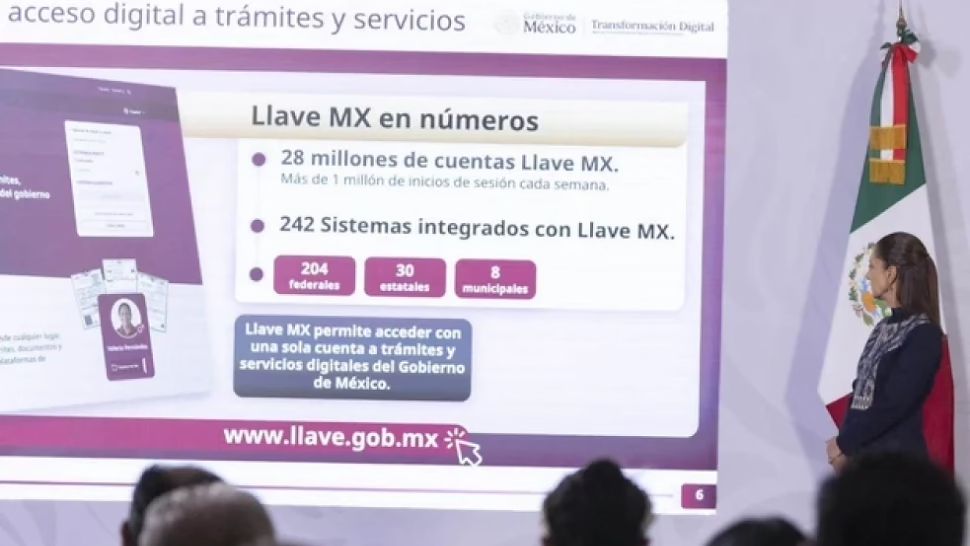
Llave Mx has 28 million accounts and one million uses per week, integrating 242 systems. The National Civil Registry Platform digitized 80 percent of its services; 18.2 million users already carry out transactions online. Resolution times went from 20 to five days.

In the passport, applications were reduced from 21 to five procedures and the requirements from six to three, with a 50 percent drop in resolution time. Almost five million users have used the platform. The consulates also simplified their processes: from 72 to 37 procedures, and from six to two requirements, with five million users.

In investments, the Digital Window for Medium-sized Companies was created, integrated into 18 entities. Federal procedures must be resolved in a maximum of 90 business days; otherwise, they will be considered authorized. For investments in Wellness Centers, amounts greater than 2 billion pesos or strategic sectors, authorization is immediate.

In addition, the Single Window for Foreign Trade and the National Platform for Commercial Establishments were activated, available in 105 municipalities. The latter allows businesses to be opened immediately and online, reducing from seven licenses to six notices and one license.

Continue reading

IPN is positioned among the three best public universities in Mexico

The Polytechnic climbs positions in the QS 2027 global ranking and consolidates itself as a reference in research.

IPN progress in the QS 2027 ranking

The National Polytechnic Institute was ranked among the three best-positioned public universities in Mexico, according to the 2027 edition of the QS World University Rankings, prepared by Quacquarelli Symonds.

The study places the IPN in the range 901–950 worldwide, within a universe of 1,507 classified institutions and more than 8,000 evaluated on a global scale. This reflects its presence on the international academic scene.

The institution highlighted that the result confirms its strategic role in higher education, science and technology, as well as sustained progress in academic quality and internationalization.

Key indicators

Among the main advances, the IPN reported improvements in the International Research Network and in the proportion of international students, with an increase of 33.33%. The ratio of students to faculty also increased by 20.58%.

The institute highlighted that the international scientific collaboration indicator showed a cumulative growth of 698% in three years. It attributed this achievement to the strengthening of its global academic ties and the institutional strategy led by its general director, Arturo Reyes Sandoval.

Continue reading

FGR appoints new prosecutors in Colima and Zacatecas

The Attorney General's Office appointed Susana Macías and Daniel Valdés to reinforce the administration of justice.

New appointments in the FGR

The Attorney General’s Office (FGR) appointed federal prosecutors for Colima and Zacatecas. The objective is to strengthen the administration of justice and improve coordination with local authorities.

Susana Aletxa Macías Medina took over as prosecutor in Colima. She has a degree in Law with a postgraduate degree in Criminology. He began his career in 2006 within law enforcement agencies and later held positions in the defunct Attorney General’s Office.

In Zacatecas, Daniel Valdés Vera was appointed representative. He has training in Law and two decades of experience in the Federal Prosecutor’s Office in Sonora, where he held various positions.

With these appointments, the FGR seeks to strengthen its state representation, improve results against irregularities and impunity, as well as strengthen collaboration with state and municipal security and justice authorities.

Continue reading