Mexico competes to host the World Social Security Forum

The IMSS seeks to position Mexico on the global map of social security with an ambitious proposal that highlights national advances.

Mexico enters the global social security auction

Picture this: Kuala Lumpur, Malaysia. A global forum so important it makes UN meetings look like a boring TikTok. There, among delegates from 163 countries, our beloved Zoé Robledo, director of the IMSS, decided that it was the perfect time to launch the most ambitious proposal since we tried to put chile en nogada on the menu of the International Space Station. Nothing more and nothing less than applying for Mexico to host the World Social Security Forum in 2028. Does it sound like a high-level diplomatic movement? It’s basically the institutional equivalent of saying “hold my michelada.”

But this is not a whim. According to Robledo himself, negotiations have already begun and, apparently, in international corridors there is a lot of talk about what is happening in our country. And no, they do not refer to the Canelo memes (this time). The conversation revolves around the advances in social security that we have had with the famous (or infamous, depending on your Twitter feed) Fourth Transformation. A concept that sounds as epic as the last season of a streaming series, but that in real life translates into public policies that, supposedly, are revolutionizing our social protection system.

RelatedIMSS will integrate 8.4 million people without social security

Context is key. The forum in Malaysia is not just anything. It is the Super Bowl of social security, an event where 338 member institutions of the International Social Security Association (ISSA) meet. Basically, it’s where all the brains who are preventing the world from becoming a dystopia without pensions get together to drink coffee and debate the future. And our beloved Mexico wants to be the host of this global party in 2028. Will we be able to impress more than with our gastronomic offer? Time will tell.

It’s not just the party, it’s what is talked about in it

Beyond the nomination, which in itself is a movement worthy of analysis in a Twitter thread, the forum has a loaded agenda. The discussions focus on good practices and concrete innovations. Translation: it’s where countries steal each other’s good ideas, but legally and with PowerPoints. A new ISSA benchmark report will be launched, which is basically the “State of the Union” for global social security, detailing trends, challenges and, hopefully, some solutions that don’t involve raising taxes.

That the IMSS is leading this charge is no small feat. It’s as if the team that has always been criticized for its endless lines and Kafkaesque formalities suddenly stood up and said, “Hey, we can host the labor rights Olympics, too.” It is a bold move that seeks to change the international narrative about Mexico, going from being in the news only for security issues (the other, violent) to being a reference in the construction of a robust and innovative social security system.

What does this mean for the ordinary citizen, the one who suffers with the IMSS App at 3 in the morning to make an appointment? Potentially, it’s a light at the end of the tunnel. For Mexico to run and, hopefully, win the seat, implies a high-level commitment to modernize and improve our system. It would be the equivalent of promising your in-laws that you will clean the entire house so that they will let you make Christmas dinner: the pressure to look good is immense, but the result can be glorious. A forum of this magnitude would put the global spotlight on our successes and, let’s be honest, also on our mistakes. It’s a risk, but one that could accelerate the long-promised transformation.

In the grand scheme of things, this is more than an event. It is a geopolitical positioning in an area that affects us all: our health, our pensions and our future peace of mind. In a post-pandemic world, where health systems collapsed and vulnerability was exposed, discussing and leading conversations about social security is no longer a luxury, it is a necessity. And for Mexico to want to be the center of that conversation is, as we would say colloquially, “going overboard” in the best way possible. It demonstrates an ambition that goes beyond the opportunistic photo and enters the territory of building an institutional legacy.

Do you think Mexico is ready to host a world-class event like this and show its real progress? Share this note on your social networks and tell us if you trust that this IMSS movement will really mark a before and after. Explore more content related to social policy and public finance on our site to stay informed on the issues shaping our collective future.
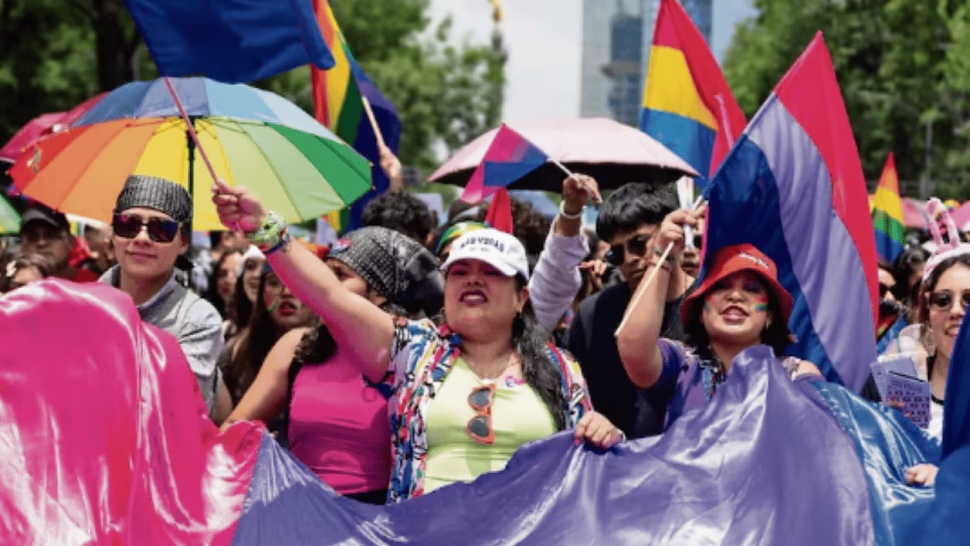
Pride March includes call for missing LGBT+ people

Collectives demand visibility for missing people of sexual diversity in CDMX.

One day before the 48th LGBT+ Pride March in Mexico City, groups called to march for missing people of sexual diversity.

Under the motto “Because we are also looking for them”, the LGBTTTIQ+ Contingent Against Disappearances called to gather this Saturday, June 27, at the Glorieta de los Desaparecidos de Reforma, at 10:00 a.m.

“This march represents a valuable opportunity to continue raising our voices, making our struggles visible and working together for a more just and inclusive society,” said the organizers.

Data on violence and disappearances

According to the National Observatory of Hate Crimes Against LGBT+ People, in 2025, 59 violent deaths, 34 disappearances, 16 attacks and 6 loss of life due to self-inflicted causes were documented.

The National Registry of Missing and Unlocated Persons reports, as of June 25 of this year, 135,155 missing people: 29,295 women, 105,489 men and 371 of undetermined sex.

An emblematic case is that of Lilith Saori Arreola Alvear, a young trans woman who disappeared at the age of 21 on January 2, 2023 in Puerto Escondido, Oaxaca. His search joins that of more than 133 thousand people in the country.

Impact of the mobilization

The march seeks to remember the victims and raise awareness about the violence faced by the LGBT+ community in Mexico. The demand for justice and visibility remains a central demand.

Continue reading

Sheinbaum and governors review progress of the IMSS-Wellbeing

Sheinbaum supervises progress of the IMSS-Bienestar with governors of 24 states to guarantee free, quality care.

President Claudia Sheinbaum led a meeting at the National Palace with federal authorities and the governors of the 24 entities attached to the IMSS-Bienestar health system. The objective: monitor progress and ensure quality, universal and free medical care.

“At the National Palace, we work with governors of states incorporated into IMSS-Bienestar to monitor progress. The objective is to guarantee quality, universal and free medical care for the people of Mexico,” the president published on her social networks.

The Secretary of the Interior, Rosa Icela Rodríguez, participated in the meeting; the legal advisor, Luisa María Alcalde; the Secretary of Health, David Kershenobich Stalnikowitz; the Undersecretary of Sectoral Integration and Development, Eduardo Clark García Dobarganes; and the general director of IMSS-Bienestar, Alejandro Svarch Pérez. Zoé Robledo, director of the IMSS, and Martí Batres Guadarrama, general director of the ISSSTE, were also present.

Built-in states and scope

Currently, 24 states are part of the IMSS-Bienestar: Baja California, Baja California Sur, Campeche, Chiapas, Mexico City, Colima, State of Mexico, Guerrero, Hidalgo, Michoacán, Morelos, Nayarit, Oaxaca, Puebla, Quintana Roo, San Luis Potosí, Sinaloa, Sonora, Tabasco, Tamaulipas, Tlaxcala, Veracruz, Yucatán and Zacatecas.

Impact on medical care

The implementation of the IMSS-Wellbeing seeks to improve access to health services in the country. According to the government, the program aims to guarantee that all citizens receive care at no cost, strengthening infrastructure and coverage in historically marginalized areas.

Continue reading

Pato Merlín achieves trademark registration with the IMPI

Merlin Duck receives official trademark registration in Mexico.

Official record of Merlin Duck

Merlin Duck, a well-known social media character, already has a trademark registration in Mexico. The Ministry of Economy and the Mexican Institute of Industrial Property (IMPI) granted protection to its owner, Karla Ivette Gómez López.

The application was submitted on June 22 through the Marcanet system. The registration numbers are 3646513 and 3646554. The trademark protects education, training, entertainment, sports and cultural activities services.

The Secretary of Economy, Marcelo Ebrard, and the general director of IMPI, Vidal Llerenas, delivered the certificate to the Gómez López family. During the event, Ebrard noted:

All trademark registration applications are subject to a technical and legal analysis procedure, with the aim of guaranteeing certainty, legality and transparency in the protection of industrial property rights in Mexico.

For his part, Llerenas explained that it is a public fact that Merlin Duck is the pet of the family of Karla Ivette Gómez, to whom the brand belongs.

The registration was granted after a person from Yucatán also submitted an application for the same name. The authority intervened to protect the rights of the owner family.

With this action, the Ministry of Economy and the IMPI reaffirm their commitment to providing legal certainty and protecting creativity and intangible assets in the country.

Continue reading