Mexico celebrates energy self-sufficiency with Australian help

Senator Olga Sosa celebrates "advances" in energy while Mexico continues to depend on foreign companies.

Mexico and its energy “self-sufficiency”: a story with a foreign protagonist

Ah, how nice that “energy self-sufficiency” sounds. As beautiful as it is unreal. Senator Olga Sosa, in a burst of optimism worthy of a campaign speech, assured that Mexico is moving towards energy independence… thanks to an Australian company. Yes, because nothing screams “we do it alone” like depending on Woodside Energy, a company that, by the way, is investing more than Pemex in the Trion project. Irony? No, here we call it “strategic collaboration”.

The forum where everyone applauds (and no one asks)

At the Trion Leadership Forum—an event whose name sounds more like a meeting of oil superheroes than a serious debate—the usual suspects gathered: diplomats, executives and officials congratulating each other on “encouraging progress”. Among them, the director of Pemex, Víctor Rodríguez Padilla, who was surely busy thinking about how to save the parastatal from its eternal crisis, and Stephane Drouaud, from Woodside, who was probably wondering why Mexico insists on talking about self-sufficiency while signing checks to foreign companies.

RelatedTamaulipas promotes Mexico’s energy sovereignty with strategic projects

“They have increased investment,” says Sosa, as if that were the government’s merit. Of course, because leasing floating ships and purchasing drilling services are just the actions one expects from a country that “no longer depends on anyone”. But hey, at least there are “clear rules”… for the private ones. Because Pemex, that one does operate in total opacity.

The Tamaulipas talent and other fictions

The senator also welcomed that Woodside included “local talent” in the project. How generous! Although one wonders: wasn’t the government the one that should train its own people? Oh, no, right, better that an Australian company do it while we fill our mouths with speeches about “energy sovereignty”. Of course, there is no shortage of the classic “job creation”, that wild card that justifies any questionable alliance. Of course, no one mentions whether these jobs pay in dollars or in promises.

And if that were not enough, even the Navy is involved in the matter. Because nothing says “national project” like having to explain to an admiral how foreign technology works that, theoretically, we should master. But hey, at least the Tamaulipas cadets will learn something useful… even if it is in English and with translated manuals.

Self-sufficiency or self-aggrandizement? Mexico continues playing at being an energy power while others do the heavy lifting. But hey, at least the speeches sound good.

Did you like this scathing review? Share it on networks and continue discovering how the headlines are cooked vs. reality.
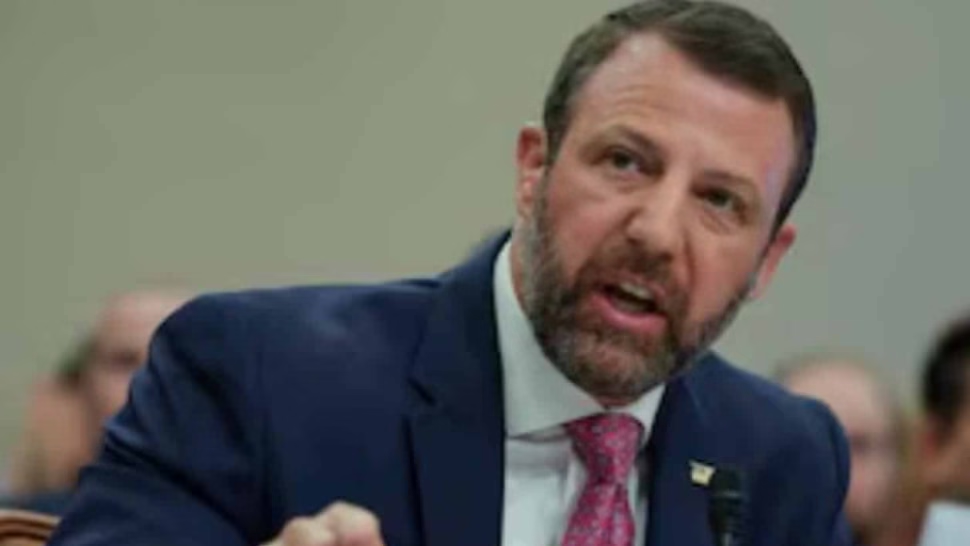

Mullin defends border wall before US committee

Secretary Markwayne Mullin assured that physical barriers stop organized crime.

Defense of the border wall

The Secretary of Homeland Security of the United States, Markwayne Mullin, defended this Thursday the construction of the wall on the border with Mexico. During a hearing before the House Appropriations Subcommittee, he stated that physical barriers have a positive impact on containing illicit activities linked to organized crime.

Mullin noted that nine criminal groups maintain a presence on the border. They operate through “plaza bosses” who identify vulnerabilities at crossing points to facilitate drug and human trafficking. This represents a constant threat to the security of the United States, he indicated.

The official maintained that physical barriers have forced these groups to modify their routes and methods. Now they use drones and tunnels to evade surveillance. For this reason, it was considered necessary to strengthen the border control strategy.

Finally, he pointed out that the security policy of the Department of Homeland Security contemplates the use of infrastructure, advanced technology and specialized monitoring. The aim is to concentrate efforts in high-risk areas and improve the detection of illicit activities on the border.

Continue reading

Lazzeri: cooperation with the US reduces fentanyl by 66%

Lazzeri attends Trump event and highlights cooperation

Roberto Lazzeri, Mexican ambassador to the United States, had his first public event after presenting his credentials in Washington. He participated in an event chaired by Donald Trump for the 250th anniversary of American independence, held on the National Mall.

During the event, Trump highlighted a 66% reduction in the flow of fentanyl into the United States. Lazzeri pointed out that these results are the product of bilateral cooperation promoted by President Claudia Sheinbaum, based on respect for sovereignty, coordination and results.

The ambassador also highlighted a 35% decrease in overdose deaths in the United States and the seizure of nearly 30,000 firearms, attributing them to joint efforts.

Trump mentioned the 2026 FIFA World Cup in North America. Lazzeri stated that Mexico contributed with security, connectivity and tourism, with an economic impact of more than 18 billion pesos.

“Security and shared prosperity are the best example of what Mexico and the United States can achieve when they work together with respect,” concluded the diplomat.

Continue reading

By Mexico party: teleworking and no classes in CDMX

Government decrees teleworking and suspension of schools for national team matches.

Measurements by the national team’s match

The federal government issued a decree for Tuesday, June 30, the day of the Mexico match at the Mexico City Stadium. Orders to implement teleworking, remote work or flexible modalities for public servants in the capital.

Exceptions and suspensions

The official objective is to contribute to urban mobility, road safety and administrative continuity. School activities are also suspended at all levels, from preschool to higher education, in public and private schools in Mexico City.

Work related to health, medical care, health emergencies, civil protection and disasters are exempt from teleworking.

“The agencies and entities of the Federal Public Administration must prioritize the use of information and communication technologies that guarantee the adequate performance of substantive and administrative functions, ensuring at all times the continuity of their services, the fulfillment of their powers and the attention to citizens.”

Continue reading