Mexico breaks tourist records beyond the beaches

Official figures reveal an unprecedented boom, driven not only by the sun and the beach, but by an offer that now seduces more curious travelers with greater purchasing power.

Tourists do not live on sun and sand alone: Mexico discovers that it has more to offer

In a revelation that surely left the crabs and the palm trees speechless, the Secretary of Tourism, Josefina Rodríguez, has proudly proclaimed that the growth of the sector in Mexico is no longer an exclusive club for beach destinations. Surprise! It turns out that the country has more than just seafood and margaritas. According to the official, the miracle is due to the diversification of cultural and recreational experiences. Or, in Christian, that tourists are finally realizing that there is life after the beach towel and are willing to spend money to discover it. Thanks to this collective epiphany, historic numbers in visitors and economic growth have been reached. Who would have thought, offering something different attracts more people.

The figures that will make your accountant smile (and your travel agency cry)

With the solemnity of someone announcing the discovery of a new element, Rodríguez presented the indicators. Between January and October 2025, Mexico received a whopping 38.4 million international tourists, 5.8% more than last year. But here’s the good thing: not everyone came to burn in the sun. The secretary stressed, perhaps so that she would not be accused of favoring sunscreen sellers, that they are “tourist records… also in cultural destinations and different segments.” Translation: people no longer just come to sleep off the hangover in the hammock, but to visit ruins, eat in local markets and, supposedly, generate a “circular economy” that benefits more families. An idea so revolutionary that it almost seems from this century.

RelatedJalisco exceeds 6.4 million tourists in summer with great economic impact

On the domestic front, national tourism also got going, with 92.6 million travelers (a 3.3% more). Apparently, Mexicans are also discovering their own country, beyond the highway to their favorite beach. Could it be the effect of streaming series that romanticize road trips? Better not speculate.

The money map: who comes and what they get in for

As in any good movie, there are clear protagonists. The United States continues to be the undisputed leader, providing 67.3% of foreign visitors. Nothing new under the sun. The interesting thing comes later: Canadians, perhaps fleeing their perpetual winter, increased by 11.4%. But the real talk is the increases in Italians (14.8%), Chinese (10.6%) and Koreans (11%). One wonders what they must have seen on their social networks to choose Mexico. Photogenic tacos? Magical towns that look like Instagram filters? The mind is lost in absurd possibilities.

And so that there is no doubt that this is a serious business, it was announced that the Gross Domestic Tourism Product (GDP) reached 2.71 trillion pesos in 2024, 2.5% more than the previous year and equivalent to 8.7% of the national GDP. That is to say, tourism is not just pretty photos for the album, it is a money-making machine that, according to authorities, has been strengthened thanks to coordination with state governments. Or what is the same: when everyone rows in the same direction (and stops fighting over the tourist), the boat moves forward. Advanced concept, we know.

In short, the message is clear: Mexico is no longer (only) a beach destination. It is a melting pot of experiences where you can go from snorkeling to visiting a pyramid before lunch. A change of narrative as welcome as it was unexpected. The million dollar question is: will they be able to maintain this pace without saturating the new “discovered” destinations and turning them, ironically, into what they wanted to avoid? Time, and the following statistics, will tell.

Are you surprised by these figures or did you already imagine that tourism in Mexico went beyond Cancún?Share this note and help us show the diversity that makes Mexico a magnet for travelers from all over the world. Explore more stories about secret destinations and travel trends on our site.

T-MEC: Mexico, the US and Canada resume negotiations in July

Sheinbaum announces virtual and in-person meetings to review the T-MEC in July.

President Claudia Sheinbaum confirmed that on July 1 economic authorities from Mexico, the United States and Canada will hold a virtual meeting to advance the review of the T-MEC.

Scheduled meetings

“In any case, on July 16 or 20 there is a meeting here, in Mexico, to continue the talks,” declared the president. Sheinbaum specified that, although Washington has requested bilateral talks, Mexico insists on a trilateral format.

“The treaty is very good for the three countries; those who defend it the most are even the American, Mexican and Canadian companies themselves,” he added.

The president highlighted that Mexico and Canada have strengthened their trade and investment relationship. He mentioned a relevant project in the port of Altamira, Tamaulipas.

Canadian mining cases

Sheinbaum also referred to two cases of alleged irregularities by Canadian mining companies in Mexico, which are being analyzed by the Security Cabinet. He stressed the importance of complying with environmental laws, a topic he discussed with Prime Minister Mark Carney.

“Alicia Bárcena sent a list of problems of Canadian mining companies in Mexico that have not fully complied with remediation, environmental impacts or mitigation; they should comply,” he stated.

Profepa and Semarnat are working on these non-compliances.

Security and reduction of homicides

The president also highlighted a decrease in homicides during her administration, attributing it to the security strategy based on attention to the causes.

The July meetings will define the course of the review of the T-MEC, in force since 2020 and key for the regional economy.

Continue reading

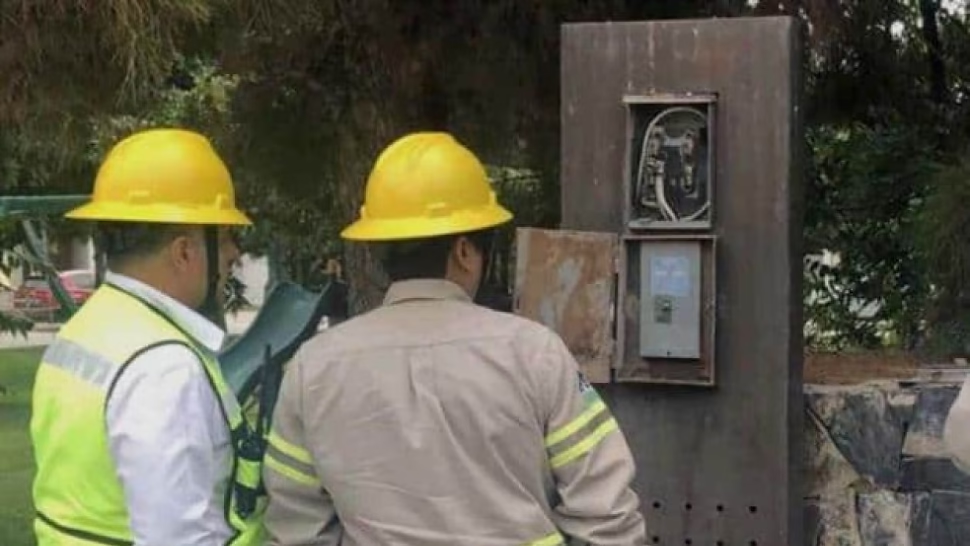
Labor trials against the CFE double in 2025

Litigations against CFE double in 2025, totaling 20,036 cases.

Labor litigation in the CFE: doubling in 2025

New labor lawsuits against the Federal Electricity Commission (CFE) doubled during 2025. According to the company’s annual report, 20,036 cases were reached.

In 2024, 9,944 processes were registered. In 2023 there were only 2,206. Specialists attribute the increase to tensions over working conditions, layoffs and benefits.

The CFE recognizes this scenario as a liability due to legal contingencies. It allocated 14,478 million pesos in 2025 to face possible adverse resolutions.

According to the report, the lawsuits include requests for reinstatement, recognition of seniority, pension adjustments, application of collective contracts and claims for benefits.

The company affirms that it has strengthened conciliation mechanisms. However, specialists warn that the increase in demands could reflect structural problems that affect the productivity and operation of the energy sector.

Continue reading

How to prevent illnesses and falls with low-cost changes

WEF study proposes simple changes in homes and physical activity to save billions.

Small actions, big savings

Reducing diabetes, preventing falls, and preventing dementia is possible with minimal home adjustments, physical activity programs, and accessible technology. This is stated by the World Economic Forum (WEF) in its study “The longevity dividend”.

The report estimates that shifting policies toward prevention would free up $6.4 trillion globally. These resources today are used to treat diseases that could be avoided.

Concrete strategies

To prevent falls, experts recommend grab bars and lighting on stairs. With an investment of less than 400 billion dollars, almost 400 million falls would be avoided by 2040. This would generate more than 5 trillion in health savings.

In diabetes, community physical activity programs could stop 8.5 million cases of type 2 diabetes by 2040. The cost per person ranges between one and 40 dollars, and the gains in productivity would exceed 125 billion.

Hearing loss has a direct link to dementia. Expanding access to hearing aids would prevent 2.4 million cases of dementia and save more than 325 billion in health.

Economic benefits

The study, applied in 21 countries by the WEF and Marsh, indicates that companies and governments address health, finances and work separately. If integrated, they would unlock 5.8 trillion in healthcare savings and 645 billion in productivity gains.

“Poor health strains health systems and personal finances, affecting financial resilience and generating broader economic costs,” the report warns.

Impact on women

A relevant fact: women who dedicate a year to care work see their retirement savings reduced by 24% due to absence from work and the wage gap. Institutions often treat these problems separately, despite their consequences.

The WEF concludes that there is a window of opportunity to align health, finance and employment policies. The key: allocate budgets to prevention and care for the elderly population with public-private collaboration.

Continue reading